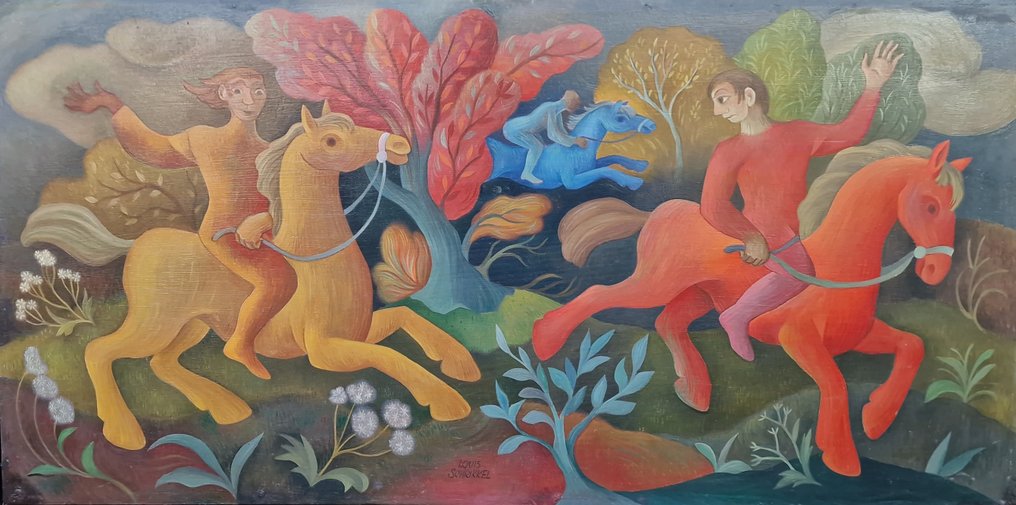
Louis Schrikkel (1902-1995) - Herfstruiters



13
days
06
hours
01
minute
25
seconds
Starting bid
€ 1
Reserve price not met

Expert
Selected by Leo Setz
Over 30 years’ experience as art dealer, appraiser and restorer.
Estimate € 1,100 - € 1,300
No bids placed
Catawiki Buyer Protection
Your payment’s safe with us until you receive your object.View details
Trustpilot 4.4 | 123536 reviews
Rated Excellent on Trustpilot.
Original, self-portrait style oil painting titled Herfstruiters by Louis Schrikkel (1902-1995), a 1930s modern Dutch work measuring 45 cm by 85 cm, signed by the artist on both sides and sold with frame, depicting animals in the wild.
AI-assisted summary
Description from the seller
This concerns an artistic work by the artist Louis Schrikkel 1902-1995.
Autumn Riders
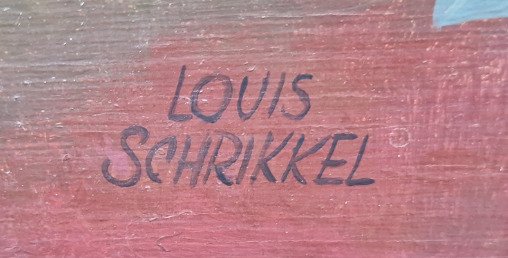
The painting is very colorful and fully signed on the front and back.
Measured without a frame, this beautiful piece is 40cm x 80cm and an enrichment in any interior.
Museum Helmond logo
Museum Helmond
Back to collection
Louis Schrikkel
Lodewijk Johannes (Louis) Schrikkel (1902-1995) was born in 1902 in Amsterdam. He studied at the Rijksacademie voor Beeldende Kunsten in Amsterdam and was taught by, among others, R.N. Roland Holst and George Breitner. After his education, he abandoned academic impressionism and chose a completely personal style. In 1931, at the age of 31, he held his first solo exhibition and became a member of various artists' associations. Despite his steadily growing success as an artist, he chose in 1936 to serve as a professional soldier. During World War II, he participated in the resistance and had to go into hiding for a long time. After the war, he resumed his artistic career. Characteristic of Schrikkel's paintings is the clarity in form, color, and composition. He depicts scenes that play out in the foreground, at the bottom of the image plane, and those in the background, at the top. Although the paint is applied thickly and impasto on the canvas, the composition is very rhythmic and neatly divided into color fields. The facial features of the depicted workers are not detailed because their actions, postures, and attributes speak for themselves. He describes his work as populist. It must be understandable for everyone and appeal to all. Street painters, gas factory workers, and garbage men are just a few of the everyday subjects of his paintings. Besides painting, Schrikkel from the 1950s onward focused on creating mosaics. This technique is well-suited for building compositions with clear boundaries of color fields and simplified forms. In the 1950s and early 1960s, there was great interest in applying his mosaics in construction projects.
This concerns an artistic work by the artist Louis Schrikkel 1902-1995.
Autumn Riders
The painting is very colorful and fully signed on the front and back.
Measured without a frame, this beautiful piece is 40cm x 80cm and an enrichment in any interior.
Museum Helmond logo
Museum Helmond
Back to collection
Louis Schrikkel
Lodewijk Johannes (Louis) Schrikkel (1902-1995) was born in 1902 in Amsterdam. He studied at the Rijksacademie voor Beeldende Kunsten in Amsterdam and was taught by, among others, R.N. Roland Holst and George Breitner. After his education, he abandoned academic impressionism and chose a completely personal style. In 1931, at the age of 31, he held his first solo exhibition and became a member of various artists' associations. Despite his steadily growing success as an artist, he chose in 1936 to serve as a professional soldier. During World War II, he participated in the resistance and had to go into hiding for a long time. After the war, he resumed his artistic career. Characteristic of Schrikkel's paintings is the clarity in form, color, and composition. He depicts scenes that play out in the foreground, at the bottom of the image plane, and those in the background, at the top. Although the paint is applied thickly and impasto on the canvas, the composition is very rhythmic and neatly divided into color fields. The facial features of the depicted workers are not detailed because their actions, postures, and attributes speak for themselves. He describes his work as populist. It must be understandable for everyone and appeal to all. Street painters, gas factory workers, and garbage men are just a few of the everyday subjects of his paintings. Besides painting, Schrikkel from the 1950s onward focused on creating mosaics. This technique is well-suited for building compositions with clear boundaries of color fields and simplified forms. In the 1950s and early 1960s, there was great interest in applying his mosaics in construction projects.
Details
Artist
Louis Schrikkel (1902-1995)
Sold with frame
Yes
Sold by
Owner or reseller
Edition
Original
Title of artwork
Herfstruiters
Technique
Oil painting
Signature
Hand signed
Country of Origin
Netherlands
Condition
Good condition
Height
45 cm
Width
85 cm
Depiction/Theme
Animals and wildlife
Style
Contemporary
Period
1930-1940
Sold by
