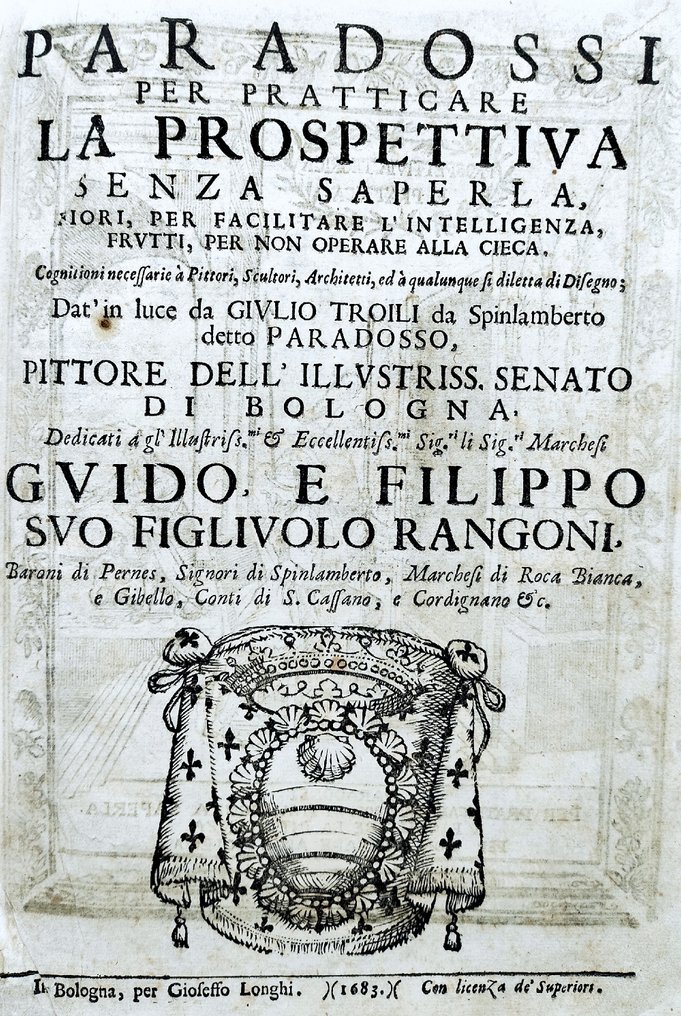
Giulio Troili - Paradossi Per Pratticare La Prospettiva (Paradoxes For Practicing Perspective) - 1683



11
days
14
hours
54
minutes
17
seconds
Current bid
€ 191
Reserve price not met

Expert
Selected by Volker Riepenhausen
Specialist in travel literature and pre-1600 rare prints with 28 years experience.
Estimate € 1,000 - € 5,200
26 other people are watching this object
 Bidder 3115 Bidder 3115 | €191 | |
|---|---|---|
| Bidder 3115 | €181 | |
 Bidder 9177 Bidder 9177 | €171 | |
Catawiki Buyer Protection
Your payment’s safe with us until you receive your object.View details
Trustpilot 4.4 | 123759 reviews
Rated Excellent on Trustpilot.
Paradossi Per Pratticare La Prospettiva (Paradoxes For Practicing Perspective) by Giulio Troili, 1683, first complete edition, illustrated edition in leather binding, 184 pages, Italian text, very good condition.
AI-assisted summary
Description from the seller
1683 FIRST COMPLETE EDITION, A MASTERPIECE OF GEOMETRY, ARCHITECTURE, SCENOGRAPHY, PAINTING, THEATERS, PERSPECTIVE, OPTICAL ILLUSIONS, ANAMORPHISM, STAGECRAFT, QUADRATURA or SQUARING, by Giulio Troili (1613–1685), an Italian quadratura painter, stage designer of the Baroque period. A richly illustrated book with 68 full-page engravings, height 315 x width 220 mm (12.4 by 8.7 inches), each framed in floral patterns. Troili was the first to illustrate many of the concepts of optical illusion, perspective, scenography, and painted ceilings that would be expressed only a few years later by Andrea Pozzo (1642–1709) in his "Perspectiva Pictorum," published in 1693 and 1698. Troili offers a theoretical and practical manual, tools, pantographs, and spectrographs for painters, sculptors, architects, and designers to create scenography, expand architecture, and create optical illusions for those without in-depth knowledge of mathematics or geometry. The result is a "paradox" of practical intelligence that seems to contradict common opinion, but is a useful and practical manual of scenographic special effects, but of the Baroque period. Original binding from the period, in very good condition, as shown in the photos. References; World Cat OCLC n°954925528 & 1002258424; USTC n°1720874; Cicognara, 866; Fowler Architectural Collection, 347; Graesse (VII, p. 205); Olschki Choix, 15334; Berlin Kat., 4722; Schlosser, 620; ETH-Bibliothek Zürich, Rar 391; Riccardi, II, 561; Honeyman, VII, 3000; Schlosser-Magnino, Letteratura Artistica, p. 620; Libreria Vinciana 4425; Patrimonio Bibliográfico Español n°CCPB000273455-9; Marini, Bibl. di Fortificazione, pp. 132-3; Zeitlinger, n. 15336; Jurgis Baltrušaitis, Anamorfosi or Thaumaturgus opticus, pp. 19, 21 and 23; Frank J. Swetz (The Pennsylvania State University), "Mathematical Treasure: Giulio Troili’s Paradossi..." Convergence (December 2022); Dunbar H. Ogden, The Italian Baroque stage: documents by Giulio Troili, Andrea Pozzo, Ferdinando Galli-Bibiena, Baldassare Orsini (Berkeley and London: University of California Press, 1978); Lanzi, Luigi (1847). History of Painting in Italy. Vol. III. Translated by Thomas Roscoe. London: Henry G. Bohn. p. 98.
In 1672 only the first two parts were published, in this second edition the third part is included for the first time, so this is the first complete edition. The third section treats shadows, fortifications and war engineering. "Troili a quadratura painter, nicknamed "Paradox" for his innovative discoveries in the field of perspective, showcases his fundamental innovations in this book, especially in the fields of architecture, theater and stagecraft. He also illustrates his invention of the "spectrograph," a transparent black veil applied to a movable frame for drawing architecture and figures with correct perspective" (Fowler Architectural Collection at John Hopkins University, p. 2774). The discovery and exploration of new lands and the expansion of the world's boundaries are reflected in the Italian Baroque in a shift in perspective in paintings and frescoes, with the application of geometry, shadows, optical illusions and modifications of the angle of classical perspective to "break through" and "expand" the limits of architecture, walls and ceilings and offer a sense of "infinity" and "three-dimensionality" in palaces, churches and theatres. "Troili, a pupil of the quadratura painter Michelangelo Colonna, became scene painter for the Farnese theater at Parma and painter of the Senate of Bologna. Ferdinando Galli da Bibbiena (1657–1743) saw his work there and absorbed its influence. This original edition of Troili's exceptionally handsome book on perspective is one of the real milestones in the history of theatrical scenery: it describes the conscious use of visual deception, the creation of greater depth, by means of oblique positioning of the wings, as common practice in Italy, twenty years before Andrea Pozzo" (Breman in Architectural Theory and Practice III-B-24). Troili's work, with a typically Baroque title, is highly interesting for its rich woodcuts, its scholarly research, its chapters examining perspective in its relationship with architecture, painting, and military art, and its references to the writings of Leon Battista Alberti, Sebastiano Serlio, Pietro Accolti, Christoph Scheiner, and Camillo Guarino Guarini. Ref. Schlosser-Magnino, Letteratura Artistica, p. 620: "(Troili's Paradoxes reveal the authentic spirit of the baroque century)".
TITLE : Paradossi per pratticare la prospettiva senza saperla, fiori, per facilitare l'intelligenza, frutti, per non operare alla cieca. Cognitioni necessarie à pittori, scultori, architetti, ed à qualunque si diletta di disegno…(Paradoxes for practicing perspective without knowing it; flowers to facilitate understanding; fruits to avoid working blindly. Knowledge necessary for painters, sculptors, architects, and anyone who enjoys drawing…)
AUTHORS: Giulio Troili or Trogli (1613–1685), was an Italian painter of the Baroque period
PUBLISHER: Gioseffo or Giuseppe Longhi
DATE: 1683, printed in Bologna, Italian text
DESCRIPTION: In folio size, height 315 x width 220 mm (12.4 by 8.7 inches). Pages [8], 120, [4], 64. Three books/parts in one volume, each work has a separate title page, FIRST COMPLETE EDITION. Antique, period hardback parchment binding, intact and sturdy, with minimal signs of use and stains, some small woodworm holes. Handwritten titles on the spine. 68 beautiful full-page and in-text woodcut plates, contained in a floral border, for each illustration there is an explanatory text, numerous decorated initials and finals. Minor corner restoration on the first leaf. The pages are clean, intact, well-printed, and generally in good condition, with a few small stains or light oxidation here and there, nothing serious. FIRST COMPLETE EDITION.
SHIPPING: via UPS, DHL, National Postal Services, protected, INSURED and fully tracked package. Estimated time for Europe 3-5 working days. Shipping within one working day, you can combine shipping if you purchases several items from us, saving money and time.
1683 FIRST COMPLETE EDITION, A MASTERPIECE OF GEOMETRY, ARCHITECTURE, SCENOGRAPHY, PAINTING, THEATERS, PERSPECTIVE, OPTICAL ILLUSIONS, ANAMORPHISM, STAGECRAFT, QUADRATURA or SQUARING, by Giulio Troili (1613–1685), an Italian quadratura painter, stage designer of the Baroque period. A richly illustrated book with 68 full-page engravings, height 315 x width 220 mm (12.4 by 8.7 inches), each framed in floral patterns. Troili was the first to illustrate many of the concepts of optical illusion, perspective, scenography, and painted ceilings that would be expressed only a few years later by Andrea Pozzo (1642–1709) in his "Perspectiva Pictorum," published in 1693 and 1698. Troili offers a theoretical and practical manual, tools, pantographs, and spectrographs for painters, sculptors, architects, and designers to create scenography, expand architecture, and create optical illusions for those without in-depth knowledge of mathematics or geometry. The result is a "paradox" of practical intelligence that seems to contradict common opinion, but is a useful and practical manual of scenographic special effects, but of the Baroque period. Original binding from the period, in very good condition, as shown in the photos. References; World Cat OCLC n°954925528 & 1002258424; USTC n°1720874; Cicognara, 866; Fowler Architectural Collection, 347; Graesse (VII, p. 205); Olschki Choix, 15334; Berlin Kat., 4722; Schlosser, 620; ETH-Bibliothek Zürich, Rar 391; Riccardi, II, 561; Honeyman, VII, 3000; Schlosser-Magnino, Letteratura Artistica, p. 620; Libreria Vinciana 4425; Patrimonio Bibliográfico Español n°CCPB000273455-9; Marini, Bibl. di Fortificazione, pp. 132-3; Zeitlinger, n. 15336; Jurgis Baltrušaitis, Anamorfosi or Thaumaturgus opticus, pp. 19, 21 and 23; Frank J. Swetz (The Pennsylvania State University), "Mathematical Treasure: Giulio Troili’s Paradossi..." Convergence (December 2022); Dunbar H. Ogden, The Italian Baroque stage: documents by Giulio Troili, Andrea Pozzo, Ferdinando Galli-Bibiena, Baldassare Orsini (Berkeley and London: University of California Press, 1978); Lanzi, Luigi (1847). History of Painting in Italy. Vol. III. Translated by Thomas Roscoe. London: Henry G. Bohn. p. 98.
In 1672 only the first two parts were published, in this second edition the third part is included for the first time, so this is the first complete edition. The third section treats shadows, fortifications and war engineering. "Troili a quadratura painter, nicknamed "Paradox" for his innovative discoveries in the field of perspective, showcases his fundamental innovations in this book, especially in the fields of architecture, theater and stagecraft. He also illustrates his invention of the "spectrograph," a transparent black veil applied to a movable frame for drawing architecture and figures with correct perspective" (Fowler Architectural Collection at John Hopkins University, p. 2774). The discovery and exploration of new lands and the expansion of the world's boundaries are reflected in the Italian Baroque in a shift in perspective in paintings and frescoes, with the application of geometry, shadows, optical illusions and modifications of the angle of classical perspective to "break through" and "expand" the limits of architecture, walls and ceilings and offer a sense of "infinity" and "three-dimensionality" in palaces, churches and theatres. "Troili, a pupil of the quadratura painter Michelangelo Colonna, became scene painter for the Farnese theater at Parma and painter of the Senate of Bologna. Ferdinando Galli da Bibbiena (1657–1743) saw his work there and absorbed its influence. This original edition of Troili's exceptionally handsome book on perspective is one of the real milestones in the history of theatrical scenery: it describes the conscious use of visual deception, the creation of greater depth, by means of oblique positioning of the wings, as common practice in Italy, twenty years before Andrea Pozzo" (Breman in Architectural Theory and Practice III-B-24). Troili's work, with a typically Baroque title, is highly interesting for its rich woodcuts, its scholarly research, its chapters examining perspective in its relationship with architecture, painting, and military art, and its references to the writings of Leon Battista Alberti, Sebastiano Serlio, Pietro Accolti, Christoph Scheiner, and Camillo Guarino Guarini. Ref. Schlosser-Magnino, Letteratura Artistica, p. 620: "(Troili's Paradoxes reveal the authentic spirit of the baroque century)".
TITLE : Paradossi per pratticare la prospettiva senza saperla, fiori, per facilitare l'intelligenza, frutti, per non operare alla cieca. Cognitioni necessarie à pittori, scultori, architetti, ed à qualunque si diletta di disegno…(Paradoxes for practicing perspective without knowing it; flowers to facilitate understanding; fruits to avoid working blindly. Knowledge necessary for painters, sculptors, architects, and anyone who enjoys drawing…)
AUTHORS: Giulio Troili or Trogli (1613–1685), was an Italian painter of the Baroque period
PUBLISHER: Gioseffo or Giuseppe Longhi
DATE: 1683, printed in Bologna, Italian text
DESCRIPTION: In folio size, height 315 x width 220 mm (12.4 by 8.7 inches). Pages [8], 120, [4], 64. Three books/parts in one volume, each work has a separate title page, FIRST COMPLETE EDITION. Antique, period hardback parchment binding, intact and sturdy, with minimal signs of use and stains, some small woodworm holes. Handwritten titles on the spine. 68 beautiful full-page and in-text woodcut plates, contained in a floral border, for each illustration there is an explanatory text, numerous decorated initials and finals. Minor corner restoration on the first leaf. The pages are clean, intact, well-printed, and generally in good condition, with a few small stains or light oxidation here and there, nothing serious. FIRST COMPLETE EDITION.
SHIPPING: via UPS, DHL, National Postal Services, protected, INSURED and fully tracked package. Estimated time for Europe 3-5 working days. Shipping within one working day, you can combine shipping if you purchases several items from us, saving money and time.
Details
Number of Books
1
Subject
Architecture, Art, Art history, Graphic design, Illustrated, Incunabula & early printing, Interior design, Mathematics, Memorabilia, Military, Science, Technology, Theatre, Topography
Book Title
Paradossi Per Pratticare La Prospettiva (Paradoxes For Practicing Perspective)
Author/ Illustrator
Giulio Troili
Condition
Very good
Publication year oldest item
1683
Height
315 mm
Edition
1st Edition, 1st Edition Thus, Illustrated Edition
Width
220 mm
Language
Italian
Original language
Yes
Binding/ Material
Leather
Number of pages
184
Sold by
