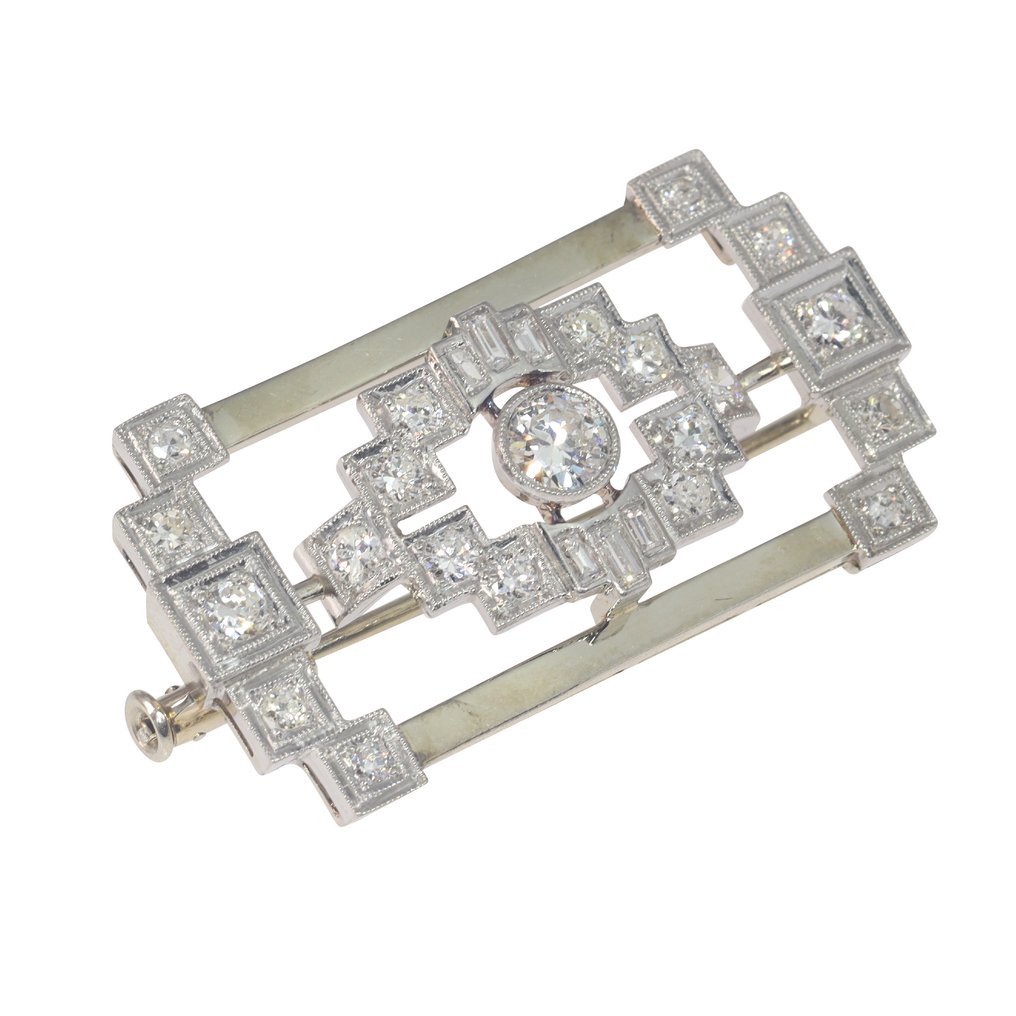
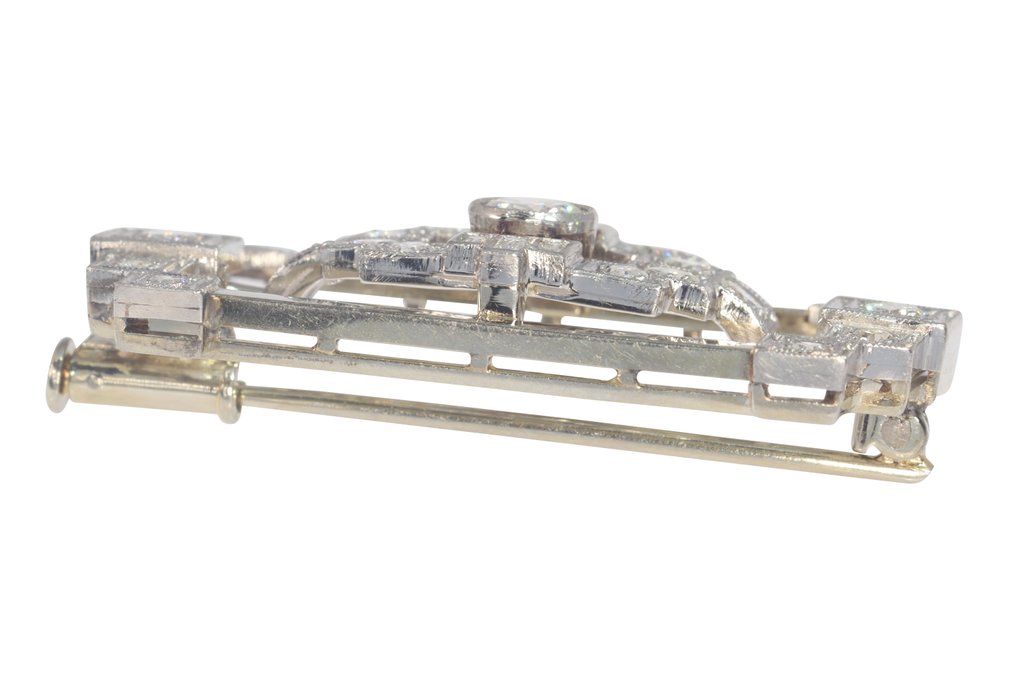
Brooch - 18 kt. White gold, Platinum - 1.49ct. tw. Diamond (Natural) - Art Deco/Interbellum 1930



06
days
22
hours
36
minutes
44
seconds
Current bid
€ 1,063
Reserve price not met

Expert
Selected by Laura Trevino
She has 15 years' auction experience, specialising in vintage jewellery from 1920 to 2000.
Estimate € 3,000 - € 3,600
23 other people are watching this object
 Bidder 7323 Bidder 7323 | €1,063 | |
|---|---|---|
 Bidder 3132 Bidder 3132 | €1 |
Catawiki Buyer Protection
Your payment’s safe with us until you receive your object.View details
Trustpilot 4.4 | 123759 reviews
Rated Excellent on Trustpilot.
A circa 1930 platinum and 18k white gold brooch set with 27 natural diamonds (total 1.49 ct), reflecting Art Deco and Interbellum design, in very good condition.
AI-assisted summary
Description from the seller
Capturing the transitional elegance between Art Deco and the Interbellum period, this circa 1930 brooch is a masterpiece of design. Its platinum and white gold composition is adorned with a stunning array of old brilliant and baguette cut diamonds. The brooch reflects the era's fascination with abstract motifs and geometric forms, embodying both the opulence of Art Deco and the emerging modernist sensibilities of the Interbellum. A perfect blend of history and style, this piece offers more than beauty; it is a wearable piece of art history.
Antique jewelry object group
brooch
Condition
very good condition
Country of origin
unknown
Style
Between Art Deco and Interbellum - Art Deco is an eclectic artistic and design style which had its origins in Paris in the first decades of the 20th century. The style originated in the 1920s and continued to be employed until after World War II. The term "art deco" first saw wide use after an exhibition in 1966, referring to the 1925 Exposition Internationale des Arts Décoratifs et Industriels Modernes that was the culmination of high-end style modern in Paris. Led by the best designers in the decorative arts such as fashion, and interior design, Art Deco affected all areas of design throughout the 1920s and 1930s, including architecture and industrial design, as well as the visual arts such as painting, the graphic arts and film. At the time, this style was seen as elegant, glamorous, functional and modern. The interwar period (1918–1939) is understood, within recent Western culture, to be the period between the end of the First World War and the beginning of the Second World War. This is also called the period between the wars or interbellum.
See also: Art Deco and Interbellum
Style specifics
Abstract motives and geometrical forms are quite typical for the Art Deco period.
Period
ca. 1930
Material
platinum and 18K white gold (touchstone tested)
Diamonds
One old brilliant cut diamond with an estimated weight of ± 0.35ct
20 old mine brilliant cut diamonds with an estimated weight of ± 1.00ct
Six baguette (long rectangular) cut diamonds with an estimated weight of ± 0.14ct
Total diamond count
27 pcs.
Total diamond weight
approx. 1.49 crt with an average colour and clarity G/I, vs/si
All diamond weights, color grades and clarity are approximate since stones are not removed from their mounts to preserve the integrity of the setting.
All diamonds we offer are screened by the I.J.G.C. for whether they are natural or synthetic, and all diamonds in this jewel are 100% guaranteed to be natural.
Hallmarks
No trace.
Dimensions
3,83 cm (1,51 inch) x 2,11 cm (0,83 inch)
Weight
12,20 gram (7,84 dwt)
Adin Reference Nº
23156-0261
- Accompanied by a professional report of authenticity for your peace of mind.
- Shipped insured and registered for your security, though you're most welcome to collect in person.
- For shipments outside the EU, import duties and other charges may apply. We advise checking this in advance.
- We invite you to browse through our customer feedback to discover the level of satisfaction we consistently provide.
- See more of our products, visit: https://auction.catawiki.com/lotsfrom/Adin
- Antique and vintage jewellery often undergoes thoughtful refurbishment, remodelling, or repairs to enhance its longevity and wearability. Such pieces frequently bear marks of this tender care. Furthermore, we present our antique and vintage jewellery in its authentic state, refraining from removing scratches or applying rhodium plating to white gold items. Our priority is to preserve the genuine allure and history of each piece. However, as the new owner, you have the option to take it to a local goldsmith for a cosmetic refresh, should you choose.
Seller's Story
Adin shares with their collection of vintage and antique jewellery over 4 decades of expertise. On our provider page, you get the experience of exploring our boutique, located in the world diamond center Antwerp. Elkan Wijnberg, Adin’s founder and CEO, is a member of the Belgian Chamber of Experts to the Courts of Justice and of both the British and American Society of Jewellery Historians.
Capturing the transitional elegance between Art Deco and the Interbellum period, this circa 1930 brooch is a masterpiece of design. Its platinum and white gold composition is adorned with a stunning array of old brilliant and baguette cut diamonds. The brooch reflects the era's fascination with abstract motifs and geometric forms, embodying both the opulence of Art Deco and the emerging modernist sensibilities of the Interbellum. A perfect blend of history and style, this piece offers more than beauty; it is a wearable piece of art history.
Antique jewelry object group
brooch
Condition
very good condition
Country of origin
unknown
Style
Between Art Deco and Interbellum - Art Deco is an eclectic artistic and design style which had its origins in Paris in the first decades of the 20th century. The style originated in the 1920s and continued to be employed until after World War II. The term "art deco" first saw wide use after an exhibition in 1966, referring to the 1925 Exposition Internationale des Arts Décoratifs et Industriels Modernes that was the culmination of high-end style modern in Paris. Led by the best designers in the decorative arts such as fashion, and interior design, Art Deco affected all areas of design throughout the 1920s and 1930s, including architecture and industrial design, as well as the visual arts such as painting, the graphic arts and film. At the time, this style was seen as elegant, glamorous, functional and modern. The interwar period (1918–1939) is understood, within recent Western culture, to be the period between the end of the First World War and the beginning of the Second World War. This is also called the period between the wars or interbellum.
See also: Art Deco and Interbellum
Style specifics
Abstract motives and geometrical forms are quite typical for the Art Deco period.
Period
ca. 1930
Material
platinum and 18K white gold (touchstone tested)
Diamonds
One old brilliant cut diamond with an estimated weight of ± 0.35ct
20 old mine brilliant cut diamonds with an estimated weight of ± 1.00ct
Six baguette (long rectangular) cut diamonds with an estimated weight of ± 0.14ct
Total diamond count
27 pcs.
Total diamond weight
approx. 1.49 crt with an average colour and clarity G/I, vs/si
All diamond weights, color grades and clarity are approximate since stones are not removed from their mounts to preserve the integrity of the setting.
All diamonds we offer are screened by the I.J.G.C. for whether they are natural or synthetic, and all diamonds in this jewel are 100% guaranteed to be natural.
Hallmarks
No trace.
Dimensions
3,83 cm (1,51 inch) x 2,11 cm (0,83 inch)
Weight
12,20 gram (7,84 dwt)
Adin Reference Nº
23156-0261
- Accompanied by a professional report of authenticity for your peace of mind.
- Shipped insured and registered for your security, though you're most welcome to collect in person.
- For shipments outside the EU, import duties and other charges may apply. We advise checking this in advance.
- We invite you to browse through our customer feedback to discover the level of satisfaction we consistently provide.
- See more of our products, visit: https://auction.catawiki.com/lotsfrom/Adin
- Antique and vintage jewellery often undergoes thoughtful refurbishment, remodelling, or repairs to enhance its longevity and wearability. Such pieces frequently bear marks of this tender care. Furthermore, we present our antique and vintage jewellery in its authentic state, refraining from removing scratches or applying rhodium plating to white gold items. Our priority is to preserve the genuine allure and history of each piece. However, as the new owner, you have the option to take it to a local goldsmith for a cosmetic refresh, should you choose.
Seller's Story
Adin shares with their collection of vintage and antique jewellery over 4 decades of expertise. On our provider page, you get the experience of exploring our boutique, located in the world diamond center Antwerp. Elkan Wijnberg, Adin’s founder and CEO, is a member of the Belgian Chamber of Experts to the Courts of Justice and of both the British and American Society of Jewellery Historians.
Details
Era
1900-2000
Laboratory Report
No laboratory report
Diamond type of main stone
Natural
Total carat weight of all stones
1.49
Metal
Platinum, White gold
Number of diamonds main stone
27
Brand jewellery
No
Fineness
18 kt.
Main Stone
Diamond
Total carat weight of main stone(s)
1.49
Total weight
12.2 g
Condition
Very good condition - slightly used with small signs of wear
Gender
Unisex
Title additional information
Art Deco/Interbellum 1930
Disclaimer
Catawiki always aims to offer you the best possible buying experience. Our experts virtually review and select every object in line with our submission guidelines. While we strive to provide a detailed description and photographs of each jewellery object, discrepancies or inaccuracies may occur. It is your responsibility to review all of the information provided about an object, including the condition and description, before placing an order. Sellers are responsible for the information, pictures and description provided, including the quality, quantity and nature of the jewelry supplied. A small imperfection that cannot be seen in the photo but is included in the description is not a non-conformity. A Lab Report is not a guarantee, valuation or appraisal regarding the articles described therein. A Lab Report contains only the characteristics of an article described after it has been graded, tested, examined, and analyzed using the techniques and equipment used at the time of the examination from that specific Lab. The results of any other examination performed on the article may differ depending when, how, by whom and with which grading standard the article is examined. In addition, any changes and improvements in techniques and equipment that may have occurred which may enable the examiner to detect, among other things, the use of processes for altering the characteristics of an article which use was previously undetectable, does not automatically mean the object does not conform to its description.
Catawiki always aims to offer you the best possible buying experience. Our experts virtually review and select every object in line with our submission guidelines. While we strive to provide a detailed description and photographs of each jewellery object, discrepancies or inaccuracies may occur. It is your responsibility to review all of the information provided about an object, including the condition and description, before placing an order. Sellers are responsible for the information, pictures and description provided, including the quality, quantity and nature of the jewelry supplied. A small imperfection that cannot be seen in the photo but is included in the description is not a non-conformity. A Lab Report is not a guarantee, valuation or appraisal regarding the articles described therein. A Lab Report contains only the characteristics of an article described after it has been graded, tested, examined, and analyzed using the techniques and equipment used at the time of the examination from that specific Lab. The results of any other examination performed on the article may differ depending when, how, by whom and with which grading standard the article is examined. In addition, any changes and improvements in techniques and equipment that may have occurred which may enable the examiner to detect, among other things, the use of processes for altering the characteristics of an article which use was previously undetectable, does not automatically mean the object does not conform to its description.