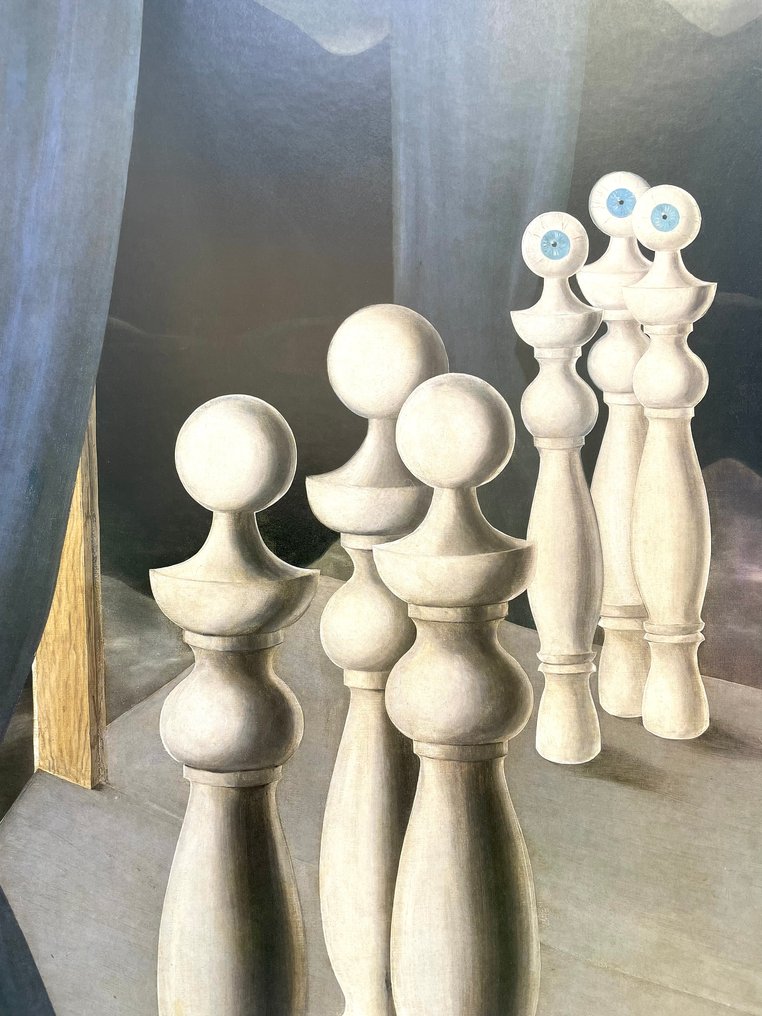
René Magritte (after) - Le Rencontre - Offset Lithography - Achenbach licensed print




02
days
18
hours
52
minutes
42
seconds
Current bid
€ 1
Reserve price not met

Expert
Selected by Juan Antonio Rodríguez
Eight years experience valuing posters, previously valuer at Balclis, Barcelona.
Estimate € 150 - € 200
9 other people are watching this object
 Bidder 3481 Bidder 3481 | €1 |
|---|
Catawiki Buyer Protection
Your payment’s safe with us until you receive your object.View details
Trustpilot 4.4 | 129747 reviews
Rated Excellent on Trustpilot.
Description from the seller
Offset lithograph after René Magritte (*)
Reproduction of the work “Le Rencontre” by Picasso in 1926 and part of the Kunstsammlung Nordrhein-Westfalen collection in Düsseldorf.
Printed on thick Fine Art board.
Published by Achenbach Art Edition, Düsseldorf.
Authorized print with copyright and legal serial number.
Large format.
- Sheet dimensions: 90 x 60 cm
- Year: 1986
- Condition: Excellent (this work has never been framed or exhibited, always kept in a professional art folder, and is therefore in perfect condition).
- Provenance: Private collection.
The work will be carefully handled and packed in reinforced cardboard. The shipment will be trackable with a tracking number.
The shipment will also include transport insurance for the final value of the work with full reimbursement in case of loss or damage, at no cost to the buyer.
(*) René François Ghislain Magritte was the Belgian surrealist who most influenced painting in his country in the 20th century.
His images, unlike other surrealists, were not 100% dream-inspired; rather Magritte distilled reality to its essence, producing, on the one hand, absolutely surprising and ingenious images, and on the other, the very questioning of that reality.
Magritte was, so to speak, a conceptual surrealist deeply interested in the ambiguity of images and words and in exploring the strange relationship between what is painted and what is real. To that end, he explored the magical aspects of everyday life.
Influenced by Giorgio de Chirico, he began to paint mysterious landscapes, with hidden meanings, silence, and much humor. For him, reality is an illusion, a trap so to speak, and throughout his career he explored the real space versus the spatial illusion, which is painting itself.
Very independent, he stayed away from Breton’s militant and dogmatic surrealism, and despite the subversive nature of many of his paintings, he led a calm, bourgeois life between Paris and his native Belgium. The life of a middle-class Belgian and his routine daily activities somewhat inspired him to paint his extraordinary pictures.
Seller's Story
EsKobARTE carefully selects artworks and posters from recognized and emerging artists worldwide to offer them here at affordable prices.*** AUTHENTIC WORKS *** We only sell genuine artworks and posters, as well as officially authorized prints.*** WE ARE PROFESSIONALS *** You can bid on your items with complete confidence. Over 1,000 positive reviews from our clients attest to our experience and professionalism on Catawiki.*** PROTECTED, CERTIFIED, AND INSURED SHIPPING *** All our items are carefully packaged in eco-friendly cardboard packaging. We work with the best shipping companies (UPS-DPD-DHL-FEDEX) to ensure the best service and tracking. Additionally, our shipments include insurance against damage or loss at no cost to the buyer.*** IF YOU PURCHASE MORE THAN ONE ITEM, WE COMBINE SHIPPING *** Even if they come from different auctions, you'll only have to pay the shipping cost for a single item.*** ANY QUESTIONS? CONTACT US *** You can use the chat to talk to us; we will be happy to assist you as soon as possible.*** THANK YOU AND GOOD LUCK WITH YOUR BIDS! ***
Translated by Google TranslateOffset lithograph after René Magritte (*)
Reproduction of the work “Le Rencontre” by Picasso in 1926 and part of the Kunstsammlung Nordrhein-Westfalen collection in Düsseldorf.
Printed on thick Fine Art board.
Published by Achenbach Art Edition, Düsseldorf.
Authorized print with copyright and legal serial number.
Large format.
- Sheet dimensions: 90 x 60 cm
- Year: 1986
- Condition: Excellent (this work has never been framed or exhibited, always kept in a professional art folder, and is therefore in perfect condition).
- Provenance: Private collection.
The work will be carefully handled and packed in reinforced cardboard. The shipment will be trackable with a tracking number.
The shipment will also include transport insurance for the final value of the work with full reimbursement in case of loss or damage, at no cost to the buyer.
(*) René François Ghislain Magritte was the Belgian surrealist who most influenced painting in his country in the 20th century.
His images, unlike other surrealists, were not 100% dream-inspired; rather Magritte distilled reality to its essence, producing, on the one hand, absolutely surprising and ingenious images, and on the other, the very questioning of that reality.
Magritte was, so to speak, a conceptual surrealist deeply interested in the ambiguity of images and words and in exploring the strange relationship between what is painted and what is real. To that end, he explored the magical aspects of everyday life.
Influenced by Giorgio de Chirico, he began to paint mysterious landscapes, with hidden meanings, silence, and much humor. For him, reality is an illusion, a trap so to speak, and throughout his career he explored the real space versus the spatial illusion, which is painting itself.
Very independent, he stayed away from Breton’s militant and dogmatic surrealism, and despite the subversive nature of many of his paintings, he led a calm, bourgeois life between Paris and his native Belgium. The life of a middle-class Belgian and his routine daily activities somewhat inspired him to paint his extraordinary pictures.
Seller's Story
EsKobARTE carefully selects artworks and posters from recognized and emerging artists worldwide to offer them here at affordable prices.*** AUTHENTIC WORKS *** We only sell genuine artworks and posters, as well as officially authorized prints.*** WE ARE PROFESSIONALS *** You can bid on your items with complete confidence. Over 1,000 positive reviews from our clients attest to our experience and professionalism on Catawiki.*** PROTECTED, CERTIFIED, AND INSURED SHIPPING *** All our items are carefully packaged in eco-friendly cardboard packaging. We work with the best shipping companies (UPS-DPD-DHL-FEDEX) to ensure the best service and tracking. Additionally, our shipments include insurance against damage or loss at no cost to the buyer.*** IF YOU PURCHASE MORE THAN ONE ITEM, WE COMBINE SHIPPING *** Even if they come from different auctions, you'll only have to pay the shipping cost for a single item.*** ANY QUESTIONS? CONTACT US *** You can use the chat to talk to us; we will be happy to assist you as soon as possible.*** THANK YOU AND GOOD LUCK WITH YOUR BIDS! ***
Translated by Google TranslateDetails
Era
1900-2000
Designer/artist
René Magritte (after)
Poster title
Le Rencontre - Offset Lithography - Achenbach licensed print
Subject
Art
Country of origin
Germany
Condition
A (excellent - mint condition)
Height
91 cm
Width
60 cm