École post-cubiste (XX) - Architecture humaine


00
days
11
hours
38
minutes
41
seconds
Current bid
€ 110
Reserve price not met

Expert
Selected by Caroline Bokobza
Graduated as French auctioneer and worked in Sotheby’s Paris valuation department.
Estimate € 400 - € 500
22 other people are watching this object
 Bidder 7176 Bidder 7176 | €110 | |
|---|---|---|
 Bidder 9588 Bidder 9588 | €100 | |
| Bidder 9588 | €50 |
Catawiki Buyer Protection
Your payment’s safe with us until you receive your object.View details
Trustpilot 4.4 | 123951 reviews
Rated Excellent on Trustpilot.
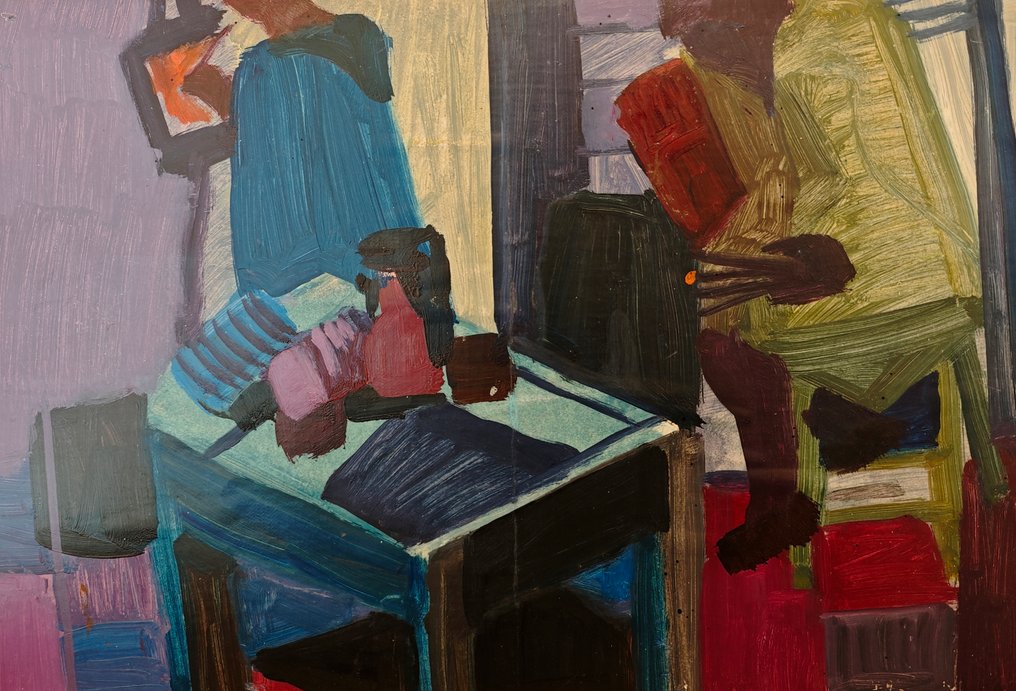
Architecture humaine, an oil painting from France in the 1940–1950 period, in the post-Cubist style, measuring 55 × 38 cm and presented unframed.
AI-assisted summary
Description from the seller
Post-Cubist figuration
Oil on paper adhered to a linen canvas.
Measurements: 55 × 38 cm
I don't know if it's signed; in one corner, there's a small mark that I couldn't confirm is the signature.
Interesting figurative composition belonging to the realm of post-war French modern painting. The work presents an interior scene constructed through broad and well-articulated chromatic planes, where human figures appear reduced to essential, almost architectural volumes, in a clear assimilation of the postcubist language.
The artist deliberately omits detailed description to focus on formal structure and compositional balance, using color as the main organizing element of space. The palette, rich and nuanced, combines deep blues, earthy greens, ochres, and muted reds, creating a contained and reflective atmosphere, characteristic of mid-20th-century French modern figuration.
The technique reveals a confident and deliberate brushstroke, applied in compact areas, without excessive gesturality, which places the work outside the dominant informalism of the period and brings it closer to an intellectually conceived painting, inheriting from Cubism, now fully internalized. The use of oil on paper, later adhered to canvas, was a common practice in French workshops of the period, especially among artists trained in free academies or within the Parisian environment, where this type of support was used both for advanced study works and for pieces aimed at the market.
In terms of style, technique, and approach, the work coherently aligns with French Post-Cubist figuration, showing affinities with the legacy of modern teaching in Paris and with painters who, in the 1950s and 1960s, managed to keep the human figure within a renewed, solid, and contemporary visual language.
The work is presented without a frame and will be sent without a frame.
Seller's Story
At ARTEMISA, we are passionately and professionally dedicated to the daily selection and auction of works of art, antiques and collectibles. Our experience in the sector allows us to offer unique and authentic pieces, carefully acquired from private collections and exclusive sources.
We have a wide stock covering a wide variety of styles and periods, designed to satisfy both experienced collectors and those looking to get started in the world of art.
Every piece tells a story and every auction is an opportunity to discover something special. Our goal is to connect art lovers with objects that inspire and enrich their collections.
Translated by Google TranslatePost-Cubist figuration
Oil on paper adhered to a linen canvas.
Measurements: 55 × 38 cm
I don't know if it's signed; in one corner, there's a small mark that I couldn't confirm is the signature.
Interesting figurative composition belonging to the realm of post-war French modern painting. The work presents an interior scene constructed through broad and well-articulated chromatic planes, where human figures appear reduced to essential, almost architectural volumes, in a clear assimilation of the postcubist language.
The artist deliberately omits detailed description to focus on formal structure and compositional balance, using color as the main organizing element of space. The palette, rich and nuanced, combines deep blues, earthy greens, ochres, and muted reds, creating a contained and reflective atmosphere, characteristic of mid-20th-century French modern figuration.
The technique reveals a confident and deliberate brushstroke, applied in compact areas, without excessive gesturality, which places the work outside the dominant informalism of the period and brings it closer to an intellectually conceived painting, inheriting from Cubism, now fully internalized. The use of oil on paper, later adhered to canvas, was a common practice in French workshops of the period, especially among artists trained in free academies or within the Parisian environment, where this type of support was used both for advanced study works and for pieces aimed at the market.
In terms of style, technique, and approach, the work coherently aligns with French Post-Cubist figuration, showing affinities with the legacy of modern teaching in Paris and with painters who, in the 1950s and 1960s, managed to keep the human figure within a renewed, solid, and contemporary visual language.
The work is presented without a frame and will be sent without a frame.
Seller's Story
At ARTEMISA, we are passionately and professionally dedicated to the daily selection and auction of works of art, antiques and collectibles. Our experience in the sector allows us to offer unique and authentic pieces, carefully acquired from private collections and exclusive sources.
We have a wide stock covering a wide variety of styles and periods, designed to satisfy both experienced collectors and those looking to get started in the world of art.
Every piece tells a story and every auction is an opportunity to discover something special. Our goal is to connect art lovers with objects that inspire and enrich their collections.
Translated by Google TranslateDetails
Artist
École post-cubiste (XX)
Sold with frame
No
Sold by
Gallery
Edition
Original
Title of artwork
Architecture humaine
Technique
Oil painting
Signature
Not signed
Country of Origin
France
Condition
Fair condition
Height
38 cm
Width
55 cm
Depiction/Theme
Interior scene
Style
Cubism
Period
1940-1950
