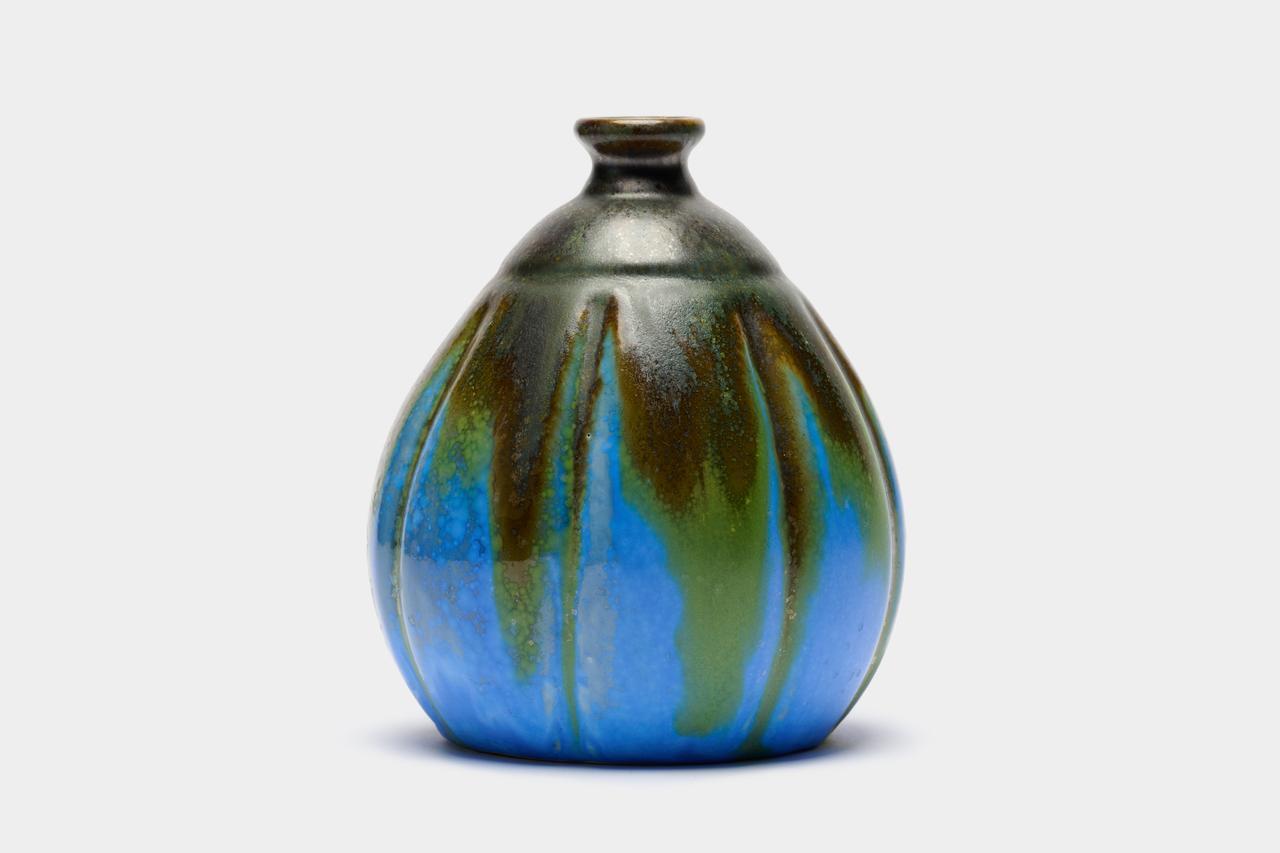
Vase - Earthenware


04
days
02
hours
52
minutes
24
seconds
Current bid
€ 1
No reserve price

Expert
Selected by Florentin Brunz Gaborieau
Holds a master’s in Art History, specialising in Second French Empire and Dutch Golden Age.
Estimate € 160 - € 200
11 other people are watching this object
 Bidder 2887 Bidder 2887 | €1 |
|---|
Catawiki Buyer Protection
Your payment’s safe with us until you receive your object.View details
Trustpilot 4.4 | 125774 reviews
Rated Excellent on Trustpilot.
Anthropomorphic ceramic botijo from Úbeda, Spain, dating to circa 1850–1900 (approx. 1890–1920), with a spherical body that becomes a figurative head with a double grotesque face, glazed in earthy brown, cream and oxide green tones, featuring a top-mounted spout and fill hole, dimensions 25 cm high by 20 cm wide by 30 cm deep and weighing 2 kg, in used good condition with minor signs of age and imperfections.
AI-assisted summary
Description from the seller
Exceptional Anthropomorphic Botijo of Deception - Traditional Pottery of Úbeda (Spain), c. 1890-1920.
Magnificent and striking Botijo (Water Jar) made of glazed ceramic, notable for its strongly sculptural nature. The piece features a spherical body that transforms into a figurative head, with a double face (one on each side) displaying a grotesque, satirical, or bearded satyr expression, richly detailed in the modeling of the mouth, nose, and eyelids.
The botijo is finished with a glossy glaze in earthy tones of brown, cream, and rust-green accents, which enhance the texture and the dramatic character of the faces. The spout (tube) and the filling mouth, typical of the botijo's function, emerge from the top of the skull, blending into the design.
This piece is an excellent example of Iberian popular pottery with artistic ambitions, in which craftsmen often endowed their utilitarian vessels with anthropomorphic and zoomorphic forms, full of expressiveness and humor. Its uniqueness and high level of modeling set it apart from common utilitarian pottery, turning it into a collectible object of great ethnographic and aesthetic interest.
Exceptional Anthropomorphic Botijo of Deception - Traditional Pottery of Úbeda (Spain), c. 1890-1920.
Magnificent and striking Botijo (Water Jar) made of glazed ceramic, notable for its strongly sculptural nature. The piece features a spherical body that transforms into a figurative head, with a double face (one on each side) displaying a grotesque, satirical, or bearded satyr expression, richly detailed in the modeling of the mouth, nose, and eyelids.
The botijo is finished with a glossy glaze in earthy tones of brown, cream, and rust-green accents, which enhance the texture and the dramatic character of the faces. The spout (tube) and the filling mouth, typical of the botijo's function, emerge from the top of the skull, blending into the design.
This piece is an excellent example of Iberian popular pottery with artistic ambitions, in which craftsmen often endowed their utilitarian vessels with anthropomorphic and zoomorphic forms, full of expressiveness and humor. Its uniqueness and high level of modeling set it apart from common utilitarian pottery, turning it into a collectible object of great ethnographic and aesthetic interest.
Details
Era
1400-1900
Weight
2 kg
Ceramics type
Earthenware
Country of Origin
Spain
Material
Ceramic
Style
Antique
Condition
Good condition - used with small signs of aging & blemishes
Height
25 cm
Width
20 cm
Depth
30 cm
Estimated period
1850-1900
Sold by