
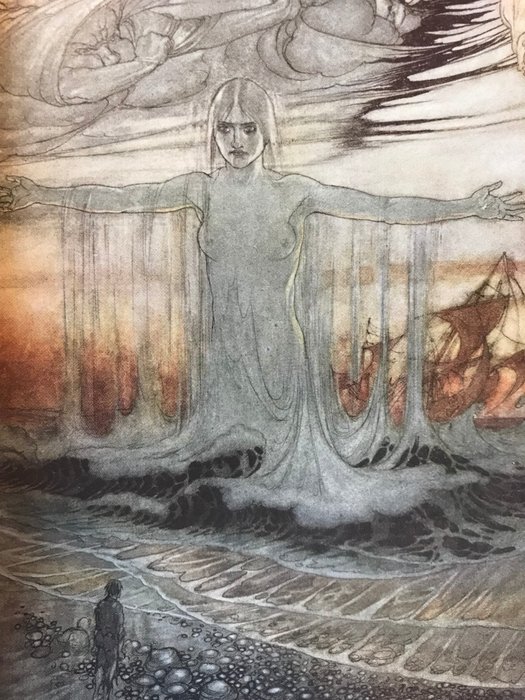
Arthur Rackham - Aesop's Fables - 1912


Add to your favourites to get an alert when the auction starts.
Catawiki Buyer Protection
Your payment’s safe with us until you receive your object.View details
Trustpilot 4.4 | 125774 reviews
Rated Excellent on Trustpilot.
Description from the seller
"Aesop's Fables" illustrated by Arthur Rackham
William Heinemann - 1912, first UK Rackham edition - 224p, 18cmx15cm - 12 colored plates + colored frontispiece and b/w illustrations by Arthur Rackham - condition: very good, in original publisher's green gilt binding, some rubbing to edges, name to ffep, minor foxing, complete with all plates by Rackham.
The peculiar secret of Rackham's success in seizing upon the essence of the human and portraying it in animal form, which is after all the basic device of the morality, is unwittingly touched upon in Chesterton's delightful introduction to the 1912 edition of Aesop's Fables: 'There can be no good fable with human beings in it. There can be no good fairy tale without them'. Rackham's genius is such that it bridges the two, and carries the didactic fable into the realm of fairy story, and lends to the imaginative world of fairies a tangible and convincing reality" (Fred Gettings, Arthur Rackham, 1976, pp. 83-4).
"Aesop's Fables" illustrated by Arthur Rackham
William Heinemann - 1912, first UK Rackham edition - 224p, 18cmx15cm - 12 colored plates + colored frontispiece and b/w illustrations by Arthur Rackham - condition: very good, in original publisher's green gilt binding, some rubbing to edges, name to ffep, minor foxing, complete with all plates by Rackham.
The peculiar secret of Rackham's success in seizing upon the essence of the human and portraying it in animal form, which is after all the basic device of the morality, is unwittingly touched upon in Chesterton's delightful introduction to the 1912 edition of Aesop's Fables: 'There can be no good fable with human beings in it. There can be no good fairy tale without them'. Rackham's genius is such that it bridges the two, and carries the didactic fable into the realm of fairy story, and lends to the imaginative world of fairies a tangible and convincing reality" (Fred Gettings, Arthur Rackham, 1976, pp. 83-4).

