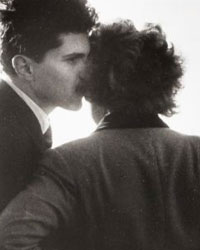
Michael Joseph (1941-) - Solarised sixties portrait, unique authentic darkroom creation

05
days
23
hours
18
minutes
13
seconds
Starting bid
€ 1
No reserve price
Kai Brückner
Expert
Selected by Kai Brückner

Over 35 years' experience; former gallery owner and Museum Folkwang curator.

Estimate  € 500 - € 600
No bids placed

Catawiki Buyer Protection

Your payment’s safe with us until you receive your object.View details

Trustpilot 4.4 | 126498 reviews

Rated Excellent on Trustpilot.

Description from the seller

This haunting image, annotated “1960s model” and hand-signed by Michael Joseph, exists in the charged space where intention loosens and the darkroom takes control. The figure — partially veiled, partially revealed — appears suspended between presence and disappearance, her features softened and fractured by light, chemistry, and chance.

The ethereal effect was almost certainly not planned in the conventional sense. It is likely the result of a darkroom anomaly: light leakage during exposure, uneven development, chemical pooling, or paper contact reacting unpredictably under the enlarger. Such moments were well known to printers — where temperature, timing, or a slight lapse in masking could transform a straightforward negative into something entirely other. In these instances, the photographer does not command the image so much as collaborate with process.

And it is precisely here that the photograph becomes something more.

Joseph understood that the darkroom was not merely a place of control, but of revelation. What emerges is not a document of a model, but a meditation on form, identity, and impermanence. The face dissolves into abstraction; lace, shadow, and grain merge into a visual language closer to drawing or etching than conventional photography. The image resists certainty — and in doing so, gains power.

This work raises the essential question: where does photography end and art begin? The answer, perhaps, is nowhere except in the mind of the viewer. The camera may have recorded the subject, but the final image belongs to accident, intuition, and acceptance — qualities shared by the most compelling modern art of the 20th century.

Offered as a vintage photographic print, produced in Michael Joseph’s own darkroom and hand-signed by the photographer, this piece stands as a rare example of photography unbound by strict authorship. It is an artefact of trust — trust in materials, in chance, and in the belief that meaning sometimes arrives uninvited.

Is this art?
If art is the act of recognising when control should be surrendered, then the answer is unmistakably yes.

Seller's Story

My father, Michael Joseph, was a London-based advertising photographer from the mid-1960s to the early 1990s. Over those decades, he produced an extraordinary body of work—his most widely recognised image being the iconic Beggars Banquet gatefold for the Rolling Stones. My ongoing mission is to share and celebrate what we call “the other photos”: the lesser-known but no less compelling images from his archive. These are the works that lived beyond the headlines—test prints, alternative frames from major shoots, and quieter, more personal photographs, all made with his characteristic intensity, discipline, and devotion to craft. Much of their atmosphere comes from the darkroom itself. These are photographs shaped by light, timing, and handwork: intricate group compositions, sculptural still lifes, and moments that invite the viewer to linger and look again. Variety is central to the archive, and I frequently offer unique, one-off pieces that exist nowhere else. I hope you enjoy discovering my father’s work as much as I enjoy sharing it, and that you find here not just an image, but a genuine piece of photographic history. All works are dispatched carefully protected, and packed with devotion and care, appropriate to a one-off historical photographic print. US purchasers please note: Customs and excise charges are paid at source and included in the postage fee. No further charges should be due on delivery, unless regulations change.

This haunting image, annotated “1960s model” and hand-signed by Michael Joseph, exists in the charged space where intention loosens and the darkroom takes control. The figure — partially veiled, partially revealed — appears suspended between presence and disappearance, her features softened and fractured by light, chemistry, and chance.

The ethereal effect was almost certainly not planned in the conventional sense. It is likely the result of a darkroom anomaly: light leakage during exposure, uneven development, chemical pooling, or paper contact reacting unpredictably under the enlarger. Such moments were well known to printers — where temperature, timing, or a slight lapse in masking could transform a straightforward negative into something entirely other. In these instances, the photographer does not command the image so much as collaborate with process.

And it is precisely here that the photograph becomes something more.

Joseph understood that the darkroom was not merely a place of control, but of revelation. What emerges is not a document of a model, but a meditation on form, identity, and impermanence. The face dissolves into abstraction; lace, shadow, and grain merge into a visual language closer to drawing or etching than conventional photography. The image resists certainty — and in doing so, gains power.

This work raises the essential question: where does photography end and art begin? The answer, perhaps, is nowhere except in the mind of the viewer. The camera may have recorded the subject, but the final image belongs to accident, intuition, and acceptance — qualities shared by the most compelling modern art of the 20th century.

Offered as a vintage photographic print, produced in Michael Joseph’s own darkroom and hand-signed by the photographer, this piece stands as a rare example of photography unbound by strict authorship. It is an artefact of trust — trust in materials, in chance, and in the belief that meaning sometimes arrives uninvited.

Is this art?
If art is the act of recognising when control should be surrendered, then the answer is unmistakably yes.

Seller's Story

My father, Michael Joseph, was a London-based advertising photographer from the mid-1960s to the early 1990s. Over those decades, he produced an extraordinary body of work—his most widely recognised image being the iconic Beggars Banquet gatefold for the Rolling Stones. My ongoing mission is to share and celebrate what we call “the other photos”: the lesser-known but no less compelling images from his archive. These are the works that lived beyond the headlines—test prints, alternative frames from major shoots, and quieter, more personal photographs, all made with his characteristic intensity, discipline, and devotion to craft. Much of their atmosphere comes from the darkroom itself. These are photographs shaped by light, timing, and handwork: intricate group compositions, sculptural still lifes, and moments that invite the viewer to linger and look again. Variety is central to the archive, and I frequently offer unique, one-off pieces that exist nowhere else. I hope you enjoy discovering my father’s work as much as I enjoy sharing it, and that you find here not just an image, but a genuine piece of photographic history. All works are dispatched carefully protected, and packed with devotion and care, appropriate to a one-off historical photographic print. US purchasers please note: Customs and excise charges are paid at source and included in the postage fee. No further charges should be due on delivery, unless regulations change.

Details

Date of print
1969
Artist
Michael Joseph (1941-)
Sold by
Owner or reseller
Title of artwork
Solarised sixties portrait, unique authentic darkroom creation
Condition
Original State
Technique
Gelatin-silver print
Height
19 cm
Edition
Signed Unique darkroom print
Width
28 cm
Signature
Hand signed
Genre
Fine art photography
FranceVerified
409
Objects sold
100%
Privatetop

Similar objects

For you in

Photography