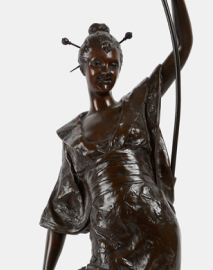
Sculpture, Apolo de Piombino - 23 cm - Modelled stone


00
days
09
hours
50
minutes
46
seconds
Current bid
€ 60
Reserve price not met

Expert
Selected by Paul Wullems
He accumulated 18 years' experience, worked as junior specialist at Sotheby’s and managed Kunsthandel Jacques Fijnaut.
Estimate € 150 - € 200
10 other people are watching this object
 Bidder 3226 Bidder 3226 | €60 | |
|---|---|---|
| Bidder 3226 | €50 | |
 Bidder 3284 Bidder 3284 | €1 |
Catawiki Buyer Protection
Your payment’s safe with us until you receive your object.View details
Trustpilot 4.4 | 126932 reviews
Rated Excellent on Trustpilot.
Description from the seller
Title: Apollo of Piombino
Object: Apollo Bust from Piombino
Material: Made in modeled stone patinated in verdigris green. Base or plinth with a square grid in white marble.
Origin: Europe, possibly Greece.
Year of manufacture: Late 20th century.
It depicts a bronze copy of the original bust.
Excellent condition. No damage, no wear, no repairs needed; everything is in good, sound condition.
Very well-protected shipment,
The Piombino Apollo, also called the Piombino Boy, is a Greek bronze statue in late archaic style, about 1.15 m tall, representing the god as a kouros or a youth, or it may be a worshiper bearing an offering. The bronze has copper inlays for the lips, eyebrows, and nipples. The eyes, which are missing, were made of another material, perhaps bone or ivory.
Regarding the original sculpture, it was found in 1832 in the Italian town of Piombino (in the ancient region of Etruria), in the port facing the southwest point, and it was purchased for the Louvre Museum two years later, in 1834. Its archaic style led scholars such as Reinhard Lullies and Max Hirmer to date it to the 5th century BC and to place its workshop in Magna Graecia, the Hellenic-cultural area of southern Italy. Kenneth Clark illustrated it in The Nude (1956); [Karl Schefold included it in Meisterwerke Griechischer Kunst (1960) and molds could be found in the study collections of universities and museums; one made by the Louvre was returned to Piombino.
Instead, the Italian archaeologist Brunilde Sismondo Ridgway showed, in 1967, that it was not merely an archaizing sculpture from the 1st century BCE, the kind designed to appeal to a Roman with refined tastes, but rather a Roman forgery, consciously manufactured, with an inscription featuring fake silver inlays with archaic letters on the left leg. The inscription dedicates this Apollo to Athena, which would be an anomaly.
The two sculptors responsible for its creation could not resist secretly writing inside the sculpture a lead tag bearing inscriptions of their names, which was found in 1842. One of the authors was a Tyrian exile who had emigrated to Rhodes. The Louvre Museum’s website added that a comparable work discovered in 1977 in Pompeii, in the villa of Gaius Julius Polybius, corroborated the hypothesis of an archaizing pastiche, made for a Roman client in the 1st century BCE. The study of ancient Greek sculpture in recent decades has moved away from the traditional practice of identifying sculptures based on brief literary descriptions and attempting to recognize the characteristic form of some famous names reflected in reproductions of their work and variants based on their style, to instead focus on the socio-political world in which the sculpture was created and other less subjective criteria.
Title: Apollo of Piombino
Object: Apollo Bust from Piombino
Material: Made in modeled stone patinated in verdigris green. Base or plinth with a square grid in white marble.
Origin: Europe, possibly Greece.
Year of manufacture: Late 20th century.
It depicts a bronze copy of the original bust.
Excellent condition. No damage, no wear, no repairs needed; everything is in good, sound condition.
Very well-protected shipment,
The Piombino Apollo, also called the Piombino Boy, is a Greek bronze statue in late archaic style, about 1.15 m tall, representing the god as a kouros or a youth, or it may be a worshiper bearing an offering. The bronze has copper inlays for the lips, eyebrows, and nipples. The eyes, which are missing, were made of another material, perhaps bone or ivory.
Regarding the original sculpture, it was found in 1832 in the Italian town of Piombino (in the ancient region of Etruria), in the port facing the southwest point, and it was purchased for the Louvre Museum two years later, in 1834. Its archaic style led scholars such as Reinhard Lullies and Max Hirmer to date it to the 5th century BC and to place its workshop in Magna Graecia, the Hellenic-cultural area of southern Italy. Kenneth Clark illustrated it in The Nude (1956); [Karl Schefold included it in Meisterwerke Griechischer Kunst (1960) and molds could be found in the study collections of universities and museums; one made by the Louvre was returned to Piombino.
Instead, the Italian archaeologist Brunilde Sismondo Ridgway showed, in 1967, that it was not merely an archaizing sculpture from the 1st century BCE, the kind designed to appeal to a Roman with refined tastes, but rather a Roman forgery, consciously manufactured, with an inscription featuring fake silver inlays with archaic letters on the left leg. The inscription dedicates this Apollo to Athena, which would be an anomaly.
The two sculptors responsible for its creation could not resist secretly writing inside the sculpture a lead tag bearing inscriptions of their names, which was found in 1842. One of the authors was a Tyrian exile who had emigrated to Rhodes. The Louvre Museum’s website added that a comparable work discovered in 1977 in Pompeii, in the villa of Gaius Julius Polybius, corroborated the hypothesis of an archaizing pastiche, made for a Roman client in the 1st century BCE. The study of ancient Greek sculpture in recent decades has moved away from the traditional practice of identifying sculptures based on brief literary descriptions and attempting to recognize the characteristic form of some famous names reflected in reproductions of their work and variants based on their style, to instead focus on the socio-political world in which the sculpture was created and other less subjective criteria.
Details
Era
1900-2000
Country of Origin
Greece
Style
Antique
Material
Modelled stone
Title of artwork
Apolo de Piombino
Signature
Not signed
Colour
Green
Condition
Good condition
Height
23 cm
Width
16 cm
Depth
9 cm
Weight
1628 g
Sold by