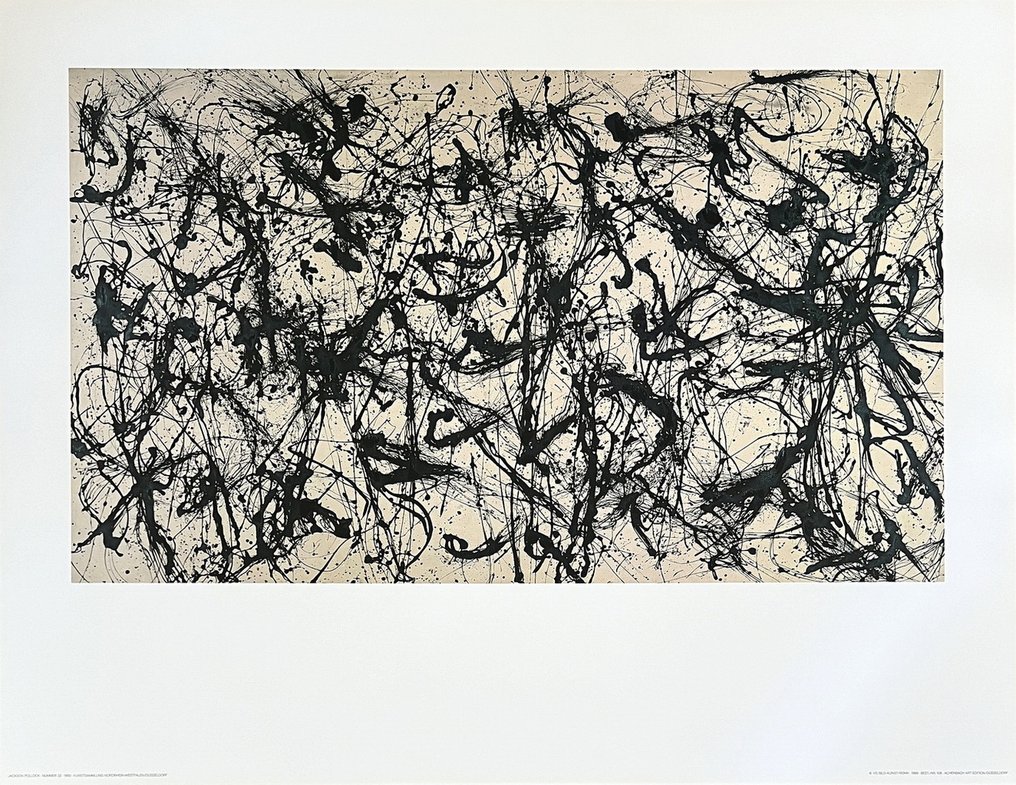
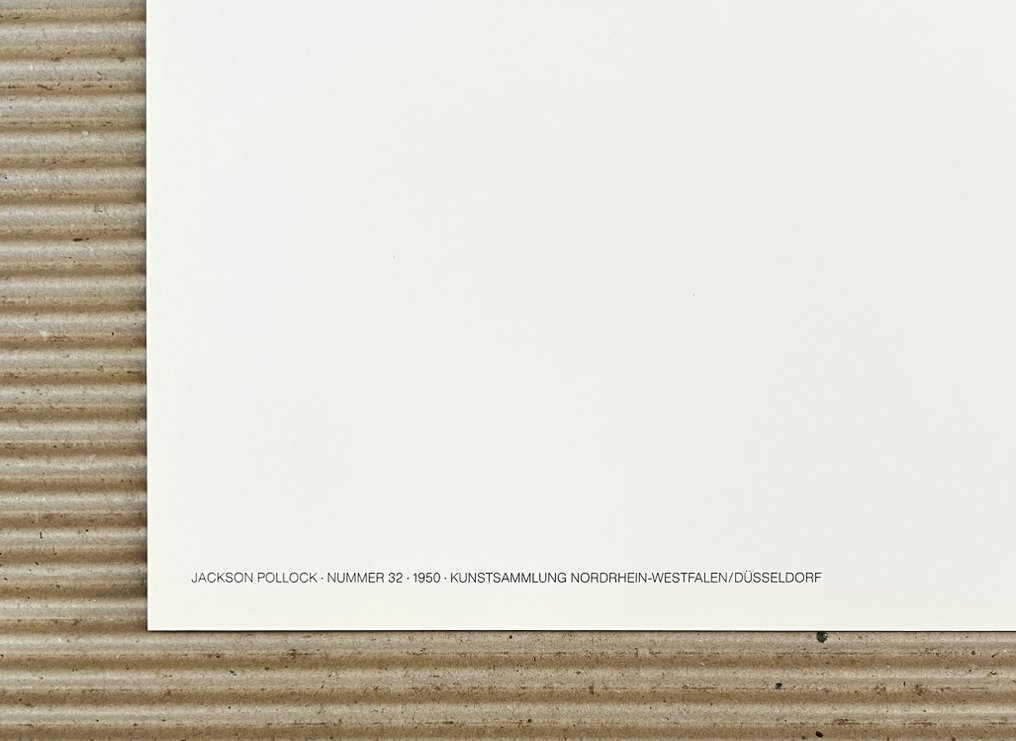
Jackson Pollock (after) - "Nummer 32" - nach Original von 1950



Opens 03 March
Starting bid
€ 1
Add to your favourites to get an alert when the auction starts.

Expert
Selected by Juan Antonio Rodríguez
Eight years experience valuing posters, previously valuer at Balclis, Barcelona.
Estimate € 150 - € 200
Catawiki Buyer Protection
Your payment’s safe with us until you receive your object.View details
Trustpilot 4.4 | 127823 reviews
Rated Excellent on Trustpilot.
Description from the seller
Reproduction of the work "Number 32", created in 1950 by Jackson Pollock
Original, oil paint on canvas, 269 x 457.5 cm
Copyright: Bild Kunst/Bonn
Artist: Jackson Pollock* (born January 28, 1912 in Cody, USA; died August 11, 1956 in New York, United States)
Print technique: color offset lithography
Print medium: very heavy paper
Original artwork: in the Kunstsammlung NRW - Düsseldorf
Sheet size: 70.0 x 90.0 cm
Subject dimensions: 45.5 x 77.0 cm
Publisher: Achenbach Art Edition - Düsseldorf 1990
Condition: very good
The artwork has been carefully stored in a climate-controlled cabinet, dust- and UV-protected. Therefore, excellent condition. This color offset lithograph has of course not been framed yet.
Shipping is carried out very carefully packed in absolutely professional packaging with maximum protection against any damage. The package is additionally insured against damage and loss at no additional cost to the buyer.
(*) Paul Jackson Pollock (* January 28, 1912 in Cody, Wyoming; died August 11, 1956 in East Hampton, New York) the founding father and master of Action Painting, undoubtedly ranks among the most important artists of the postwar period. From 1925 to 1929 he attended the Manual Arts School in Los Angeles. In 1930 he moved to New York and studied painting at the Art Students League with Thomas Hart Benton. In the 1930s he engaged with Mexican muralists José Clemente Orozco and Diego Rivera. From 1938 to 1942 he painted murals for the Federal Art Project of the Works Progress Administration. In 1942 he participated in the International Surrealist Exhibition. In addition to the New York Surrealist group, he also had contact with artists such as Willem de Kooning or Robert Motherwell. In 1943 Pollock had his first solo show at Peggy Guggenheim's Art of This Century gallery. Soon after, his "Drip Paintings" emerged, in which Pollock poured, flung or dripped paint onto canvases. Numerous national and European solo and group exhibitions followed. He became a central representative of Abstract Expressionism. Pollock fought a lifelong battle with alcohol addiction, underwent therapy several times. He died in a car accident in East Hampton in 1956.
Works by Jackson Pollock, one of the most important artists of the past century, can be found worldwide in numerous renowned museums such as the Art Institute of Chicago, the British Museum in London and the Tate Gallery, the Centre Pompidou in Paris, the Museum Folkwang in Essen, the National Museum of Western Art in Tokyo, or the Tel Aviv Museum of Art.
About the artwork:
“Number 32, 1950” ranks among the most radical image formulations not only in Pollock’s oeuvre but in American Abstract Expressionism as a whole. It stands as a paradigm for the separation of the New York School from European art history and for the articulation of a new American self-confidence in art after World War II. “Number 32, 1950” represents a culmination and intensification of his art since the end of 1947.
Reproduction of the work "Number 32", created in 1950 by Jackson Pollock
Original, oil paint on canvas, 269 x 457.5 cm
Copyright: Bild Kunst/Bonn
Artist: Jackson Pollock* (born January 28, 1912 in Cody, USA; died August 11, 1956 in New York, United States)
Print technique: color offset lithography
Print medium: very heavy paper
Original artwork: in the Kunstsammlung NRW - Düsseldorf
Sheet size: 70.0 x 90.0 cm
Subject dimensions: 45.5 x 77.0 cm
Publisher: Achenbach Art Edition - Düsseldorf 1990
Condition: very good
The artwork has been carefully stored in a climate-controlled cabinet, dust- and UV-protected. Therefore, excellent condition. This color offset lithograph has of course not been framed yet.
Shipping is carried out very carefully packed in absolutely professional packaging with maximum protection against any damage. The package is additionally insured against damage and loss at no additional cost to the buyer.
(*) Paul Jackson Pollock (* January 28, 1912 in Cody, Wyoming; died August 11, 1956 in East Hampton, New York) the founding father and master of Action Painting, undoubtedly ranks among the most important artists of the postwar period. From 1925 to 1929 he attended the Manual Arts School in Los Angeles. In 1930 he moved to New York and studied painting at the Art Students League with Thomas Hart Benton. In the 1930s he engaged with Mexican muralists José Clemente Orozco and Diego Rivera. From 1938 to 1942 he painted murals for the Federal Art Project of the Works Progress Administration. In 1942 he participated in the International Surrealist Exhibition. In addition to the New York Surrealist group, he also had contact with artists such as Willem de Kooning or Robert Motherwell. In 1943 Pollock had his first solo show at Peggy Guggenheim's Art of This Century gallery. Soon after, his "Drip Paintings" emerged, in which Pollock poured, flung or dripped paint onto canvases. Numerous national and European solo and group exhibitions followed. He became a central representative of Abstract Expressionism. Pollock fought a lifelong battle with alcohol addiction, underwent therapy several times. He died in a car accident in East Hampton in 1956.
Works by Jackson Pollock, one of the most important artists of the past century, can be found worldwide in numerous renowned museums such as the Art Institute of Chicago, the British Museum in London and the Tate Gallery, the Centre Pompidou in Paris, the Museum Folkwang in Essen, the National Museum of Western Art in Tokyo, or the Tel Aviv Museum of Art.
About the artwork:
“Number 32, 1950” ranks among the most radical image formulations not only in Pollock’s oeuvre but in American Abstract Expressionism as a whole. It stands as a paradigm for the separation of the New York School from European art history and for the articulation of a new American self-confidence in art after World War II. “Number 32, 1950” represents a culmination and intensification of his art since the end of 1947.
Details
Era
1900-2000
Designer/Artist
Jackson Pollock (after)
Poster title
"Nummer 32" - nach Original von 1950
Country of Origin
Germany
Condition
A (excellent - mint condition)
Nr of items
1
Height
70 cm
Width
90 cm
Sold by