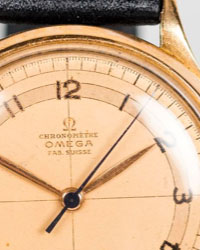
Omega - Geneve Chronostop


05
days
00
hours
48
minutes
47
seconds
Current bid
€ 100
Reserve price not met

Expert
Selected by Erwin Dekker
Experienced antique dealer with extensive watch collecting expertise and antiques background.
Estimate € 1,200 - € 1,400
9 other people are watching this object
 Bidder 9200 Bidder 9200 | €100 |
|---|
Catawiki Buyer Protection
Your payment’s safe with us until you receive your object.View details
Trustpilot 4.4 | 127526 reviews
Rated Excellent on Trustpilot.
Omega Geneve Chronostop reference 145.009, a 1960s manual-wind vintage men's watch with a 35mm stainless steel case, grey baton dial, grey leather strap, plexi crystal, and solid case back, described as worn and in very good condition.
AI-assisted summary
Description from the seller
Model Number: 145.009
This Omega Chronostop Vintage Men's Watch Watch has undergone a thorough inspection of water resistance, accuracy, functionality, and condition. It has also been referenced against technical documents and manufacturer records where available to ensure authenticity and a clean history.
This is a Pre-owned Omega Chronostop Vintage Men's Watch Watch. It has a 35mm Stainless Steel Case Case, a Grey Baton Dial on a Omega Grey Leather Strap Bracelet. The watch is powered by an Manual Wind movement.
Gender: Men's
Case Material: Stainless Steel Case
Dial Color: Grey Baton Dial
Bracelet/Strap: Leather
Clasp Type: Tang
Movement: Manual Wind
Screw Down Crown: No
Bezel: Fixed
Crystal: Plexi
Case Back: Solid
Case Diameter: 35mm
Year: 1960's
It’s easy to find articles about the "classic” vintage watches, such as the Speedmaster, Submariner, Zenith El Primero, or Heuer Autavia. I thought it would be interesting to explore one of Omega's least remembered and most misunderstood watches: the Chronostop.
Unlike conventional chronographs that record seconds, minutes, and hours with two or three subdials, the Chronostop was designed to be used for short interval timing -- less than one minute -- with a central hand for seconds and a single pusher.
Omega released the Chronostop in 1966. Originally intended to be part of the Seamaster collection, the Chronostop was transferred to the Geneve collection in 1967 as a lower-priced chronograph watch for younger buyers.
Echoes of the Speedmaster
Despite the low price, the Chronostop was a premium model. The watch’s movement seemed simple, but it was a high-accuracy, high-beat, high-quality engine, essentially a simpler version of the movement that powered the Speedmaster. Omega used two movements for its Chronostop models: the cal.920 (with a date), and the cal.865 (no date). Both manual-wind movements had 17 jewels, run at a rapid 21,600 Bph, and were used only on the Chronostop.
The cal.865 movement was introduced in 1966 and Omega used that model for 124,000 Chronostops. The cal.920 movement appeared in 1968 and was used for 61,000 watches.

The Chronostop was well-regarded within the watch industry: the watch won the 1967 Honor Prize for “Chronographs and Sport Watches” in the competition sponsored by the Swiss Watchmaking Federation to boost creativity.
The Chronostop also took the first prize for Industrial Aesthetics at the Utrecht Spring Fair in 1968.
An Official Olympic Timer
Even though the Chronostop featured only one measurement function, it was selected as the official Omega timer at the Pan-American Games in Winnipeg and the 1968 Olympic Games in Mexico. Available in olive green, red, white, and blue, the Mexico Olympics versions of the watch used the cal.920 movement with the date function and included dial-matching leather straps.
Model Number: 145.009
This Omega Chronostop Vintage Men's Watch Watch has undergone a thorough inspection of water resistance, accuracy, functionality, and condition. It has also been referenced against technical documents and manufacturer records where available to ensure authenticity and a clean history.
This is a Pre-owned Omega Chronostop Vintage Men's Watch Watch. It has a 35mm Stainless Steel Case Case, a Grey Baton Dial on a Omega Grey Leather Strap Bracelet. The watch is powered by an Manual Wind movement.
Gender: Men's
Case Material: Stainless Steel Case
Dial Color: Grey Baton Dial
Bracelet/Strap: Leather
Clasp Type: Tang
Movement: Manual Wind
Screw Down Crown: No
Bezel: Fixed
Crystal: Plexi
Case Back: Solid
Case Diameter: 35mm
Year: 1960's
It’s easy to find articles about the "classic” vintage watches, such as the Speedmaster, Submariner, Zenith El Primero, or Heuer Autavia. I thought it would be interesting to explore one of Omega's least remembered and most misunderstood watches: the Chronostop.
Unlike conventional chronographs that record seconds, minutes, and hours with two or three subdials, the Chronostop was designed to be used for short interval timing -- less than one minute -- with a central hand for seconds and a single pusher.
Omega released the Chronostop in 1966. Originally intended to be part of the Seamaster collection, the Chronostop was transferred to the Geneve collection in 1967 as a lower-priced chronograph watch for younger buyers.
Echoes of the Speedmaster
Despite the low price, the Chronostop was a premium model. The watch’s movement seemed simple, but it was a high-accuracy, high-beat, high-quality engine, essentially a simpler version of the movement that powered the Speedmaster. Omega used two movements for its Chronostop models: the cal.920 (with a date), and the cal.865 (no date). Both manual-wind movements had 17 jewels, run at a rapid 21,600 Bph, and were used only on the Chronostop.
The cal.865 movement was introduced in 1966 and Omega used that model for 124,000 Chronostops. The cal.920 movement appeared in 1968 and was used for 61,000 watches.

The Chronostop was well-regarded within the watch industry: the watch won the 1967 Honor Prize for “Chronographs and Sport Watches” in the competition sponsored by the Swiss Watchmaking Federation to boost creativity.
The Chronostop also took the first prize for Industrial Aesthetics at the Utrecht Spring Fair in 1968.
An Official Olympic Timer
Even though the Chronostop featured only one measurement function, it was selected as the official Omega timer at the Pan-American Games in Winnipeg and the 1968 Olympic Games in Mexico. Available in olive green, red, white, and blue, the Mexico Olympics versions of the watch used the cal.920 movement with the date function and included dial-matching leather straps.
Details
Era
1900-2000
Brand
Omega
Condition
Worn & in very good condition
Model
Geneve Chronostop
Sold by