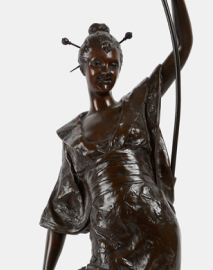
Gemito - Bust, Scugnizzo Napoletano - 43 cm - Bronze


05
days
02
hours
38
minutes
47
seconds
Starting bid
€ 1
Reserve price not met

Expert
Selected by Paul Wullems
He accumulated 18 years' experience, worked as junior specialist at Sotheby’s and managed Kunsthandel Jacques Fijnaut.
Estimate € 400 - € 500
No bids placed
Catawiki Buyer Protection
Your payment’s safe with us until you receive your object.View details
Trustpilot 4.4 | 127526 reviews
Rated Excellent on Trustpilot.
Description from the seller
This splendid bronze bust is a work by the celebrated Neapolitan sculptor Vincenzo Gemito (1852–1929), one of the leading figures of Italian realism in the late 19th and early 20th centuries.
Here is a detailed description
Subject and Style
The bust depicts a young boy, a so-called Neapolitan street urchin, a central and recurring theme in Gemito's work. The expression is lively and rich in realism: the boy is captured in an open and spontaneous smile showing the dental arcades, with his eyes slightly squinted, conveying a great vital force and an almost photographic immediacy. The rendering of the hair is animated and tactile, typical of the artist's style, who loved to model matter in a vibrant way.
Technical Details and Foundry Marks
The work presents essential elements for identification:
Signature: On the base of the bronze it is clearly engraved with the name "GEMITO" in block letters, with the characteristic stroke of his works.
Foundry: The photo shows a foundry mark punched on the base. Although partially worn, it bears the inscription "Artistic Property - Gemito Foundry". The presence of this mark indicates that it is a melting produced directly by the foundry created by the sculptor or by his heirs, who used the original molds.
Patina: The bronze has a warm, glossy patina, with golden reflections due to the browning, which enhances the volumes of the face and the play of light and shadow.
Analysis of the Work
This piece is a classic example of Gemito's ability to transform popular subjects into masterpieces of plastic art. The circular stepped base lifts the bust, giving it an elegance that contrasts with the humble and joyous nature of the depicted subject.
The piece is in excellent preserved condition. In the collecting world, Gemito works with original foundry marks are highly sought after, especially when they retain the expressive vivacity visible in this specimen.
The work is an excellent example of the famous "Smiling Scugnizzo" (sometimes cataloged also as "The Boy Who Laughs"), one of the most iconic and beloved subjects of Vincenzo Gemito.
Here are the details emerging from the technical analysis
1. Identification of the Mark and Foundry
The rectangular stamp visible in the photo is the mark of the "Fonderia Gemito Napoli".
Meaning: This mark indicates that the work is not a generic posthumous copy, but a melt produced by the foundry founded by Gemito himself in Naples (active from the late 19th century to the first half of the 20th century, later continued by his heirs, the Guerritore).
2. Artistic Analysis
The bust embodies the Neapolitan verismo poetics:
Expression: Unlike noble portraits, here Gemito captures the frank and almost brazen laughter of a street boy. The attention to detail—such as visible teeth and the lines around the eyes—signs a high-quality casting that preserved the freshness of the original wax model.
Style: The influence of Hellenistic sculpture (which Gemito studied at the Naples National Archaeological Museum) is evident, fused with a modern, popular vitality.
Note: The presence of the signature "GEMITO" on the base and the foundry mark on the chest/shoulder is the ideal combination for collectors, as it guarantees provenance from the artist's authentic molds.
Seller's Story
I offer a selection of unique and fascinating objects from different parts of the world.
Discover the magic of travel and culture through our selection of interesting objects from around the world.
We offer a variety of unique and fascinating items, perfect for collectors, travel and culture enthusiasts, or simply for those seeking special objects.
From our collection
ART OBJECTS AND CULTURAL MANUFACTURES
Traditional and modern craftsmanship
Unique collectible and souvenir items
Decorative and functional articles
Translated by Google TranslateThis splendid bronze bust is a work by the celebrated Neapolitan sculptor Vincenzo Gemito (1852–1929), one of the leading figures of Italian realism in the late 19th and early 20th centuries.
Here is a detailed description
Subject and Style
The bust depicts a young boy, a so-called Neapolitan street urchin, a central and recurring theme in Gemito's work. The expression is lively and rich in realism: the boy is captured in an open and spontaneous smile showing the dental arcades, with his eyes slightly squinted, conveying a great vital force and an almost photographic immediacy. The rendering of the hair is animated and tactile, typical of the artist's style, who loved to model matter in a vibrant way.
Technical Details and Foundry Marks
The work presents essential elements for identification:
Signature: On the base of the bronze it is clearly engraved with the name "GEMITO" in block letters, with the characteristic stroke of his works.
Foundry: The photo shows a foundry mark punched on the base. Although partially worn, it bears the inscription "Artistic Property - Gemito Foundry". The presence of this mark indicates that it is a melting produced directly by the foundry created by the sculptor or by his heirs, who used the original molds.
Patina: The bronze has a warm, glossy patina, with golden reflections due to the browning, which enhances the volumes of the face and the play of light and shadow.
Analysis of the Work
This piece is a classic example of Gemito's ability to transform popular subjects into masterpieces of plastic art. The circular stepped base lifts the bust, giving it an elegance that contrasts with the humble and joyous nature of the depicted subject.
The piece is in excellent preserved condition. In the collecting world, Gemito works with original foundry marks are highly sought after, especially when they retain the expressive vivacity visible in this specimen.
The work is an excellent example of the famous "Smiling Scugnizzo" (sometimes cataloged also as "The Boy Who Laughs"), one of the most iconic and beloved subjects of Vincenzo Gemito.
Here are the details emerging from the technical analysis
1. Identification of the Mark and Foundry
The rectangular stamp visible in the photo is the mark of the "Fonderia Gemito Napoli".
Meaning: This mark indicates that the work is not a generic posthumous copy, but a melt produced by the foundry founded by Gemito himself in Naples (active from the late 19th century to the first half of the 20th century, later continued by his heirs, the Guerritore).
2. Artistic Analysis
The bust embodies the Neapolitan verismo poetics:
Expression: Unlike noble portraits, here Gemito captures the frank and almost brazen laughter of a street boy. The attention to detail—such as visible teeth and the lines around the eyes—signs a high-quality casting that preserved the freshness of the original wax model.
Style: The influence of Hellenistic sculpture (which Gemito studied at the Naples National Archaeological Museum) is evident, fused with a modern, popular vitality.
Note: The presence of the signature "GEMITO" on the base and the foundry mark on the chest/shoulder is the ideal combination for collectors, as it guarantees provenance from the artist's authentic molds.
Seller's Story
I offer a selection of unique and fascinating objects from different parts of the world.
Discover the magic of travel and culture through our selection of interesting objects from around the world.
We offer a variety of unique and fascinating items, perfect for collectors, travel and culture enthusiasts, or simply for those seeking special objects.
From our collection
ART OBJECTS AND CULTURAL MANUFACTURES
Traditional and modern craftsmanship
Unique collectible and souvenir items
Decorative and functional articles
Translated by Google TranslateDetails
Era
1400-1900
Manufacturer/ Brand
Gemito
Over 200 years old
No
Country of Origin
Italy
Style
Realism
Material
Bronze
Title of artwork
Scugnizzo Napoletano
Signature
Signed
Condition
Good condition
Height
43 cm
Width
30 cm
Depth
35 cm
Sold by