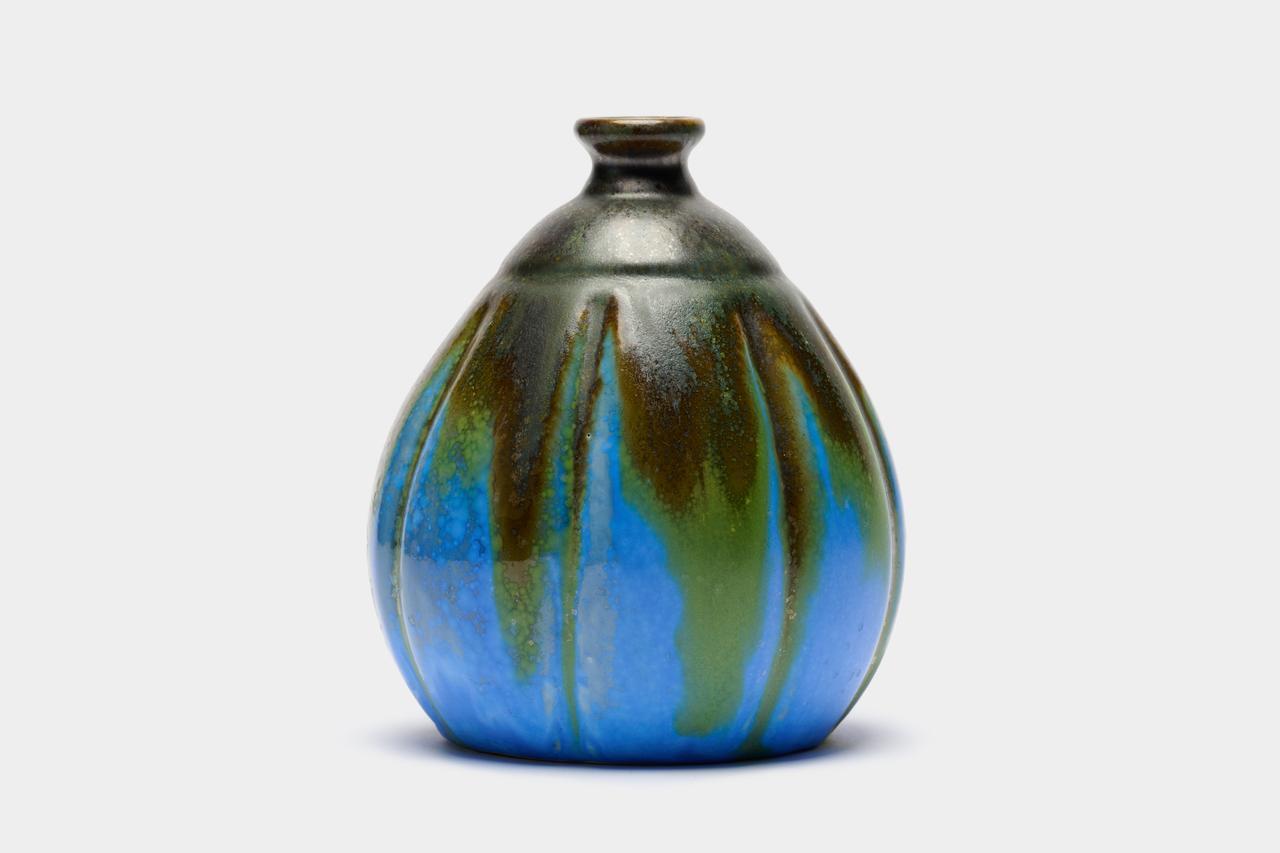
Harrach - Bottle - Uranium glass


03
days
19
hours
23
minutes
43
seconds
Current bid
€ 30
Reserve price not met

Expert
Selected by Florentin Brunz Gaborieau
Holds a master’s in Art History, specialising in Second French Empire and Dutch Golden Age.
Estimate € 150 - € 200
13 other people are watching this object
 Bidder 1859 Bidder 1859 | €30 | |
|---|---|---|
 Bidder 6740 Bidder 6740 | €25 |
Catawiki Buyer Protection
Your payment’s safe with us until you receive your object.View details
Trustpilot 4.4 | 128340 reviews
Rated Excellent on Trustpilot.
Victorian opalescent uranium glass vase by Harrach of Bohemian origin, dating from the late 19th century, with a rounded form, pink hand‑painted enamel decoration, height 8 cm, opening 12 cm and base 6 cm, in excellent condition.
AI-assisted summary
Description from the seller
Victorian opalescent uranium glass art vase, late 19th century, produced in the Bohemian glass workshops of HARRACH.
The vase shown is a piece of opalescent uranium glass art, produced in the Victorian style in the late 19th century. It is a decorative object, possibly a rose bowl, with wavy edges finished in pink and rich decoration, applied by hand, with polychrome enamels depicting flowers, including pansies.
• Material: Opalescent uranium glass, which has a milky hue and a slight iridescence.
• Design: Rounded shape, with a small base and wide, hand-curled edges.
• Decoration: Hand-painted with enamels, a popular technique for artistic glassware of that period.
• Manufacturer: The opalescent uranium glass vase was produced by the Czech manufacturer Harrach.
Impeccable condition
Opening diameter - 12 cm
Base diameter - 6 cm
Height - 8 cm
Uranium was used in glass (known as "uranium glass" or "Vaseline glass") mainly between the 1830s and 1940s, being added in percentages of 1% to 2%
(sometimes up to 25% for intense colors) to the composition of the glass to give it a yellow-green, fluorescent hue, visible under ultraviolet light.
• Appearance and color: Under black light (UV), the glass glows brightly in a neon green color.
• History: Its use was popular in the 19th and early 20th centuries. It was restricted during World War II due to the use of uranium in nuclear projects.
• Use: It was used for decorative objects, tableware, vases, jewelry, and table glassware.
• Radioactivity: Uranium glass is generally weakly radioactive, but is considered safe for occasional or occasional exposure, but it is recommended to avoid using it for acidic foods/beverages, as the uranium may leach out over time.
• Identification: The easiest way to identify it is to use a UV flashlight, which will make the glass glow.
Trimiteți feedback
By the end of the 19th century, the glassworks employed around 400 people, and in 1895 a large grinding workshop was established, with electric lighting and electricity from water turbines, now a national technical monument.
In the early 20th century, the glassworks pioneered Art Nouveau. Under the leadership of Bohdan Kadlec and Jan Malina and with artists such as Josef Petříček and Julius Jelínek, the glassworks collaborated with notable figures including Alfons Mucha and Jan Kotěra. Floral motifs inspired by French florists and LC Tiffany were developed.
The product will be properly packaged so that it reaches you in perfect condition.
Victorian opalescent uranium glass art vase, late 19th century, produced in the Bohemian glass workshops of HARRACH.
The vase shown is a piece of opalescent uranium glass art, produced in the Victorian style in the late 19th century. It is a decorative object, possibly a rose bowl, with wavy edges finished in pink and rich decoration, applied by hand, with polychrome enamels depicting flowers, including pansies.
• Material: Opalescent uranium glass, which has a milky hue and a slight iridescence.
• Design: Rounded shape, with a small base and wide, hand-curled edges.
• Decoration: Hand-painted with enamels, a popular technique for artistic glassware of that period.
• Manufacturer: The opalescent uranium glass vase was produced by the Czech manufacturer Harrach.
Impeccable condition
Opening diameter - 12 cm
Base diameter - 6 cm
Height - 8 cm
Uranium was used in glass (known as "uranium glass" or "Vaseline glass") mainly between the 1830s and 1940s, being added in percentages of 1% to 2%
(sometimes up to 25% for intense colors) to the composition of the glass to give it a yellow-green, fluorescent hue, visible under ultraviolet light.
• Appearance and color: Under black light (UV), the glass glows brightly in a neon green color.
• History: Its use was popular in the 19th and early 20th centuries. It was restricted during World War II due to the use of uranium in nuclear projects.
• Use: It was used for decorative objects, tableware, vases, jewelry, and table glassware.
• Radioactivity: Uranium glass is generally weakly radioactive, but is considered safe for occasional or occasional exposure, but it is recommended to avoid using it for acidic foods/beverages, as the uranium may leach out over time.
• Identification: The easiest way to identify it is to use a UV flashlight, which will make the glass glow.
Trimiteți feedback
By the end of the 19th century, the glassworks employed around 400 people, and in 1895 a large grinding workshop was established, with electric lighting and electricity from water turbines, now a national technical monument.
In the early 20th century, the glassworks pioneered Art Nouveau. Under the leadership of Bohdan Kadlec and Jan Malina and with artists such as Josef Petříček and Julius Jelínek, the glassworks collaborated with notable figures including Alfons Mucha and Jan Kotěra. Floral motifs inspired by French florists and LC Tiffany were developed.
The product will be properly packaged so that it reaches you in perfect condition.
Details
Era
1400-1900
Weight
275 g
Glass type
Uranium glass
Specific region of origin
Harrachov
No. of items
1
Country of Origin
Czechia
Manufacturer/brand
Harrach
Material
Glass
Condition
Excellent condition: barely used with minimal signs of wear
Height
8 cm
Width
12 cm
Depth
12 cm
Estimated period
1850-1900
Sold by