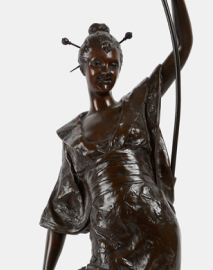
E. Riccardi - Statue, Busto ritratto (Beethoven?) - 50 cm - Bronze


05
days
04
hours
04
minutes
33
seconds
Starting bid
€ 1
Reserve price not met

Expert
Selected by Paul Wullems
He accumulated 18 years' experience, worked as junior specialist at Sotheby’s and managed Kunsthandel Jacques Fijnaut.
Estimate € 1,500 - € 1,800
No bids placed
Catawiki Buyer Protection
Your payment’s safe with us until you receive your object.View details
Trustpilot 4.4 | 128151 reviews
Rated Excellent on Trustpilot.
Description from the seller
Bronze sculpture with its original patina by E. Riccardi. Large dimensions and spectacular details.
The mounting bracket is still present.
It is attributed with probability to Eleuterio Riccardi, a well-known sculptor who produced bronze works of such importance. The bronze, according to early analyses, presumably portrays Ludwig van Beethoven or another important illustrious figure.
attrib. to ELEUTERIO RICCARDI
Col Felice 1884 - Rome 1963;
sculptor and painter
Trained in Rome, in the circle of Giovanni Prini, there he learned the craft of sculptor, exhibiting publicly for the first time as early as 1905, in the late Symbolist era. Discontent, restless, also attracted to painting, he travels north in a journey started in 1912 that leads him as far as Berlin, where, in 1914, he sees a memorable show by Vincent van Gogh. The works produced between 1914 and 1918 originate from the attempt to unite Van Gogh and futurism, while preserving a robustness of form that remains rooted in the Italian tradition.
In the exhibitions of the Roman Secession, Riccardi appears in 1915 in a mixed room of divisionists and experimenters of Fauvism; in the 1916 edition with seven works, some of which enter the Olga and Angelo Signorelli collection. With a nucleus of drawings "futurist" he is present at the National Exhibition of Bianco e Nero (Palazzo delle Esposizioni, Rome 1917). In 1918 (May-June) he organizes, with Mario Recchi in the Roman style, the Galleria dell’Epoca, the Mostra d'Arte Indipendente, an important collective exhibition, in which he exhibits seven paintings and six sculptures.
From 1921 to 1925 he is absent from Italy because he moved to London, where he becomes the preferred portraitist of politicians, collectors, and nobles. Exhibitions follow at the Royal Academy, at the Leicester Gallery, and at the Goupil Gallery. He executes two monuments to the Honorable Montagu for Bombay and Calcutta. A friend of poets and musicians, he paints the portrait of Maestro Alfredo Casella, models the portraits of Poet Nicola Moscardelli, Bruno Barilli, Ferruccio Scattola, carves in wood the portrait of Corrado Alvaro. In 1931, at the First Roman Quadriennale he exhibits the marble Portrait of Mrs. Dettori and the plaster The Mother of the Hero. At the III Roman Syndical Exhibition (1932) he presents himself as painter and sculptor. At the II Roman Quadriennale (1935) he is present with Attesa and Fanciulla, two monumental works in marble and stone. In 1940 he holds a solo show in Milan. Painting still attracts him more in the years around the Second World War. In 1960 at the Rome Quadriennale he exhibits an abstract green ceramic bas-relief.
Bronze sculpture with its original patina by E. Riccardi. Large dimensions and spectacular details.
The mounting bracket is still present.
It is attributed with probability to Eleuterio Riccardi, a well-known sculptor who produced bronze works of such importance. The bronze, according to early analyses, presumably portrays Ludwig van Beethoven or another important illustrious figure.
attrib. to ELEUTERIO RICCARDI
Col Felice 1884 - Rome 1963;
sculptor and painter
Trained in Rome, in the circle of Giovanni Prini, there he learned the craft of sculptor, exhibiting publicly for the first time as early as 1905, in the late Symbolist era. Discontent, restless, also attracted to painting, he travels north in a journey started in 1912 that leads him as far as Berlin, where, in 1914, he sees a memorable show by Vincent van Gogh. The works produced between 1914 and 1918 originate from the attempt to unite Van Gogh and futurism, while preserving a robustness of form that remains rooted in the Italian tradition.
In the exhibitions of the Roman Secession, Riccardi appears in 1915 in a mixed room of divisionists and experimenters of Fauvism; in the 1916 edition with seven works, some of which enter the Olga and Angelo Signorelli collection. With a nucleus of drawings "futurist" he is present at the National Exhibition of Bianco e Nero (Palazzo delle Esposizioni, Rome 1917). In 1918 (May-June) he organizes, with Mario Recchi in the Roman style, the Galleria dell’Epoca, the Mostra d'Arte Indipendente, an important collective exhibition, in which he exhibits seven paintings and six sculptures.
From 1921 to 1925 he is absent from Italy because he moved to London, where he becomes the preferred portraitist of politicians, collectors, and nobles. Exhibitions follow at the Royal Academy, at the Leicester Gallery, and at the Goupil Gallery. He executes two monuments to the Honorable Montagu for Bombay and Calcutta. A friend of poets and musicians, he paints the portrait of Maestro Alfredo Casella, models the portraits of Poet Nicola Moscardelli, Bruno Barilli, Ferruccio Scattola, carves in wood the portrait of Corrado Alvaro. In 1931, at the First Roman Quadriennale he exhibits the marble Portrait of Mrs. Dettori and the plaster The Mother of the Hero. At the III Roman Syndical Exhibition (1932) he presents himself as painter and sculptor. At the II Roman Quadriennale (1935) he is present with Attesa and Fanciulla, two monumental works in marble and stone. In 1940 he holds a solo show in Milan. Painting still attracts him more in the years around the Second World War. In 1960 at the Rome Quadriennale he exhibits an abstract green ceramic bas-relief.
Details
Era
1900-2000
Country of Origin
Italy
Material
Bronze
Artist
E. Riccardi
Title of artwork
Busto ritratto (Beethoven?)
Signature
Signed
Colour
Bronze
Condition
Good condition
Height
50 cm
Width
35 cm
Depth
35 cm
Weight
18 kg
Sold by