Plinio - Naturalis Historiae - 1530



10
days
10
hours
38
minutes
01
second
Current bid
€ 250
Reserve price not met

Expert
Selected by Ilaria Colombo
Specialist in old books, specialising in theological disputes since 1999.
Estimate € 700 - € 2,500
27 other people are watching this object
 Bidder 8689 Bidder 8689 | €250 | |
|---|---|---|
 Bidder 3533 Bidder 3533 | €3 | |
 Bidder 7465 Bidder 7465 | €2 | |
Catawiki Buyer Protection
Your payment’s safe with us until you receive your object.View details
Trustpilot 4.4 | 128965 reviews
Rated Excellent on Trustpilot.
Naturalis Historiae by Gaio Plinio Secondo, Paris 1530 edition in Latin, illustrated with refined typography, bound in modern leather with original boards partly preserved and 754 pages.
AI-assisted summary
Description from the seller
THE SECRET NATURE OF PLINY: SCIENCE, POWER, AND MYSTERY AT THE FRENCH COURT
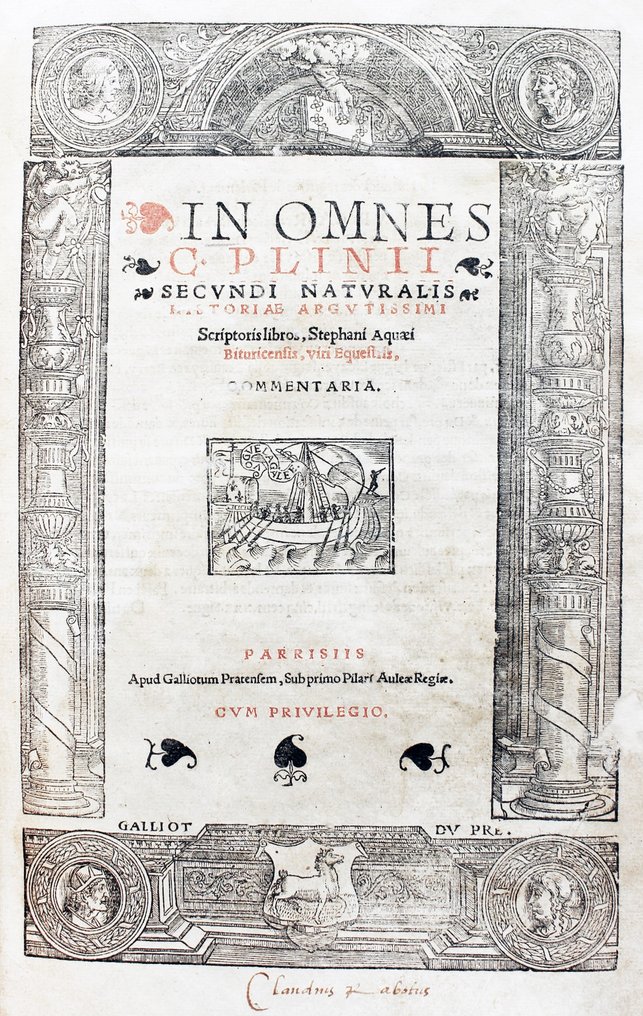
Rare Parisian edition of 1530 of Pliny the Elder’s Naturalis Historia, enriched by the commentary of Stéphane de Laqué, a philosopher and humanist from Bourges, in a specimen of exceptional interest for its provenance from royal counselor Claude Rabot, an enigmatic figure tied to magical-hermetic circles and a Padua student in 1534, where he was accused of possessing prohibited books. The work testifies to the tension between naturalistic knowledge and alchemical research in Renaissance France, within a context of extraordinary editorial and intellectual revival.
MARKET VALUE
Copies of this edition rarely appear on the market. Complete and well-preserved specimens have reached, in recent years, valuations between €4,000 and €6,000, with higher peaks (over €7,000) for copies with illustrious provenances or in intact contemporary bindings. Editions with a rubricated title-page and an intact woodcut frame, as in the present specimen, are particularly appreciated by collectors of Pliny and of French humanistic typography.
PHYSICAL DESCRIPTION AND CONDITION
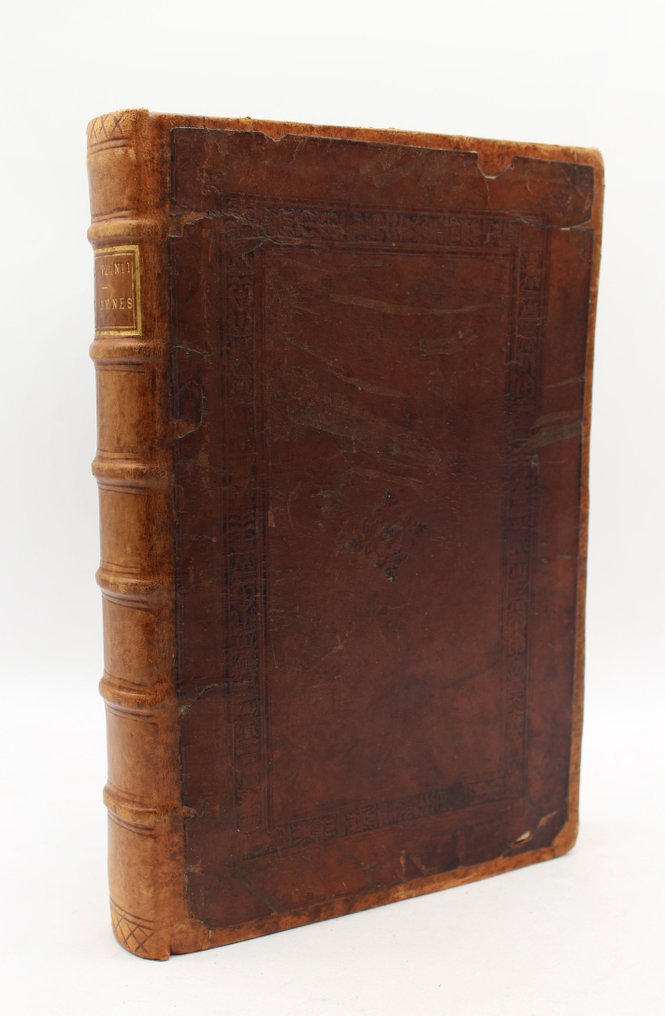
Modern leather binding preserving part of the original boards, six raised bands on the spine with gilt titles on a label, blind tooling and red edges. Title page printed in red and black within an elaborate woodcut border with architectural motifs and classical busts; catchwords, initials, and woodcut printer’s marks. Title page washed and restored with minor losses; restorations and losses to the first and last leaves; binding thread attached to the guard; some waterstains and signs of humidity; small beetle holes, foxing, and light marginal staining. Claudius Rabotus (ownership note on title page and colophon); contemporary marginal notes, some cropped. Pages (2); 32 leaves; 718; 2 leaves;
FULL TITLE AND AUTHOR
Naturalis historiae.
Parrisiis, Apud Galliotum Pratensem, 1530.
Gaius Plinius Secundus.
CONTEXT AND SIGNIFICANCE
This edition represents one of the earliest and most influential Renaissance interpretations of Pliny the Elder’s Naturalis Historia. Stéphane de Laqué (or Stephanus Aqueus) accompanies the text with a apparatus of comments that attempts to reconcile the ancient naturalist heritage with the new empirical and experimental curiosity of the 16th century. The graphical setup, of refined elegance, belongs to the Parisian printing tradition of Galliot du Pré, one of the major Paris printers of the early sixteenth century, known for architectural title pages and for collaboration with humanist printers such as Pierre Vidoue.
The specimen belonging to Claude Rabot, royal counselor and scholar linked to the Padua milieu, suggests an “hermetic” reading of Pliny’s text, perceived in the Renaissance as a source of natural and occult wisdom. The connections with his brother Guillaume Rabot, translator of alchemical texts and promoter of Roger Bacon’s Miroir d’alchimie, enhance the historical and symbolic interest of this copy, in which Naturalis Historia appears as a universal compendium of natural sciences, arts, and the mysteries of the cosmos.
BIOGRAPHY OF THE AUTHOR
Gaius Plinius Secundus, called the Elder (Como, 23 CE – Stabiae, 79 CE), was a Roman military man, naturalist and writer. His encyclopedic work Naturalis Historia is one of the broadest syntheses of ancient knowledge, covering astronomy, zoology, botany, mineralogy, medicine, and the arts. He died during the eruption of Vesuvius in 79 CE while attempting to observe the phenomenon up close. His legacy influenced medieval and Renaissance science, serving as a bridge between empirical curiosity and philosophical speculation.
PRINTING HISTORY AND CIRCULATION
Printed in Paris in 1530, this edition represents one of the most important achievements of the workshop of Galliot du Pré, the king’s favored bookseller-editor, who used Pierre Vidoue’s presses. The collaboration with Poncet le Preux, known for disseminating humanist and scholastic texts, marks the maturity of Parisian typography in the early sixteenth century. Copies of this edition were primarily intended for French university and scholarly circles, but were also exported to Italy and the Netherlands. The two-color composition and the page’s harmonic structure, with wide margins and figurated initials, make it a typical example of pre-Aldine French editorial elegance.
BIBLIOGRAPHY AND REFERENCES
Adams P1530. — Renouard, Imprimeurs et libraires parisiens du XVIe siècle, I, p. 324. — Brunet IV, 707. — Graesse V, 339. — Baudrier, Bibliographie lyonnaise, IX, p. 73. — Mortimer, French Sixteenth Century Books, 444. — USTC 146273.
Seller's Story
As a Top Seller on Catawiki, Box Privé presents a curated selection of distinctive objects chosen for their quality, authenticity, and refined character.
Our lots span multiple categories and are selected with careful attention to craftsmanship, condition, and provenance.
Each item is thoroughly reviewed and described with accuracy and transparency.
We aim to offer objects of lasting interest and strong collectible appeal.
Translated by Google TranslateTHE SECRET NATURE OF PLINY: SCIENCE, POWER, AND MYSTERY AT THE FRENCH COURT
Rare Parisian edition of 1530 of Pliny the Elder’s Naturalis Historia, enriched by the commentary of Stéphane de Laqué, a philosopher and humanist from Bourges, in a specimen of exceptional interest for its provenance from royal counselor Claude Rabot, an enigmatic figure tied to magical-hermetic circles and a Padua student in 1534, where he was accused of possessing prohibited books. The work testifies to the tension between naturalistic knowledge and alchemical research in Renaissance France, within a context of extraordinary editorial and intellectual revival.
MARKET VALUE
Copies of this edition rarely appear on the market. Complete and well-preserved specimens have reached, in recent years, valuations between €4,000 and €6,000, with higher peaks (over €7,000) for copies with illustrious provenances or in intact contemporary bindings. Editions with a rubricated title-page and an intact woodcut frame, as in the present specimen, are particularly appreciated by collectors of Pliny and of French humanistic typography.
PHYSICAL DESCRIPTION AND CONDITION
Modern leather binding preserving part of the original boards, six raised bands on the spine with gilt titles on a label, blind tooling and red edges. Title page printed in red and black within an elaborate woodcut border with architectural motifs and classical busts; catchwords, initials, and woodcut printer’s marks. Title page washed and restored with minor losses; restorations and losses to the first and last leaves; binding thread attached to the guard; some waterstains and signs of humidity; small beetle holes, foxing, and light marginal staining. Claudius Rabotus (ownership note on title page and colophon); contemporary marginal notes, some cropped. Pages (2); 32 leaves; 718; 2 leaves;
FULL TITLE AND AUTHOR
Naturalis historiae.
Parrisiis, Apud Galliotum Pratensem, 1530.
Gaius Plinius Secundus.
CONTEXT AND SIGNIFICANCE
This edition represents one of the earliest and most influential Renaissance interpretations of Pliny the Elder’s Naturalis Historia. Stéphane de Laqué (or Stephanus Aqueus) accompanies the text with a apparatus of comments that attempts to reconcile the ancient naturalist heritage with the new empirical and experimental curiosity of the 16th century. The graphical setup, of refined elegance, belongs to the Parisian printing tradition of Galliot du Pré, one of the major Paris printers of the early sixteenth century, known for architectural title pages and for collaboration with humanist printers such as Pierre Vidoue.
The specimen belonging to Claude Rabot, royal counselor and scholar linked to the Padua milieu, suggests an “hermetic” reading of Pliny’s text, perceived in the Renaissance as a source of natural and occult wisdom. The connections with his brother Guillaume Rabot, translator of alchemical texts and promoter of Roger Bacon’s Miroir d’alchimie, enhance the historical and symbolic interest of this copy, in which Naturalis Historia appears as a universal compendium of natural sciences, arts, and the mysteries of the cosmos.
BIOGRAPHY OF THE AUTHOR
Gaius Plinius Secundus, called the Elder (Como, 23 CE – Stabiae, 79 CE), was a Roman military man, naturalist and writer. His encyclopedic work Naturalis Historia is one of the broadest syntheses of ancient knowledge, covering astronomy, zoology, botany, mineralogy, medicine, and the arts. He died during the eruption of Vesuvius in 79 CE while attempting to observe the phenomenon up close. His legacy influenced medieval and Renaissance science, serving as a bridge between empirical curiosity and philosophical speculation.
PRINTING HISTORY AND CIRCULATION
Printed in Paris in 1530, this edition represents one of the most important achievements of the workshop of Galliot du Pré, the king’s favored bookseller-editor, who used Pierre Vidoue’s presses. The collaboration with Poncet le Preux, known for disseminating humanist and scholastic texts, marks the maturity of Parisian typography in the early sixteenth century. Copies of this edition were primarily intended for French university and scholarly circles, but were also exported to Italy and the Netherlands. The two-color composition and the page’s harmonic structure, with wide margins and figurated initials, make it a typical example of pre-Aldine French editorial elegance.
BIBLIOGRAPHY AND REFERENCES
Adams P1530. — Renouard, Imprimeurs et libraires parisiens du XVIe siècle, I, p. 324. — Brunet IV, 707. — Graesse V, 339. — Baudrier, Bibliographie lyonnaise, IX, p. 73. — Mortimer, French Sixteenth Century Books, 444. — USTC 146273.
Seller's Story
As a Top Seller on Catawiki, Box Privé presents a curated selection of distinctive objects chosen for their quality, authenticity, and refined character.
Our lots span multiple categories and are selected with careful attention to craftsmanship, condition, and provenance.
Each item is thoroughly reviewed and described with accuracy and transparency.
We aim to offer objects of lasting interest and strong collectible appeal.
Translated by Google TranslateDetails
Number of books
1
Subject
Esotericism
Book title
Naturalis Historiae
Author/ Illustrator
Plinio
Condition
Good
Publication year oldest item
1530
Height
332 mm
Edition
1st Edition Thus, Illustrated Edition
Width
222 mm
Language
Latin
Original language
Yes
Publisher
Parrisiis, Apud Galliotum Pratensem, 1530
Binding/ Material
Leather
Number of pages
754
Sold by
