Ovidio - Metamorphoseon - 1670




09
days
21
hours
42
minutes
58
seconds
Current bid
€ 230
Reserve price met

Expert
Selected by Ilaria Colombo
Specialist in old books, specialising in theological disputes since 1999.
Estimate € 250 - € 1,000
20 other people are watching this object
 Bidder 5447 Bidder 5447 | €230 | |
|---|---|---|
 Bidder 4197 Bidder 4197 | €210 | |
| Bidder 4197 | €105 |
Catawiki Buyer Protection
Your payment’s safe with us until you receive your object.View details
Trustpilot 4.4 | 129059 reviews
Rated Excellent on Trustpilot.
Metamorphoseon by Publius Ovidius Naso, a Latin illustrated edition of 1670 printed in Lugduni Batavorum by Ex Officina Hackiana, bound in parchment with full-page plates.
AI-assisted summary
Description from the seller
THE GREAT WESTERN BOOK OF CHANGES: THE UNIVERSE ACCORDING TO THE MOST IRONIC OF POETS
A edition of extraordinary refinement, this splendid tome of Publio Ovidio Nasone’s Opera Omnia, printed at Lugduni Batavorum in 1670 by Hackiana’s workshop, gathers the fifteen books of the Metamorphoses in a guise that transforms mythological poetry into allegorical vision. The full-page copper engravings illustrate the poem’s most famous passages, restoring the symbolic force of metamorphosis as a cosmic principle: the universe in perpetual change, matter becoming image, the word becoming form. The Hackiana edition, one of the most refined of the Dutch Seventeenth Century, consecrates Ovid as a poet of light and eternal transformation.
MARKET VALUE
Hackiana editions of Ovid’s Opera Omnia, particularly the volume dedicated to the Metamorphoses, are among the most valued by scholars and collectors of illustrated classical texts. Complete copies, in contemporaneous parchment bindings, today command in the antiquarian market between 1,200 and 2,000 euros, with higher figures for copies in excellent condition with sharp plates and full margins. This copy, complete, fresh, and with inked plates precisely, falls into the high end of value.
PHYSICAL DESCRIPTION AND CONDITION - COLLECTOR'S COPY
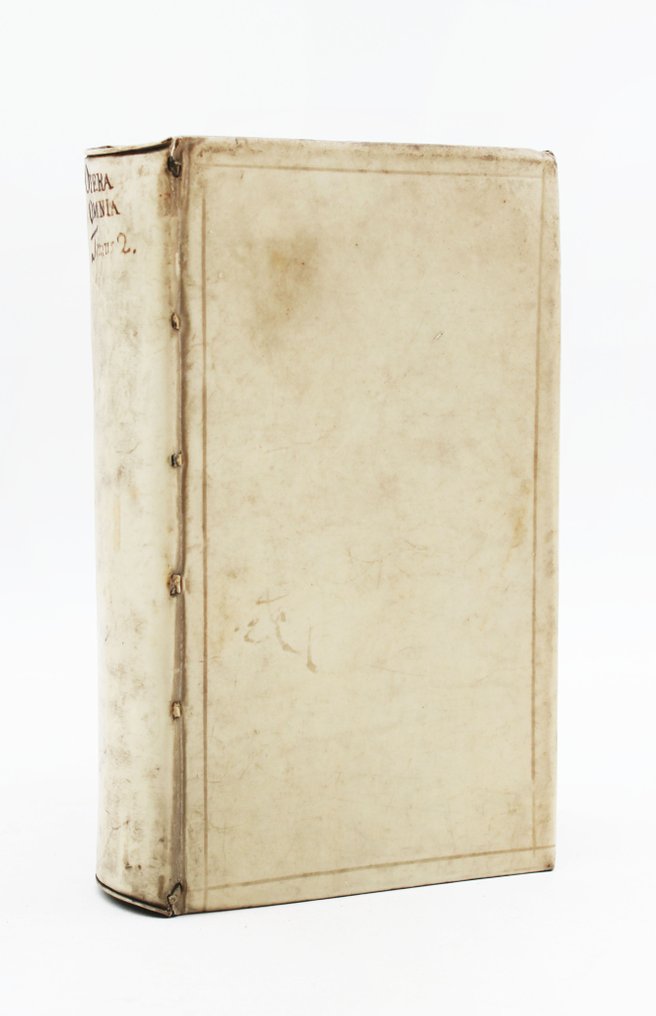
Contemporary full parchment stiff binding with handwritten title on the spine: Opera Omnia. Typographic title page in elegant Roman type, numerous full-page plates depicting mythological episodes drawn from the Metamorphoses. Normal signs of use, some marginal reddening. Pp. (2); 806; 10nn; (4).
In old books, with a long history, a few imperfections may be present, not always noted in the description.
FULL TITLE AND AUTHOR
Metamorphoseon.
Lugd., Ex Officina Hackiana, 1670.
Pub. Ovidii Nasonis.
CONTEXT AND SIGNIFICANCE
The Hackiana workshop, among the most prestigious of the Dutch Seventeenth Century, continued Elzevier’s tradition in printing Latin classics, offering philologically accurate texts enriched with baroque-style engravings. This edition of the Metamorphoses stands out for the balance between typographic elegance and iconographic splendor. The plates, of Dutch school, are not mere illustrations but true figurative dramas: they translate into image the exact moment of transformation, the threshold between human and divine, matter and spirit.
Ovid’s poem, in this guise, becomes a manual of poetic alchemy, a journey through the grades of change that unites the universe and reveals the continuity of all forms.
BIOGRAPHY OF THE AUTHOR
Publio Ovidio Nasone (Sulmona, 43 B.C. – Tomi, 17 A.D.), a Latin poet of extraordinary refinement, was the author of the Metamorphoses, the Amores, the Heroides, the Ars Amatoria, and the Tristia. His poetry, elegant and learned, blends myth and introspection, eroticism and philosophy of fate. Exiled by Augustus for reasons not fully clarified, he transformed his personal experience into an art of memory and desire. The Metamorphoses, written in dactylic hexameter, represent the summa of his thought: reality as a flow of forms, life as perpetual transfiguration.
PRINTING HISTORY AND CIRCULATION
The 1670 Hackiana edition fits into the great Dutch tradition of Latin classics, inaugurated by the Elzeviers and continued with philological rigor by Hackius. The Metamorphoses are highly appreciated for the richness of the illustrative apparatus and for the elegance of the typeface. The edition was distributed throughout Europe, often included in aristocratic and academic libraries of the North, and became a model for reissues in Leiden and The Hague in the early eighteenth century.
BIBLIOGRAPHY AND REFERENCES
Brunet IV, 237; Graesse V, 108; Schweiger, Handbuch der klassischen Bibliographie, II, 666; Willems, Les Elzevier, p. 486 (note on the Hackiana workshop); Moss, Manual of Classical Bibliography, II, p. 417; Gaskell, Dutch Printing and Bookmaking, 1968; BnF Rés. P-Y 3945; Ovid, Opera Omnia, Hackiana 1670, WorldCat OCLC 45834592.
Seller's Story
As a Top Seller on Catawiki, Box Privé presents a curated selection of distinctive objects chosen for their quality, authenticity, and refined character.
Our lots span multiple categories and are selected with careful attention to craftsmanship, condition, and provenance.
Each item is thoroughly reviewed and described with accuracy and transparency.
We aim to offer objects of lasting interest and strong collectible appeal.
Translated by Google TranslateTHE GREAT WESTERN BOOK OF CHANGES: THE UNIVERSE ACCORDING TO THE MOST IRONIC OF POETS
A edition of extraordinary refinement, this splendid tome of Publio Ovidio Nasone’s Opera Omnia, printed at Lugduni Batavorum in 1670 by Hackiana’s workshop, gathers the fifteen books of the Metamorphoses in a guise that transforms mythological poetry into allegorical vision. The full-page copper engravings illustrate the poem’s most famous passages, restoring the symbolic force of metamorphosis as a cosmic principle: the universe in perpetual change, matter becoming image, the word becoming form. The Hackiana edition, one of the most refined of the Dutch Seventeenth Century, consecrates Ovid as a poet of light and eternal transformation.
MARKET VALUE
Hackiana editions of Ovid’s Opera Omnia, particularly the volume dedicated to the Metamorphoses, are among the most valued by scholars and collectors of illustrated classical texts. Complete copies, in contemporaneous parchment bindings, today command in the antiquarian market between 1,200 and 2,000 euros, with higher figures for copies in excellent condition with sharp plates and full margins. This copy, complete, fresh, and with inked plates precisely, falls into the high end of value.
PHYSICAL DESCRIPTION AND CONDITION - COLLECTOR'S COPY
Contemporary full parchment stiff binding with handwritten title on the spine: Opera Omnia. Typographic title page in elegant Roman type, numerous full-page plates depicting mythological episodes drawn from the Metamorphoses. Normal signs of use, some marginal reddening. Pp. (2); 806; 10nn; (4).
In old books, with a long history, a few imperfections may be present, not always noted in the description.
FULL TITLE AND AUTHOR
Metamorphoseon.
Lugd., Ex Officina Hackiana, 1670.
Pub. Ovidii Nasonis.
CONTEXT AND SIGNIFICANCE
The Hackiana workshop, among the most prestigious of the Dutch Seventeenth Century, continued Elzevier’s tradition in printing Latin classics, offering philologically accurate texts enriched with baroque-style engravings. This edition of the Metamorphoses stands out for the balance between typographic elegance and iconographic splendor. The plates, of Dutch school, are not mere illustrations but true figurative dramas: they translate into image the exact moment of transformation, the threshold between human and divine, matter and spirit.
Ovid’s poem, in this guise, becomes a manual of poetic alchemy, a journey through the grades of change that unites the universe and reveals the continuity of all forms.
BIOGRAPHY OF THE AUTHOR
Publio Ovidio Nasone (Sulmona, 43 B.C. – Tomi, 17 A.D.), a Latin poet of extraordinary refinement, was the author of the Metamorphoses, the Amores, the Heroides, the Ars Amatoria, and the Tristia. His poetry, elegant and learned, blends myth and introspection, eroticism and philosophy of fate. Exiled by Augustus for reasons not fully clarified, he transformed his personal experience into an art of memory and desire. The Metamorphoses, written in dactylic hexameter, represent the summa of his thought: reality as a flow of forms, life as perpetual transfiguration.
PRINTING HISTORY AND CIRCULATION
The 1670 Hackiana edition fits into the great Dutch tradition of Latin classics, inaugurated by the Elzeviers and continued with philological rigor by Hackius. The Metamorphoses are highly appreciated for the richness of the illustrative apparatus and for the elegance of the typeface. The edition was distributed throughout Europe, often included in aristocratic and academic libraries of the North, and became a model for reissues in Leiden and The Hague in the early eighteenth century.
BIBLIOGRAPHY AND REFERENCES
Brunet IV, 237; Graesse V, 108; Schweiger, Handbuch der klassischen Bibliographie, II, 666; Willems, Les Elzevier, p. 486 (note on the Hackiana workshop); Moss, Manual of Classical Bibliography, II, p. 417; Gaskell, Dutch Printing and Bookmaking, 1968; BnF Rés. P-Y 3945; Ovid, Opera Omnia, Hackiana 1670, WorldCat OCLC 45834592.
Seller's Story
As a Top Seller on Catawiki, Box Privé presents a curated selection of distinctive objects chosen for their quality, authenticity, and refined character.
Our lots span multiple categories and are selected with careful attention to craftsmanship, condition, and provenance.
Each item is thoroughly reviewed and described with accuracy and transparency.
We aim to offer objects of lasting interest and strong collectible appeal.
Translated by Google TranslateDetails
Number of books
1
Subject
Esotericism
Book title
Metamorphoseon
Author/ Illustrator
Ovidio
Condition
Good
Publication year oldest item
1670
Height
206 mm
Edition
1st Edition Thus, Illustrated Edition
Width
122 mm
Language
Latin
Original language
Yes
Publisher
Lugd., Ex Officina Hackiana, 1670
Binding/ Material
Vellum
Extras
Tipped in plates
Number of pages
822
Sold by
