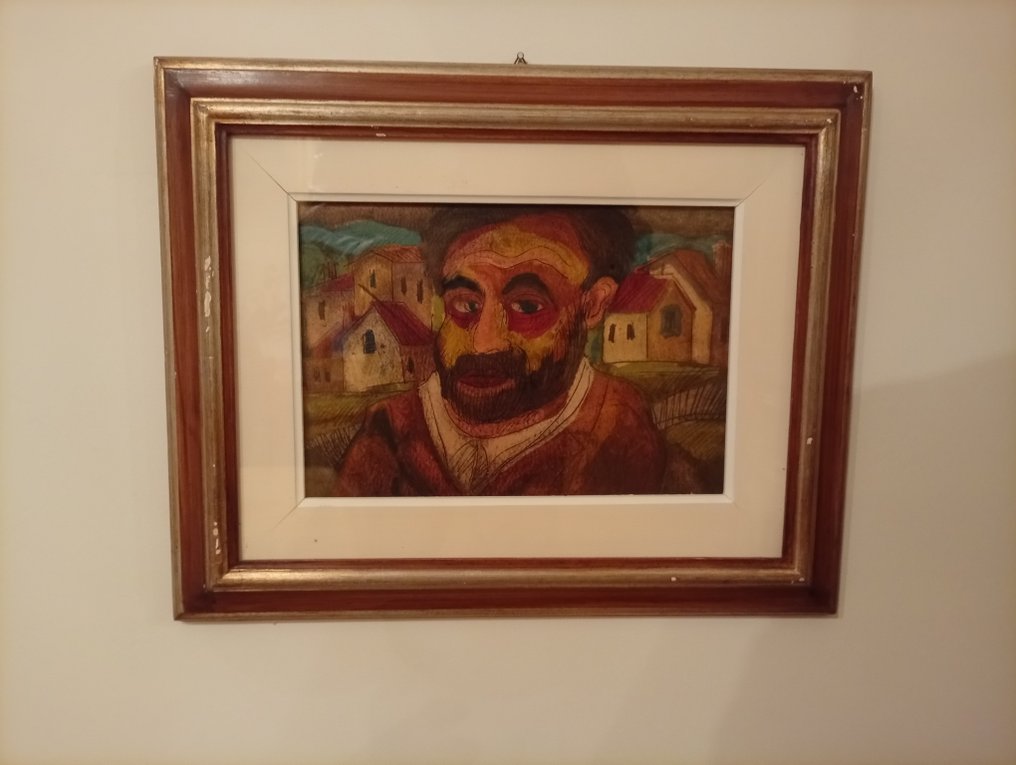
Giuseppe Serafini (1915-1987) - Figura




01
day
20
hours
45
minutes
26
seconds

13 other people are watching this object
 Bidder 9006 Bidder 9006 | €56 | |
|---|---|---|
| Bidder 9110 | €51 | |
| Bidder 9006 | €44 | |
Catawiki Buyer Protection
Your payment’s safe with us until you receive your object.View details
Trustpilot 4.4 | 129382 reviews
Rated Excellent on Trustpilot.
Figura, a mixed‑media portrait by Giuseppe Serafini (1915–1987) in Expressionism, dating from the 1960s, 20 × 30 cm, original edition and unsigned, Italy.
AI-assisted summary
Description from the seller
Giuseppe, also known as Beppe Serafini, was born in the hamlet of Torre in the Municipality of Montelupo Fiorentino on October 20, 1915.
His father Gino was a fisherman on the Arno, his mother Amelia a fiascaia, that is, a maker of wicker wine flasks.
Beppe Serafini pursued the craft of ceramics and, out of passion, painting as well; he has been painting since he was a boy, perhaps driven by despair for his body, which, after a fall from his bicycle while on his way to school, grew disproportionately. From then on he would be known to everyone as Beppegrasso.
The miserable conditions of his family did not allow him to buy paints, so he invented his own painting technique.
He was discovered in 1967 by Antonio Possenti and placed in the naifs (naive art) movement.
The most important event of his artistic activity is undoubtedly the prestigious exhibition at Palazzo Strozzi in Florence in 1976.
Milan, Viareggio, Bologna, Frankfurt, Siena, Nice are just some of the cities that hosted exhibitions of his works.
In Serafini’s paintings, both poverty and the trades he had always practiced in his world are depicted. Oxen and doves, animals in general, men and women, rough hands and wide-open eyes, are permeated by an atmosphere that expresses the author’s entire gentleness. This one put up for auction is one of the first paintings Beppe made; there is the inscription that he himself wrote on the back of the painting which says that he presents himself with the street and place where he practiced, namely Montelupo Fiorentino, where he indicated his studio at Via Tussmori 6, a unique piece painted on cardboard with an engraving.
Giuseppe, also known as Beppe Serafini, was born in the hamlet of Torre in the Municipality of Montelupo Fiorentino on October 20, 1915.
His father Gino was a fisherman on the Arno, his mother Amelia a fiascaia, that is, a maker of wicker wine flasks.
Beppe Serafini pursued the craft of ceramics and, out of passion, painting as well; he has been painting since he was a boy, perhaps driven by despair for his body, which, after a fall from his bicycle while on his way to school, grew disproportionately. From then on he would be known to everyone as Beppegrasso.
The miserable conditions of his family did not allow him to buy paints, so he invented his own painting technique.
He was discovered in 1967 by Antonio Possenti and placed in the naifs (naive art) movement.
The most important event of his artistic activity is undoubtedly the prestigious exhibition at Palazzo Strozzi in Florence in 1976.
Milan, Viareggio, Bologna, Frankfurt, Siena, Nice are just some of the cities that hosted exhibitions of his works.
In Serafini’s paintings, both poverty and the trades he had always practiced in his world are depicted. Oxen and doves, animals in general, men and women, rough hands and wide-open eyes, are permeated by an atmosphere that expresses the author’s entire gentleness. This one put up for auction is one of the first paintings Beppe made; there is the inscription that he himself wrote on the back of the painting which says that he presents himself with the street and place where he practiced, namely Montelupo Fiorentino, where he indicated his studio at Via Tussmori 6, a unique piece painted on cardboard with an engraving.
Details
Artist
Giuseppe Serafini (1915-1987)
Sold with frame
No
Sold by
Owner or reseller
Edition
Original
Title of artwork
Figura
Technique
Mixed media
Signature
Not signed
Country of origin
Italy
Condition
Excellent condition
Height
20 cm
Width
30 cm
Depiction/theme
Portrait
Style
Expressionism
Period
1960-1970
Sold by
