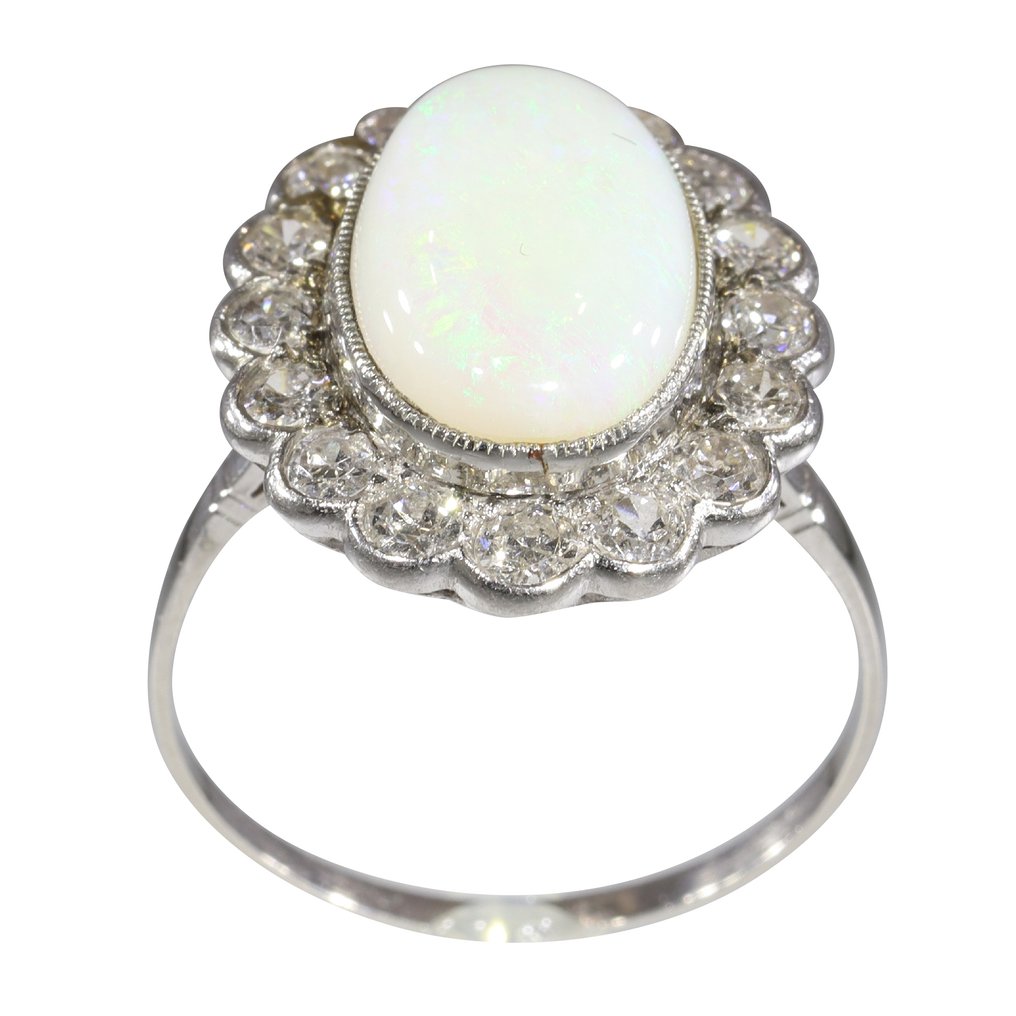
Ring Platinum - 4.10ct. tw. Opal - Diamond - Vintage, 1950


08
days
10
hours
06
minutes
27
seconds
Starting bid
€ 1
Reserve price not met

Expert
Selected by Laura Trevino
She has 15 years' auction experience, specialising in vintage jewellery from 1920 to 2000.
Estimate € 4,600 - € 5,600
No bids placed
Catawiki Buyer Protection
Your payment’s safe with us until you receive your object.View details
Trustpilot 4.4 | 129461 reviews
Rated Excellent on Trustpilot.
Vintage platinum engagement ring from the 1950s featuring a cabochon opal of about 4.10 ct, surrounded by 16 old mine brilliant cut diamonds totaling about 1.12 ct, EU size 60 (US 9), in very good condition with no laboratory report and Belgian origin believed.
AI-assisted summary
Description from the seller
This exquisite vintage engagement ring from the 1950s, crafted in lustrous platinum, showcases a harmonious blend of opulence and elegance. It features a magnificent cabochon opal, weighing approximately 4.10 ct, ensconced amidst 16 old mine brilliant cut diamonds totaling around 1.12 ct. The ring embodies the era's transition towards more personalized and distinctive jewelry designs, combining the timeless allure of diamonds with the enchanting iridescence of opal. This piece is a testament to the romantic spirit of the time, offering a unique and sophisticated expression of love and commitment.
Antique jewelry object group: engagement ring (or anniversary ring)
Condition: excellent condition
- (more info on our condition scale)
Country of origin: Although it does not carry any legible control marks we believe this to be of Belgian origin.
Style: Vintage
- See also: vintage jewelry or more info on styles
Period: ca. 1950
- (events & facts of this era, poetry of this era, fashion of this era)
Material: platinum
- (more info on precious metals)
Extra information: Betrothal rings were used during Roman times, but weren't generally revived in the Western world until the 13th century. The first well-documented use of a diamond ring to signify engagement was by the Archduke Maximilian of Austria in imperial court of Vienna in 1477, upon his betrothal to Mary of Burgundy.
Before the 20th century, other types of betrothal gifts were common. Before the end of the 19th century, the bride-to-be frequently received a sewing thimble rather than a engagement ring. This practice was particularly common among religious groups that shunned jewelry. Engagement rings didn't become standard in the West until the end of the 19th century, and diamond rings didn't become common until the 1930s. Now, 80% of the women are offered a diamond ring to signify engagement. (from: Wikipedia)
Diamond(s): 16 old mine brilliant cut diamonds with an estimated weight of ± 1.12ct. (colour and clarity: H/J, i).
- All diamond weights, color grades and clarity are approximate since the stones were not removed from their mounts to preserve the integrity of the setting.
Precious stones: One cabochon opal with an estimated weight of ± 4.10 ct.
Birthstones: Diamond is the birthstone (or month stone) for April and opal for October.
- (more info on birthstones)
Hallmarks: No trace.
- (more info on hallmarks)
Dimensions: top of ring 1,70 cm (0,67 inch) x 2,20 cm (0,87 inch)
Weight: 5,40 gram (3,47 dwt)
Ring size Continental: 60 & 19¼ , Size US 9¼ , Size UK: S
Reference Nº: 17226-0017
- Accompanied by a professional report of authenticity for your peace of mind.
- Shipped insured and registered for your security, though you're most welcome to collect in person.
- For shipments outside the EU, import duties and other charges may apply. We advise checking this in advance.
- We invite you to browse through our customer feedback to discover the level of satisfaction we consistently provide.
- See more of our products, visit: https://auction.catawiki.com/lotsfrom/Adin
- Antique and vintage jewellery often undergoes thoughtful refurbishment, remodelling, or repairs to enhance its longevity and wearability. Such pieces frequently bear marks of this tender care. Furthermore, we present our antique and vintage jewellery in its authentic state, refraining from removing scratches or applying rhodium plating to white gold items. Our priority is to preserve the genuine allure and history of each piece. However, as the new owner, you have the option to take it to a local goldsmith for a cosmetic refresh, should you choose.
Seller's Story
Adin shares with their collection of vintage and antique jewellery over 4 decades of expertise. On our provider page, you get the experience of exploring our boutique, located in the world diamond center Antwerp. Elkan Wijnberg, Adin’s founder and CEO, is a member of the Belgian Chamber of Experts to the Courts of Justice and of both the British and American Society of Jewellery Historians.
This exquisite vintage engagement ring from the 1950s, crafted in lustrous platinum, showcases a harmonious blend of opulence and elegance. It features a magnificent cabochon opal, weighing approximately 4.10 ct, ensconced amidst 16 old mine brilliant cut diamonds totaling around 1.12 ct. The ring embodies the era's transition towards more personalized and distinctive jewelry designs, combining the timeless allure of diamonds with the enchanting iridescence of opal. This piece is a testament to the romantic spirit of the time, offering a unique and sophisticated expression of love and commitment.
Antique jewelry object group: engagement ring (or anniversary ring)
Condition: excellent condition
- (more info on our condition scale)
Country of origin: Although it does not carry any legible control marks we believe this to be of Belgian origin.
Style: Vintage
- See also: vintage jewelry or more info on styles
Period: ca. 1950
- (events & facts of this era, poetry of this era, fashion of this era)
Material: platinum
- (more info on precious metals)
Extra information: Betrothal rings were used during Roman times, but weren't generally revived in the Western world until the 13th century. The first well-documented use of a diamond ring to signify engagement was by the Archduke Maximilian of Austria in imperial court of Vienna in 1477, upon his betrothal to Mary of Burgundy.
Before the 20th century, other types of betrothal gifts were common. Before the end of the 19th century, the bride-to-be frequently received a sewing thimble rather than a engagement ring. This practice was particularly common among religious groups that shunned jewelry. Engagement rings didn't become standard in the West until the end of the 19th century, and diamond rings didn't become common until the 1930s. Now, 80% of the women are offered a diamond ring to signify engagement. (from: Wikipedia)
Diamond(s): 16 old mine brilliant cut diamonds with an estimated weight of ± 1.12ct. (colour and clarity: H/J, i).
- All diamond weights, color grades and clarity are approximate since the stones were not removed from their mounts to preserve the integrity of the setting.
Precious stones: One cabochon opal with an estimated weight of ± 4.10 ct.
Birthstones: Diamond is the birthstone (or month stone) for April and opal for October.
- (more info on birthstones)
Hallmarks: No trace.
- (more info on hallmarks)
Dimensions: top of ring 1,70 cm (0,67 inch) x 2,20 cm (0,87 inch)
Weight: 5,40 gram (3,47 dwt)
Ring size Continental: 60 & 19¼ , Size US 9¼ , Size UK: S
Reference Nº: 17226-0017
- Accompanied by a professional report of authenticity for your peace of mind.
- Shipped insured and registered for your security, though you're most welcome to collect in person.
- For shipments outside the EU, import duties and other charges may apply. We advise checking this in advance.
- We invite you to browse through our customer feedback to discover the level of satisfaction we consistently provide.
- See more of our products, visit: https://auction.catawiki.com/lotsfrom/Adin
- Antique and vintage jewellery often undergoes thoughtful refurbishment, remodelling, or repairs to enhance its longevity and wearability. Such pieces frequently bear marks of this tender care. Furthermore, we present our antique and vintage jewellery in its authentic state, refraining from removing scratches or applying rhodium plating to white gold items. Our priority is to preserve the genuine allure and history of each piece. However, as the new owner, you have the option to take it to a local goldsmith for a cosmetic refresh, should you choose.
Seller's Story
Adin shares with their collection of vintage and antique jewellery over 4 decades of expertise. On our provider page, you get the experience of exploring our boutique, located in the world diamond center Antwerp. Elkan Wijnberg, Adin’s founder and CEO, is a member of the Belgian Chamber of Experts to the Courts of Justice and of both the British and American Society of Jewellery Historians.
Details
Era
1900-2000
Laboratory report
No laboratory report
No. of main gemstones
1
Total carat weight of all stones
4.10
Free resizing offered
No
Metal
Platinum
Number of diamonds surrounding stones
16
Total carat weight of main stone(s)
4.10
Brand jewellery
No
Main stone
Opal
Total carat weight of surrounding stones
1.12
Total weight
5.4 g
Surrounding stones
Diamond
Condition
Very good condition - slightly used with small signs of wear
Gender
Unisex
Title additional information
Vintage, 1950
Ring size
60 (EU) / 20 (IT) / 9 (US)
Disclaimer
Catawiki always aims to offer you the best possible buying experience. Our experts virtually review and select every object in line with our submission guidelines. While we strive to provide a detailed description and photographs of each jewellery object, discrepancies or inaccuracies may occur. It is your responsibility to review all of the information provided about an object, including the condition and description, before placing an order. Sellers are responsible for the information, pictures and description provided, including the quality, quantity and nature of the jewelry supplied. A small imperfection that cannot be seen in the photo but is included in the description is not a non-conformity. A Lab Report is not a guarantee, valuation or appraisal regarding the articles described therein. A Lab Report contains only the characteristics of an article described after it has been graded, tested, examined, and analyzed using the techniques and equipment used at the time of the examination from that specific Lab. The results of any other examination performed on the article may differ depending when, how, by whom and with which grading standard the article is examined. In addition, any changes and improvements in techniques and equipment that may have occurred which may enable the examiner to detect, among other things, the use of processes for altering the characteristics of an article which use was previously undetectable, does not automatically mean the object does not conform to its description.
Catawiki always aims to offer you the best possible buying experience. Our experts virtually review and select every object in line with our submission guidelines. While we strive to provide a detailed description and photographs of each jewellery object, discrepancies or inaccuracies may occur. It is your responsibility to review all of the information provided about an object, including the condition and description, before placing an order. Sellers are responsible for the information, pictures and description provided, including the quality, quantity and nature of the jewelry supplied. A small imperfection that cannot be seen in the photo but is included in the description is not a non-conformity. A Lab Report is not a guarantee, valuation or appraisal regarding the articles described therein. A Lab Report contains only the characteristics of an article described after it has been graded, tested, examined, and analyzed using the techniques and equipment used at the time of the examination from that specific Lab. The results of any other examination performed on the article may differ depending when, how, by whom and with which grading standard the article is examined. In addition, any changes and improvements in techniques and equipment that may have occurred which may enable the examiner to detect, among other things, the use of processes for altering the characteristics of an article which use was previously undetectable, does not automatically mean the object does not conform to its description.