Germaine Krull - 100 x Paris - 1929


Opens tomorrow
Starting bid
€ 1
Add to your favourites to get an alert when the auction starts.

Catawiki Buyer Protection
Your payment’s safe with us until you receive your object.View details
Trustpilot 4.4 | 129747 reviews
Rated Excellent on Trustpilot.
Description from the seller
GREAT OPPORTUNITY to purchase this FAMOUS PHOTOBOOK TITLE by Germaine Krull from 1929 (!) -
with the VERY SCARCE AND VERY BEAUTIFUL ORIGINAL DUSTJACKET.
- Hans-Michael Koetzle, "Eyes on Paris. Paris im Fotobuch. 1890 bis heute" ("Paris in
Photobooks. 1890 until today"), pages 84-85
- Christian Bouqueret, "Paris. Les Livres de Photographie. Des Années 1920 Aux Années
1950", pages 35-37
Germaine Krull (1897-1985), a German-Dutch photographer, famous through "Metal", lived in Paris since 1926.
WONDERFUL SEPIA PHOTOS IN BREATH-TAKING PHOTOGRAVURE PRINTING.
This is a lot by 5Uhr30.com (Ecki Heuser, Cologne, Germany).
5Uhr30.com guarantees detailed and accurate descriptions, 100% protection,
100% insurance and combined shipping worldwide.
Verlag der Reihe, Berlin-Westend. 1929. First edition, first printing.
Paperback with dustjacket. 172 x 248 mm (each). 528 pages (132 pages each). 100 photos (each) in black and white. Photos: Germaine Krull. Foreword: Florent Fels. Text in French, English, German.
Condition:
Inside excellent, very fresh and absolutely flawless, super clean with no marks and with no foxing; much more better and fresher than usual (often foxed or with marks). Dustjacket with small missing parts (see pictures) and some small tears (professionally, acid-free, taped from behind), still highly impressive, with both beautiful flaps (fresh and complete, see pictures). Overall fine, much better and fresher than usual condition.
Germaine Krull's scarce photobook "100 x Paris" from 1929 - with the very scarce original dustjacket.
"The slim volume was published in May 1929, just two years after ‘Métal’ by the Berlin ‘Verlag der Reihe’. The initiator of this short-lived enterprise was the Viennese-born Oscar Camillo Recht (1894-1959), art dealer, publisher, publicist and, under the name Camille Recht, author of the foreword to the German edition of the ‘Atget’ monograph by Berenice
Abbott's ‘Atget’ monograph.
‘100 x Paris’ was the first of three comparable titles, before “100 x Berlin” (published in May 1929 with photographs by László Willinger) and “100 x Munich” (also published in 1929 with photographs by Ludwig Preiss).
The book was offered both in a hardcover version (blue linen, silver embossed title, photographically illustrated dust jacket) and as a brochure with a much more modern, Art Deco-inspired cover solution, which also - unmistakably - bears the author's name.
The book opens with a foreword by Florent Fels, editor-in-chief of L'Art vivant at the time, followed by detailed captions, these and the introduction in German, French and English respectively, and finally a programmatic number of 100 full-page plates.
On the one hand, the book follows a comparatively conventional path with its brownish copper intaglio print, the illustrations set in the centre and a pictorial aesthetic that at first glance appears less innovative. On the other hand, it is exemplary of the modern ‘type of metropolitan photo book’ that emerged in the 1920s and in opposition to ‘the magnificent photo albums and picture postcard collections still in the tradition of veduta works’.
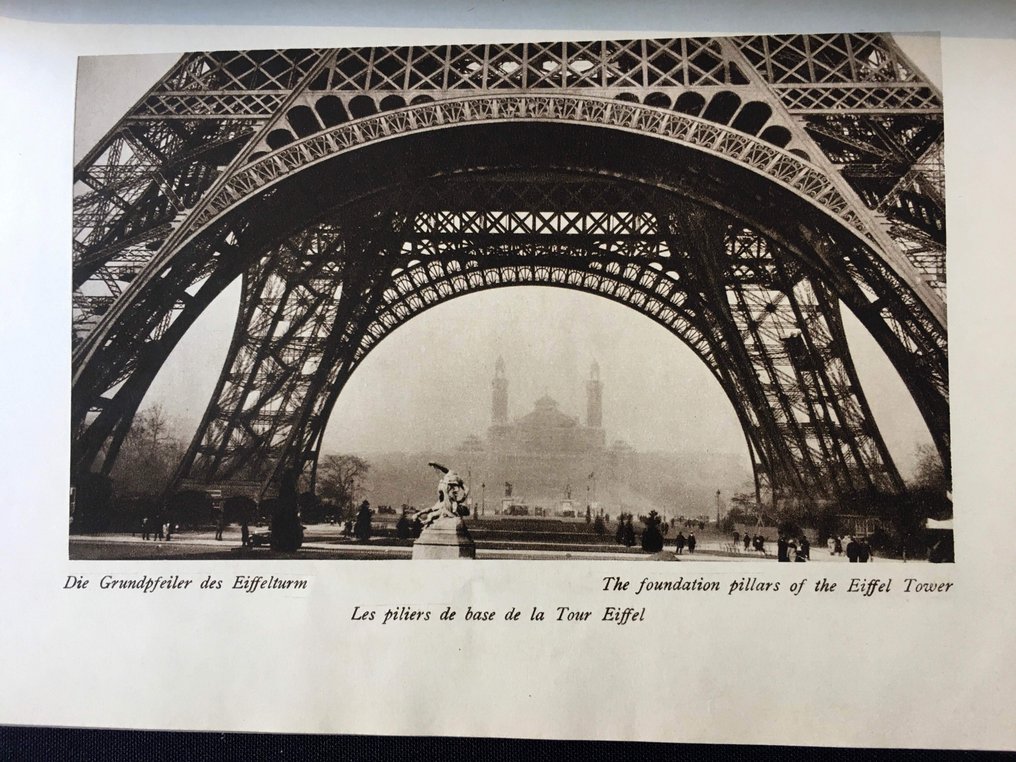
What the book definitely lacks is the formal stringency and aesthetic coherence that characterise ‘Métal’. On the other hand, Krull herself proves to be a distinguished representative of artistic modernism - both in terms of the themes and their realisation. No fewer than 44 panels show automobiles. Traffic, some of it dense, becomes as much a subject of the picture as electric light, the new entertainment medium of cinema appears (in the form of large posters) as does new building in the spirit of a functional ‘International Style’. Krull directs her journalistically trained gaze at both clochards and traditional small businesses, she eavesdrops on modernly dressed walkers in the Bois de Boulogne or guests on the terrace of the Dôme on Montparnasse.
The majority of the images are ‘frontal and static, but some offer surprises’.
For example, in the form of a bold camera pointing from top to bottom, bold image details or surreal pictorial inventions (such as the July column on the Place de la Bastille, which is only recognisable as a shadow). Indeed, Paul Fierens, for example, recognised surreal moments in Krull's book in his review, referring to André Breton, Atget or Cubism and concluding that Krull's lens ‘has an affinity with poetry.’ All in all, Kim Sichel can be agreed with when she says that in
‘100 x Paris’, the structure of the book remains conventional, ’but it adds modern punctuation to the photographs.’
(Hans-Michael Koetzle)
"In the 1920s, Germaine Krull made her mark on the history of photography with her photo reportages. Using oblique perspectives and cropping, she developed her very own visual language. Her reportages symbolise socio-political empathy.
Born on 20 November 1897, she trained at the Munich School of Photography until 1918, documenting everyday life in the big city with her camera, but also developing a sense for the artistic experiments of the avant-garde. Friends with writers, theatre people and filmmakers, the photographer first lived and worked in Berlin, then in Amsterdam and from 1926 onwards in the French metropolis. In 1967, the only surviving audio document was made at the Cinémathèque française on the occasion of an exhibition that André Malraux, the Minister of Culture, personally organised. However, Germaine Krull is not interested in glamour and high honours, she emphasises: "Photography is a profession. A craft.
After completing her apprenticeship in 1918, the photographer initially put her profession on the back burner and became politically active. But the Munich Soviet Republic was bloodily suppressed and Germaine Krull fled to Moscow. Back in Germany, she opened her own studio in Berlin in 1923. But it was only after she moved to Amsterdam with documentary filmmaker Joris Ivens, where she discovered her penchant for technical installations, quay walls, cranes and warehouses, that she made her breakthrough.
Having now arrived in Paris, the photographer presents the portfolio "Métal". The writer Pierre MacOrlan is enthusiastic: "Whether Germaine Krull is transforming a machine landscape into a symphony or playing with the lights of Paris, she reveals secret details."
The photographer emphasises the beauty of ball bearings or transformers with multiple exposures or black and white compositions that are as objective as they are surrealistically alienated. André Kertész, Man Ray and Berenice Abbott, who established the photographic image as a new, independent art form in 1928 with the "First Independent Salon of Photography", worked in a similar way.
Germaine Krull was one of the participants, but found her own way for her profession: "It is neither painting nor fantasy. The photographer is a witness. The witness of his era. The real photographer is the witness of all days, the reporter."
The virtuoso reporter Germaine Krull becomes the mainstay of the magazine "VU". With her subjective photographic eye and a precisely controlled camera, temperament and technique, art and craftsmanship merge. Highlights of this combination of formal, aesthetic creativity with socio-political empathy are reportages such as "The Women Workers of Paris". For the philosopher Walter Benjamin, Germaine Krull thus stands on a par with photographers such as August Sander or Wilhelm Bloßfeldt in her very own way: "The photographers who did not come to photography by chance, not out of convenience from the fine arts, today form the avant-garde among their peers."
As if she had achieved her goal, Germaine Krull said goodbye to photography. After working as a war reporter during the liberation of France, she travelled through Southeast Asia in 1946 and opened a hotel in Bangkok. It was not until 1960 that the now successful businesswoman picked up her camera again to document relics and monuments of Asian cultures.
Germaine Krull, who died in Wetzlar in 1985, leaves a piece of advice for future generations of photographers: "Photography is not a machine. Unfortunately, you are tied to the machine, the camera, the film, the development. But everyone has to feel their image. And then take one or at most two photos. Just clicking, clicking, clicking - that doesn't get you anywhere."
(Deutschlandfunk)
Seller's Story
welcome to 5h30.
5Uhr30 is based in ehrenfeld, the trendiest neighborhood in cologne - with a shop and with a showroom for photography.
5H30 offers very rare, very beautiful, very special photobooks - sold-out, modern-antiquarian and antiquarian. we are also offering photo invitation cards, film and photo posters, photo catalogs and original photo prints.
5Uhr30 is specialized on german photo publications,
but also has an exciting range of photo books from all over europe, japan, north and south america. travel brochures, children's books, company brochures...everything that has to do with photography in the narrower or broader sense inspires us. please visit us if you are in cologne or the surrounding area. You will not regret it! :)
5:30 am always tries to offer the best condition.
5h30 is shipping worldwide, fast and safe -
with 100% protection, with full insurance and with tracking number.
please contact us by email, if you have any questions or if you are looking for something special, cause only a part of our offers are online.
Thanks for your interest.
ecki heuser and team
Translated by Google TranslateGREAT OPPORTUNITY to purchase this FAMOUS PHOTOBOOK TITLE by Germaine Krull from 1929 (!) -
with the VERY SCARCE AND VERY BEAUTIFUL ORIGINAL DUSTJACKET.
- Hans-Michael Koetzle, "Eyes on Paris. Paris im Fotobuch. 1890 bis heute" ("Paris in
Photobooks. 1890 until today"), pages 84-85
- Christian Bouqueret, "Paris. Les Livres de Photographie. Des Années 1920 Aux Années
1950", pages 35-37
Germaine Krull (1897-1985), a German-Dutch photographer, famous through "Metal", lived in Paris since 1926.
WONDERFUL SEPIA PHOTOS IN BREATH-TAKING PHOTOGRAVURE PRINTING.
This is a lot by 5Uhr30.com (Ecki Heuser, Cologne, Germany).
5Uhr30.com guarantees detailed and accurate descriptions, 100% protection,
100% insurance and combined shipping worldwide.
Verlag der Reihe, Berlin-Westend. 1929. First edition, first printing.
Paperback with dustjacket. 172 x 248 mm (each). 528 pages (132 pages each). 100 photos (each) in black and white. Photos: Germaine Krull. Foreword: Florent Fels. Text in French, English, German.
Condition:
Inside excellent, very fresh and absolutely flawless, super clean with no marks and with no foxing; much more better and fresher than usual (often foxed or with marks). Dustjacket with small missing parts (see pictures) and some small tears (professionally, acid-free, taped from behind), still highly impressive, with both beautiful flaps (fresh and complete, see pictures). Overall fine, much better and fresher than usual condition.
Germaine Krull's scarce photobook "100 x Paris" from 1929 - with the very scarce original dustjacket.
"The slim volume was published in May 1929, just two years after ‘Métal’ by the Berlin ‘Verlag der Reihe’. The initiator of this short-lived enterprise was the Viennese-born Oscar Camillo Recht (1894-1959), art dealer, publisher, publicist and, under the name Camille Recht, author of the foreword to the German edition of the ‘Atget’ monograph by Berenice
Abbott's ‘Atget’ monograph.
‘100 x Paris’ was the first of three comparable titles, before “100 x Berlin” (published in May 1929 with photographs by László Willinger) and “100 x Munich” (also published in 1929 with photographs by Ludwig Preiss).
The book was offered both in a hardcover version (blue linen, silver embossed title, photographically illustrated dust jacket) and as a brochure with a much more modern, Art Deco-inspired cover solution, which also - unmistakably - bears the author's name.
The book opens with a foreword by Florent Fels, editor-in-chief of L'Art vivant at the time, followed by detailed captions, these and the introduction in German, French and English respectively, and finally a programmatic number of 100 full-page plates.
On the one hand, the book follows a comparatively conventional path with its brownish copper intaglio print, the illustrations set in the centre and a pictorial aesthetic that at first glance appears less innovative. On the other hand, it is exemplary of the modern ‘type of metropolitan photo book’ that emerged in the 1920s and in opposition to ‘the magnificent photo albums and picture postcard collections still in the tradition of veduta works’.
What the book definitely lacks is the formal stringency and aesthetic coherence that characterise ‘Métal’. On the other hand, Krull herself proves to be a distinguished representative of artistic modernism - both in terms of the themes and their realisation. No fewer than 44 panels show automobiles. Traffic, some of it dense, becomes as much a subject of the picture as electric light, the new entertainment medium of cinema appears (in the form of large posters) as does new building in the spirit of a functional ‘International Style’. Krull directs her journalistically trained gaze at both clochards and traditional small businesses, she eavesdrops on modernly dressed walkers in the Bois de Boulogne or guests on the terrace of the Dôme on Montparnasse.
The majority of the images are ‘frontal and static, but some offer surprises’.
For example, in the form of a bold camera pointing from top to bottom, bold image details or surreal pictorial inventions (such as the July column on the Place de la Bastille, which is only recognisable as a shadow). Indeed, Paul Fierens, for example, recognised surreal moments in Krull's book in his review, referring to André Breton, Atget or Cubism and concluding that Krull's lens ‘has an affinity with poetry.’ All in all, Kim Sichel can be agreed with when she says that in
‘100 x Paris’, the structure of the book remains conventional, ’but it adds modern punctuation to the photographs.’
(Hans-Michael Koetzle)
"In the 1920s, Germaine Krull made her mark on the history of photography with her photo reportages. Using oblique perspectives and cropping, she developed her very own visual language. Her reportages symbolise socio-political empathy.
Born on 20 November 1897, she trained at the Munich School of Photography until 1918, documenting everyday life in the big city with her camera, but also developing a sense for the artistic experiments of the avant-garde. Friends with writers, theatre people and filmmakers, the photographer first lived and worked in Berlin, then in Amsterdam and from 1926 onwards in the French metropolis. In 1967, the only surviving audio document was made at the Cinémathèque française on the occasion of an exhibition that André Malraux, the Minister of Culture, personally organised. However, Germaine Krull is not interested in glamour and high honours, she emphasises: "Photography is a profession. A craft.
After completing her apprenticeship in 1918, the photographer initially put her profession on the back burner and became politically active. But the Munich Soviet Republic was bloodily suppressed and Germaine Krull fled to Moscow. Back in Germany, she opened her own studio in Berlin in 1923. But it was only after she moved to Amsterdam with documentary filmmaker Joris Ivens, where she discovered her penchant for technical installations, quay walls, cranes and warehouses, that she made her breakthrough.
Having now arrived in Paris, the photographer presents the portfolio "Métal". The writer Pierre MacOrlan is enthusiastic: "Whether Germaine Krull is transforming a machine landscape into a symphony or playing with the lights of Paris, she reveals secret details."
The photographer emphasises the beauty of ball bearings or transformers with multiple exposures or black and white compositions that are as objective as they are surrealistically alienated. André Kertész, Man Ray and Berenice Abbott, who established the photographic image as a new, independent art form in 1928 with the "First Independent Salon of Photography", worked in a similar way.
Germaine Krull was one of the participants, but found her own way for her profession: "It is neither painting nor fantasy. The photographer is a witness. The witness of his era. The real photographer is the witness of all days, the reporter."
The virtuoso reporter Germaine Krull becomes the mainstay of the magazine "VU". With her subjective photographic eye and a precisely controlled camera, temperament and technique, art and craftsmanship merge. Highlights of this combination of formal, aesthetic creativity with socio-political empathy are reportages such as "The Women Workers of Paris". For the philosopher Walter Benjamin, Germaine Krull thus stands on a par with photographers such as August Sander or Wilhelm Bloßfeldt in her very own way: "The photographers who did not come to photography by chance, not out of convenience from the fine arts, today form the avant-garde among their peers."
As if she had achieved her goal, Germaine Krull said goodbye to photography. After working as a war reporter during the liberation of France, she travelled through Southeast Asia in 1946 and opened a hotel in Bangkok. It was not until 1960 that the now successful businesswoman picked up her camera again to document relics and monuments of Asian cultures.
Germaine Krull, who died in Wetzlar in 1985, leaves a piece of advice for future generations of photographers: "Photography is not a machine. Unfortunately, you are tied to the machine, the camera, the film, the development. But everyone has to feel their image. And then take one or at most two photos. Just clicking, clicking, clicking - that doesn't get you anywhere."
(Deutschlandfunk)
Seller's Story
welcome to 5h30.
5Uhr30 is based in ehrenfeld, the trendiest neighborhood in cologne - with a shop and with a showroom for photography.
5H30 offers very rare, very beautiful, very special photobooks - sold-out, modern-antiquarian and antiquarian. we are also offering photo invitation cards, film and photo posters, photo catalogs and original photo prints.
5Uhr30 is specialized on german photo publications,
but also has an exciting range of photo books from all over europe, japan, north and south america. travel brochures, children's books, company brochures...everything that has to do with photography in the narrower or broader sense inspires us. please visit us if you are in cologne or the surrounding area. You will not regret it! :)
5:30 am always tries to offer the best condition.
5h30 is shipping worldwide, fast and safe -
with 100% protection, with full insurance and with tracking number.
please contact us by email, if you have any questions or if you are looking for something special, cause only a part of our offers are online.
Thanks for your interest.
ecki heuser and team
Translated by Google TranslateDetails
Number of books
1
Subject
Art, Photography
Book title
100 x Paris
Author/ Illustrator
Germaine Krull
Condition
Very good
Publication year oldest item
1929
Height
248 mm
Edition
1st Edition
Width
172 mm
Language
English, French, German
Original language
Yes
Publisher
Verlag der Reihe, Berlin-Westend
Binding/ Material
Softback
Extras
Dust jacket
Number of pages
528
Sold by
GermanyVerified
protop
Rechtliche Informationen des Verkäufers
- Unternehmen:
- 5Uhr30.com
- Repräsentant:
- Ecki Heuser
- Adresse:
- 5Uhr30.com
Thebäerstr. 34
50823 Köln
GERMANY - Telefonnummer:
- +491728184000
- Email:
- photobooks@5Uhr30.com
- USt-IdNr.:
- DE154811593
AGB
AGB des Verkäufers. Mit einem Gebot auf dieses Los akzeptieren Sie ebenfalls die AGB des Verkäufers.
Widerrufsbelehrung
- Frist: 14 Tage sowie gemäß den hier angegebenen Bedingungen
- Rücksendkosten: Käufer trägt die unmittelbaren Kosten der Rücksendung der Ware
- Vollständige Widerrufsbelehrung