Giorgio Luxardo (1937-2019) - Barche ormeggiate


04
days
02
hours
54
minutes
42
seconds

22 other people are watching this object
 Bidder 8716 Bidder 8716 | €92 | |
|---|---|---|
| Bidder 0689 | €87 | |
| Bidder 6549 | €82 | |
Catawiki Buyer Protection
Your payment’s safe with us until you receive your object.View details
Trustpilot 4.4 | 130478 reviews
Rated Excellent on Trustpilot.
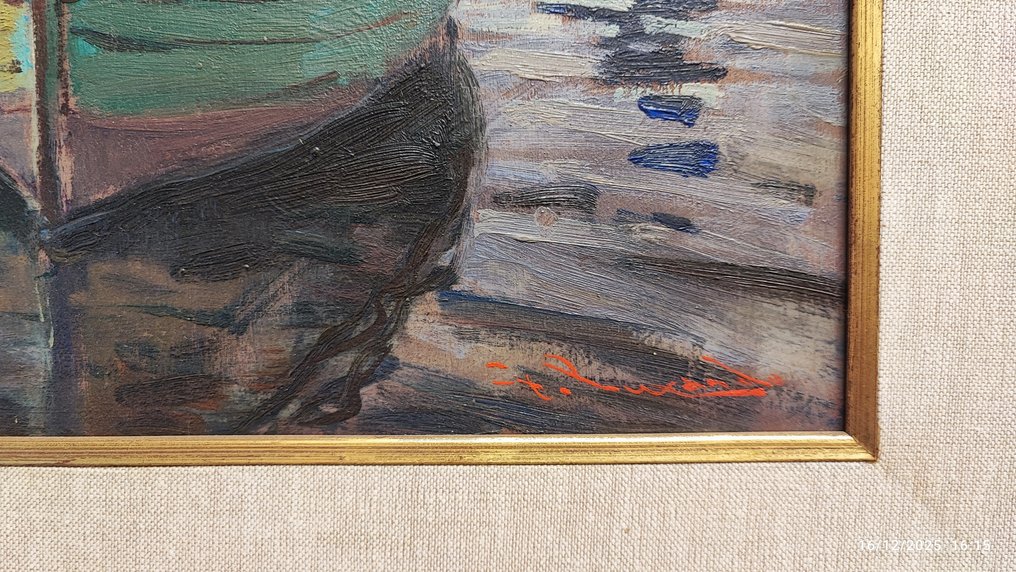
Barche ormeggiate is an original oil painting by Giorgio Luxardo (1937–2019), created in 1975, measuring 33 cm high by 43 cm wide and weighing 500 g, depicting a maritime landscape, originating from Italy, sold with a frame.
AI-assisted summary
Description from the seller
A Livorno-born artist begins to study at the studios of the masters of his city, Gino Romiti and Ferruccio Mataresi, who discover in him notable technical gifts and qualities and thus urge him to continue his activity. The first master who guides him toward a figurative language derived from the Macchiaioli tradition is Renato Natali. The Livornese master pushes him toward the study of truth and teaches him to draw from the attentive, meticulous, and direct vision of nature the source for his thematic inquiries. He begins to create paintings constructed with sharp forms, shaped by a skilled use of color and a perfect modulation of light. Daily outings to paint “en plein air” allow him to masterfully render colors, lights, and contrasts of the Tuscan coasts, the boundless Maremma lands, the splendid Livorno countryside, without neglecting interior views with transcendent still lifes. Luxardo belongs to that group of post-Macchiaioli artists who were attached to their territory and felt it as an inexhaustible source of inspiration and research.
He becomes part of Gruppo Labronico, an association of artists that since the 1920s has sought to safeguard the heritage of the painters of the “macchia,” and in 1964 he becomes its oldest member. The Group, whose founders included Renato Natali in 1920, used to meet at Caffè Bardi in Piazza Cavour in Livorno. It was the promoter of the Rotonda Award and took part in exhibitions and conferences in Italy and abroad. In 1975 he was awarded the National Marc’Aurelio Prize for painting. Many of his works are in private collections, which have appreciated the intimate value of the master (Cf. www.giorgioluxardo).
A pleasant painting. Size without a frame: 24x34 and it is executed on a wooden panel. It comes from my private collection.
A Livorno-born artist begins to study at the studios of the masters of his city, Gino Romiti and Ferruccio Mataresi, who discover in him notable technical gifts and qualities and thus urge him to continue his activity. The first master who guides him toward a figurative language derived from the Macchiaioli tradition is Renato Natali. The Livornese master pushes him toward the study of truth and teaches him to draw from the attentive, meticulous, and direct vision of nature the source for his thematic inquiries. He begins to create paintings constructed with sharp forms, shaped by a skilled use of color and a perfect modulation of light. Daily outings to paint “en plein air” allow him to masterfully render colors, lights, and contrasts of the Tuscan coasts, the boundless Maremma lands, the splendid Livorno countryside, without neglecting interior views with transcendent still lifes. Luxardo belongs to that group of post-Macchiaioli artists who were attached to their territory and felt it as an inexhaustible source of inspiration and research.
He becomes part of Gruppo Labronico, an association of artists that since the 1920s has sought to safeguard the heritage of the painters of the “macchia,” and in 1964 he becomes its oldest member. The Group, whose founders included Renato Natali in 1920, used to meet at Caffè Bardi in Piazza Cavour in Livorno. It was the promoter of the Rotonda Award and took part in exhibitions and conferences in Italy and abroad. In 1975 he was awarded the National Marc’Aurelio Prize for painting. Many of his works are in private collections, which have appreciated the intimate value of the master (Cf. www.giorgioluxardo).
A pleasant painting. Size without a frame: 24x34 and it is executed on a wooden panel. It comes from my private collection.
Details
Artist
Giorgio Luxardo (1937-2019)
Sold with frame
Yes
Sold by
Owner or reseller
Edition
Original
Title of artwork
Barche ormeggiate
Technique
Oil painting
Signature
Hand signed
Country of origin
Italy
Year
1975
Condition
Good condition
Height
33 cm
Width
43 cm
Weight
500 g
Depiction/theme
Seascape
Period
1970-1980
Sold by
