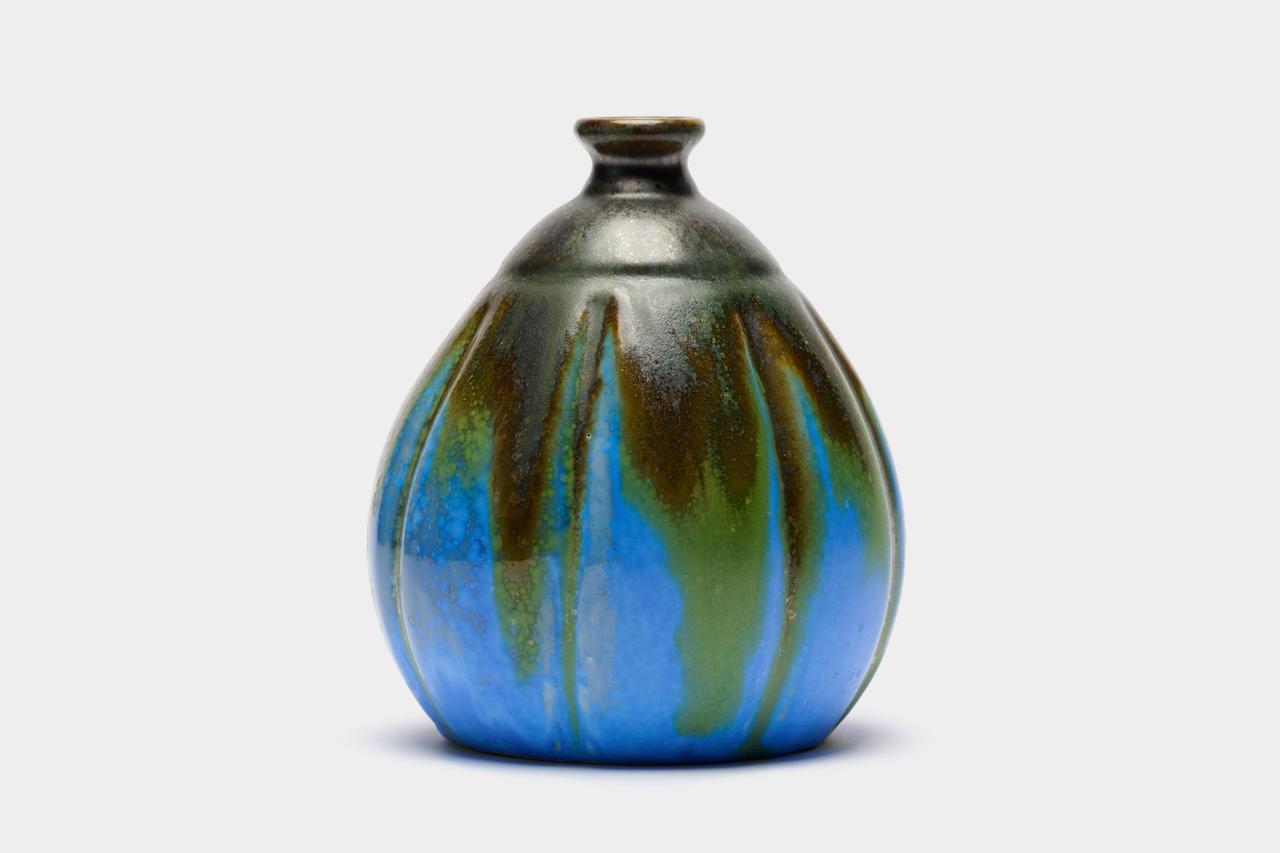
Atelier de Glatigny (1897-1902) - Lucien Gaillard (1861-1942) - Vase - Stoneware, Silver - Silver-mounted vase


03
days
23
hours
27
minutes
46
seconds
Current bid
€ 1
Reserve price not met

Expert
Selected by Michel Karis
Art historian with extensive experience working at various auction houses in antiques.
Estimate € 1,900 - € 2,100
 | €1 |
|---|
Catawiki Buyer Protection
Your payment’s safe with us until you receive your object.View details
Trustpilot 4.4 | 144426 reviews
Rated Excellent on Trustpilot.
An Art Nouveau stoneware vase with an 800‰ silver mount, made by Lucien Gaillard at the Atelier de Glatigny around 1900, measuring 31.5 cm high and 23 cm in diameter.
AI-assisted summary
Description from the seller
Lucien Gaillard (1861-1942) at the Glatigny workshop (1897-1902)
Important stoneware vase
With a low belly, a globe-neck
The mount is in 800/1000 silver with a boar head hallmark
Art Nouveau period, 1900
Glatigny mark on the underside, signed L. Gaillard on the silver base
Magnificent work of exceptional quality
Height: 31.5 cm
Diameter: about 23 cm
Neck diameter: 6.5 cm
Very good condition, one electrification hole
*Lucien Gaillard, born November 13, 1861 and died November 23, 1942 in Paris, was a French silversmith, jeweler and glassmaker, one of the masters of Art Nouveau.
Lucien Gaillard comes from a family of jewelers: his grandfather, Amédée Alexandre Gaillard (1811-1882), founded in 1840 in Paris a studio for art jewelery, passed to his son Ernest (1836-1909). Lucien trained as an apprentice with his father from 1878 and, in 1892, took the helm of the Paris establishment at 107 rue La Boétie. He became a member of the Chamber of jewelers, métiers d’art and silversmiths.
In 1900 in Paris, his creations were distinguished at the Universal Exposition, where he received the Grand Prize in his specialty. Seven years earlier, he was already a member of the jury of the Chicago Exposition. In 1902, he was made a Knight of the Legion of Honour.
His style is deeply linked to Japonism. In his workshop, artists from Tokyo work alongside him on materials such as horn and lacquer.
From 1904, his production of works of art expands. He produced vases, cane handles, hair combs, brooches, pendants, inspired by floral and animal motifs (bee, butterfly, dragonfly, serpent, etc.), using precious stones and metals.
Dragonflies in horn, gold, emeralds, diamonds, enamel and citrine, 1904, Rijksmuseum, Amsterdam
As a damascener (metalworker), he was closely interested in patinas, varnishes and alloys.
Around 1910, he broadened his production to glass. He designed bottles for perfume houses such as Gueldy, Corday, Callot Sœurs or Violet. His collaboration with Violet remained active until 1926.
*The Glatigny workshop, founded by Frédéric Alfred le Chatelier in Versailles, had a brief existence (1897-1902) but was highly ambitious. In 1901, the critic Henri Cazalis (alias Jean Lahor) compared the workshop to the greatest names of the time: Dammouse, Delaherche, Chaplet, Hoentschel, etc.
Glatigny’s research in chemistry at the time was renowned for flamed stoneware and porcelain. As early as 1898, Siegfried Bing bought Glatigny vases for his gallery “L'Art Nouveau.”
Details
Era
1900-2000
Gross weight
0 g
Title additional information
Silver-mounted vase
Country of origin
France
Designer/artist/maker
Lucien Gaillard (1861-1942)
Material
Silver, Stoneware
Style
Art Nouveau
Manufacturer/brand
Atelier de Glatigny (1897-1902)
Condition
Good condition - used with small signs of aging & blemishes
Height
31.5 cm
Width
23 cm
Depth
23 cm
Estimated period
1900-1910
Sold by