Signed; Alec Soth - Sleeping in Mississipi - 2008



06
days
16
hours
49
minutes
13
seconds

No bids placed
Catawiki Buyer Protection
Your payment’s safe with us until you receive your object.View details
Trustpilot 4.4 | 131562 reviews
Rated Excellent on Trustpilot.
Alec Soth's Sleeping in Mississipi is a signed, hardbound photography monograph in English, published by Steidl in 2008 with 100 pages, measuring 29 by 28 cm and in excellent condition.
AI-assisted summary
Description from the seller
Welcome to this special sale of books or authors listed in Parr & Badger’s Photobook. All of them are signed copies. Alec Soth’s book is referenced in Martin Parr and Gerry Badger, The Photobook, volume II, page 50 and in Martin Parr’s Best Books of the Decade, pages 22–23. All previous editions have sold out, but this book is so important that the English publisher MACK reissued it in 2017 (do not confuse). In excellent condition, almost like new.
Rare copy of the 2008 edition exceptionally signed on the title page by Alec Soth ('born in 1969'), undoubtedly the finest edition with its gray toiled binding and the photo mounted on the cover. 45 full-page color photographs printed on recto only. English text by Patricia Hampl and Anne Wilkes Tucker.
A landmark book in contemporary photographic publishing, which was first self-published by its author in two successive editions produced on an inkjet printer in 25 copies before being picked up by Steidl.
Alec Soth has for two decades been regarded as one of the greatest American photographers, and this is his first work. He explored the Mississippi River from its source to its mouth, photographing with the camera both landscapes and people leading marginal lives he encountered, as well as their interiors, giving them full dignity. This documentary and lyrical work conveys a constant atmosphere of solitude, nostalgia, and dreaminess far removed from the image of America we know.
“I was a sulky, introverted young man,” Soth recalls about his early years, a dreamy, solitary young man who struggled to realize his creative ambitions. Working in a public photo-processing laboratory, he nearly abandoned the ambition of becoming an artist. He lived in a city on the Mississippi in Minneapolis, Minnesota.
Reading a biography of the famous aviator Charles Lindbergh, Alec Soth visits the childhood home of the celebrated aviator about 150 kilometers from his own home in Little Falls, a small town also on the Mississippi, and he photographs his modest bed. As a child, Charles Lindbergh and his father had considered traveling by boat along the Mississippi. Soth thinks of the few photos he has taken of the river and decides to make the river the guiding thread of his photographic project. The Mississippi is one of the world’s great rivers, at 3,800 kilometers, and it communicates with 31 central states of the United States over a vast territory, about six times the size of France.
Soth is also inspired by Mark Twain’s novel The Adventures of Huckleberry Finn, where a boy flees civilization with a Black slave who has escaped. He narrates their wanderings for over 1,200 kilometers on a raft down the Mississippi.
The photographer begins by following the Mississippi in his car, moving from one place to another with a list of keywords stuck to the steering wheel. He stops as soon as something catches his attention and “using the river as a route to meet people.” “A miraculous period in my life,” that’s how Soth describes this process. He felt warmly welcomed in the region. As the Mississippi descends southward, it becomes hotter and more open, he explains. It is also in the South that country music has its roots. The river and the people he meets thus allow him to move from one photograph to another.
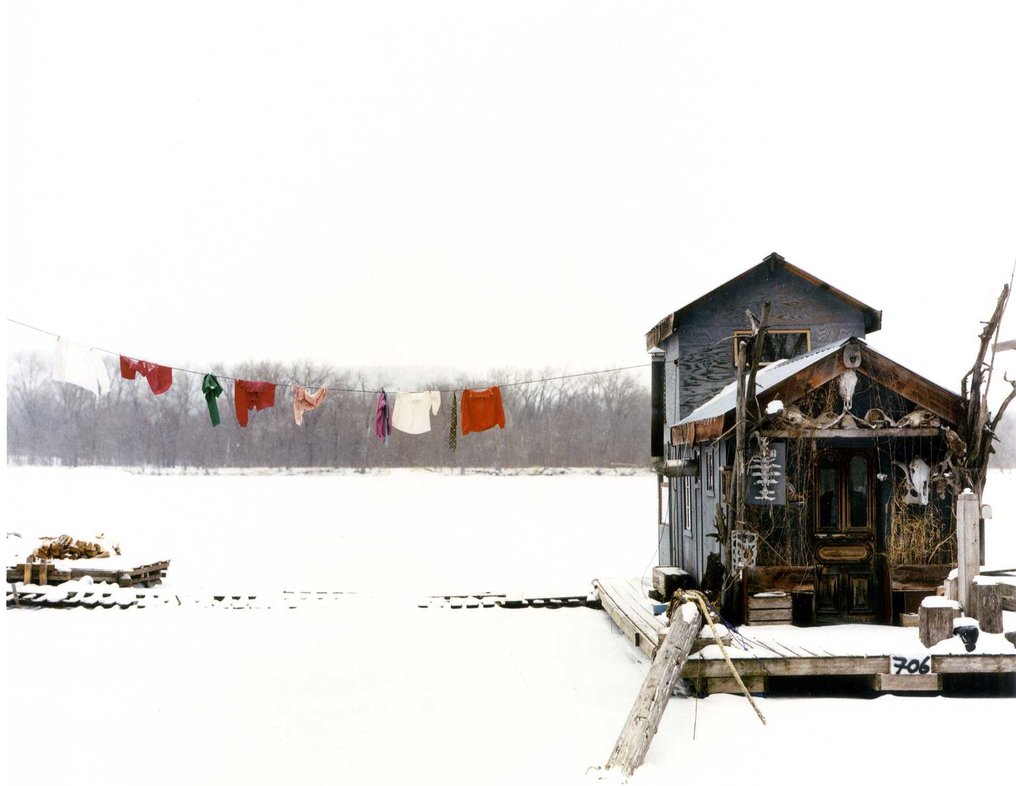
Most often the people he stops with are dreamers like him, marginal artists, and each time he photographs someone he asks them to write a dream in a small notebook. One of them keeps building things, especially model airplanes, which he keeps in his house. Another hangs out his laundry as if it were a work of art. Soth also visits a prison where activities are planned, and he photographs a murderer who bears a tear tattooed under his eye.
In Davenport, Iowa, Soth spots a building that looks like a brothel. He steels himself and goes in, saying he’s a photographer and that he will pay to take photos. He is told: “No need to pay. It’s good publicity.” He spends hours there, photographing different rooms and several women, including a mother and her daughter.
Soth is not particularly religious, but he photographs here a statue of Jesus on a cross hung on a utility pole, and a tapestry depicting Christ.
Finally, death is a very present theme in Sleeping by the Mississippi, as shown by the images of a service station in the foreground revealing in the background a cemetery with rudimentary graves among which children play.
Sleeping by the Mississippi sits in the tradition of books that shaped the history of photography, particularly Walker Evans’s American Photographs, where cars are a recurring motif that provides a through-line. Soth uses beds in the same way, and one sees beds in bedrooms at various places, or the frame of a bed in the bushes, or a mattress in the water, hence the book’s title.
Personal collection book, in excellent condition (practically like new), kept with the utmost care. Very efficient protected shipping and guaranteed international tracking. For multiple purchases, grouped shipping is possible with reimbursement of excess postage paid via PayPal.
Weight excluding packaging: 2.1 kg.
Welcome to this special sale of books or authors listed in Parr & Badger’s Photobook. All of them are signed copies. Alec Soth’s book is referenced in Martin Parr and Gerry Badger, The Photobook, volume II, page 50 and in Martin Parr’s Best Books of the Decade, pages 22–23. All previous editions have sold out, but this book is so important that the English publisher MACK reissued it in 2017 (do not confuse). In excellent condition, almost like new.
Rare copy of the 2008 edition exceptionally signed on the title page by Alec Soth ('born in 1969'), undoubtedly the finest edition with its gray toiled binding and the photo mounted on the cover. 45 full-page color photographs printed on recto only. English text by Patricia Hampl and Anne Wilkes Tucker.
A landmark book in contemporary photographic publishing, which was first self-published by its author in two successive editions produced on an inkjet printer in 25 copies before being picked up by Steidl.
Alec Soth has for two decades been regarded as one of the greatest American photographers, and this is his first work. He explored the Mississippi River from its source to its mouth, photographing with the camera both landscapes and people leading marginal lives he encountered, as well as their interiors, giving them full dignity. This documentary and lyrical work conveys a constant atmosphere of solitude, nostalgia, and dreaminess far removed from the image of America we know.
“I was a sulky, introverted young man,” Soth recalls about his early years, a dreamy, solitary young man who struggled to realize his creative ambitions. Working in a public photo-processing laboratory, he nearly abandoned the ambition of becoming an artist. He lived in a city on the Mississippi in Minneapolis, Minnesota.
Reading a biography of the famous aviator Charles Lindbergh, Alec Soth visits the childhood home of the celebrated aviator about 150 kilometers from his own home in Little Falls, a small town also on the Mississippi, and he photographs his modest bed. As a child, Charles Lindbergh and his father had considered traveling by boat along the Mississippi. Soth thinks of the few photos he has taken of the river and decides to make the river the guiding thread of his photographic project. The Mississippi is one of the world’s great rivers, at 3,800 kilometers, and it communicates with 31 central states of the United States over a vast territory, about six times the size of France.
Soth is also inspired by Mark Twain’s novel The Adventures of Huckleberry Finn, where a boy flees civilization with a Black slave who has escaped. He narrates their wanderings for over 1,200 kilometers on a raft down the Mississippi.
The photographer begins by following the Mississippi in his car, moving from one place to another with a list of keywords stuck to the steering wheel. He stops as soon as something catches his attention and “using the river as a route to meet people.” “A miraculous period in my life,” that’s how Soth describes this process. He felt warmly welcomed in the region. As the Mississippi descends southward, it becomes hotter and more open, he explains. It is also in the South that country music has its roots. The river and the people he meets thus allow him to move from one photograph to another.
Most often the people he stops with are dreamers like him, marginal artists, and each time he photographs someone he asks them to write a dream in a small notebook. One of them keeps building things, especially model airplanes, which he keeps in his house. Another hangs out his laundry as if it were a work of art. Soth also visits a prison where activities are planned, and he photographs a murderer who bears a tear tattooed under his eye.
In Davenport, Iowa, Soth spots a building that looks like a brothel. He steels himself and goes in, saying he’s a photographer and that he will pay to take photos. He is told: “No need to pay. It’s good publicity.” He spends hours there, photographing different rooms and several women, including a mother and her daughter.
Soth is not particularly religious, but he photographs here a statue of Jesus on a cross hung on a utility pole, and a tapestry depicting Christ.
Finally, death is a very present theme in Sleeping by the Mississippi, as shown by the images of a service station in the foreground revealing in the background a cemetery with rudimentary graves among which children play.
Sleeping by the Mississippi sits in the tradition of books that shaped the history of photography, particularly Walker Evans’s American Photographs, where cars are a recurring motif that provides a through-line. Soth uses beds in the same way, and one sees beds in bedrooms at various places, or the frame of a bed in the bushes, or a mattress in the water, hence the book’s title.
Personal collection book, in excellent condition (practically like new), kept with the utmost care. Very efficient protected shipping and guaranteed international tracking. For multiple purchases, grouped shipping is possible with reimbursement of excess postage paid via PayPal.
Weight excluding packaging: 2.1 kg.
Details
Number of books
1
Subject
Art
Book title
Sleeping in Mississipi
Author/ Illustrator
Signed; Alec Soth
Condition
Fine
Publication year oldest item
2008
Height
29 cm
Edition
Other edition, Reprint
Width
28 cm
Language
English
Original language
Yes
Publisher
Steidl
Binding/ Material
Hardback
Extras
Signed
Number of pages
100
Sold by