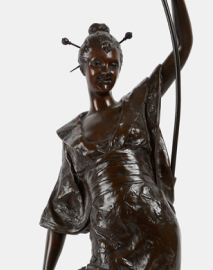
Sculpture, Le baiser donné - 29 cm - Bronze, Wood


00
days
07
hours
25
minutes
28
seconds
Current bid
€ 8
Reserve price not met

12 other people are watching this object
 | €8 | |
|---|---|---|
| €7 | |
| €6 | |
Catawiki Buyer Protection
Your payment’s safe with us until you receive your object.View details
Trustpilot 4.4 | 133802 reviews
Rated Excellent on Trustpilot.
Bronze sculpture on a wooden base, titled Le baiser donné, in the Art Nouveau style, unsigned, measuring 22 cm wide by 29 cm high by 15 cm deep and weighing 4 kg, origin unknown.
AI-assisted summary
Description from the seller
This sculpture is a reproduction of the work titled "Le Baiser Donné" (El beso dado), created by the renowned French neoclassical sculptor Jean-Antoine Houdon (1741–1828). Houdon is especially celebrated for his realistic portraits of key figures of the Enlightenment, such as Voltaire, Benjamin Franklin, and George Washington.
Details of the Work
Composition: It depicts a young couple in a passionate embrace. The young man wears a ribbon in his wavy hair (classic Greek style), while the woman wears a light tunic that reveals her chest.
Symbolism: A garland of flowers unites the two lovers, symbolizing their union and mutual attraction in an "ode to sensuality".
Style: It is an example of French Neoclassicism, characterized by naturalism in the forms and precise details in the hair and features.
Context: The original 18th-century work has been widely reproduced in bronze during the 19th and early 20th centuries, often mounted on marble or wood bases.
This sculpture is a reproduction of the work titled "Le Baiser Donné" (El beso dado), created by the renowned French neoclassical sculptor Jean-Antoine Houdon (1741–1828). Houdon is especially celebrated for his realistic portraits of key figures of the Enlightenment, such as Voltaire, Benjamin Franklin, and George Washington.
Details of the Work
Composition: It depicts a young couple in a passionate embrace. The young man wears a ribbon in his wavy hair (classic Greek style), while the woman wears a light tunic that reveals her chest.
Symbolism: A garland of flowers unites the two lovers, symbolizing their union and mutual attraction in an "ode to sensuality".
Style: It is an example of French Neoclassicism, characterized by naturalism in the forms and precise details in the hair and features.
Context: The original 18th-century work has been widely reproduced in bronze during the 19th and early 20th centuries, often mounted on marble or wood bases.
Details
Era
1900-2000
Country of origin
Unknown
Style
Art Nouveau
Material
Bronze, Wood
Title of artwork
Le baiser donné
Signature
Not signed
Colour
Bronze, Brown
Condition
Good condition
Height
29 cm
Width
22 cm
Depth
15 cm
Weight
4 kg
Sold by