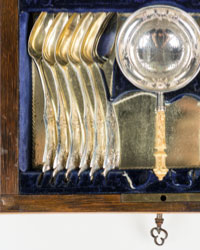
Christofle - Crumber - Silverplated


04
days
19
hours
12
minutes
09
seconds

No bids placed
Catawiki Buyer Protection
Your payment’s safe with us until you receive your object.View details
Trustpilot 4.4 | 133888 reviews
Rated Excellent on Trustpilot.
Description from the seller
Crumb catcher (Crumb scoop)
This is a desktop crumb catcher (often also called a silent butler in English). It was used during table service to sweep crumbs from the tablecloth between courses.
• Functioning: The hinged lid allows brushing the crumbs inside the container and keeping them hidden until emptying.
• Materials: It is made of silver-plated metal with a handle that appears to be wood or bakelite.
The Brand: Christofle France
The hallmark you photographed confirms that it is a product of the famed house Christofle, founded in Paris in 1830. Christofle is synonymous with luxury and has supplied silverware to royal households and top-level hotels worldwide.
• Hallmarking: In addition to the inscription "CHRISTOFLE FRANCE", small symbols can be seen in the squares. These are the maker marks guaranteeing the quality of the silver plating typical of their production.
• Style: The clean design and the linear handle suggest production in the mid-20th century (1950s–1970s), probably linked to a modernist line or a revised Art Deco.
Crumb catcher (Crumb scoop)
This is a desktop crumb catcher (often also called a silent butler in English). It was used during table service to sweep crumbs from the tablecloth between courses.
• Functioning: The hinged lid allows brushing the crumbs inside the container and keeping them hidden until emptying.
• Materials: It is made of silver-plated metal with a handle that appears to be wood or bakelite.
The Brand: Christofle France
The hallmark you photographed confirms that it is a product of the famed house Christofle, founded in Paris in 1830. Christofle is synonymous with luxury and has supplied silverware to royal households and top-level hotels worldwide.
• Hallmarking: In addition to the inscription "CHRISTOFLE FRANCE", small symbols can be seen in the squares. These are the maker marks guaranteeing the quality of the silver plating typical of their production.
• Style: The clean design and the linear handle suggest production in the mid-20th century (1950s–1970s), probably linked to a modernist line or a revised Art Deco.
Details
Era
1900-2000
Country of origin
France
Manufacturer/brand
Christofle
Material
Silverplated
Colour
Silver
Height
30 cm
Width
15 cm
Depth
5 cm
Estimated period
1990-2000
Sold by