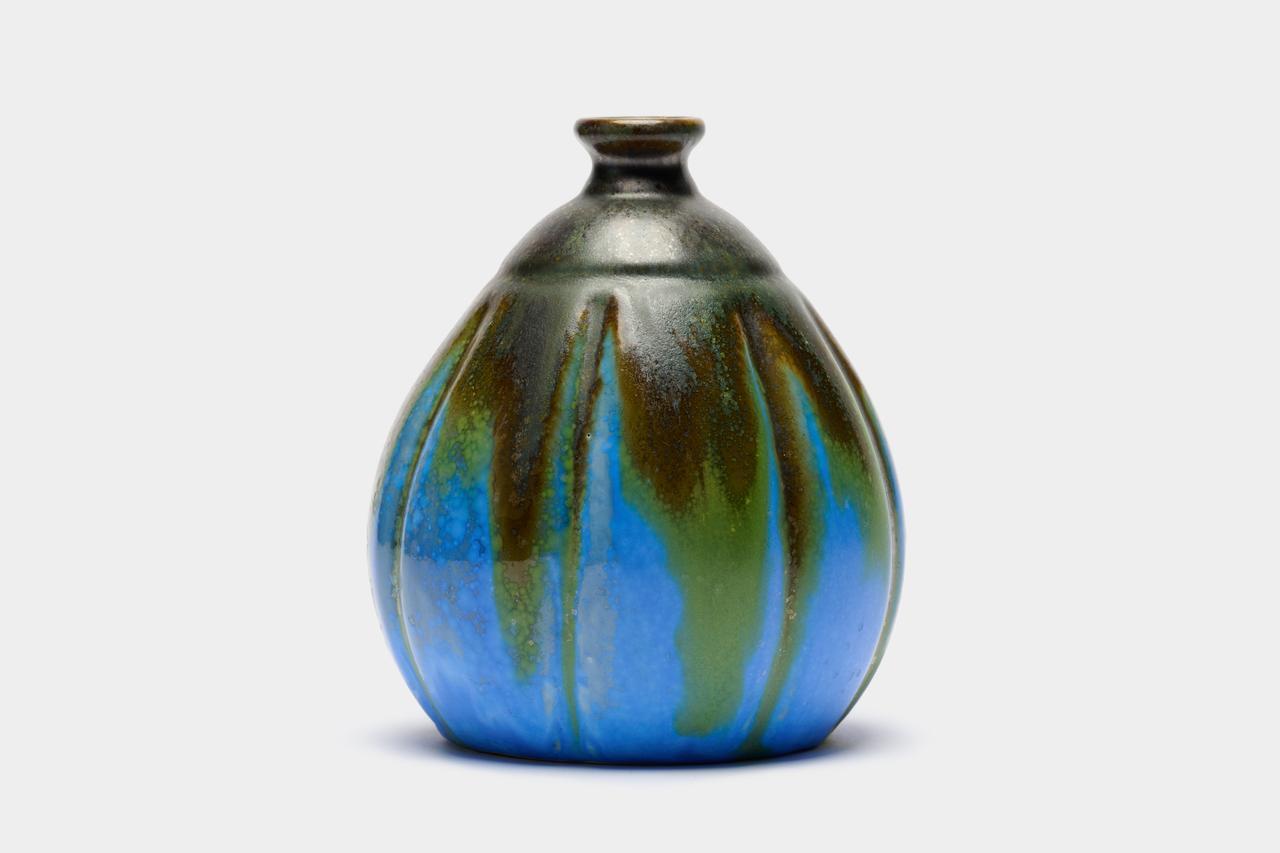
Vase - Stoneware - Early design piece


Art historian with extensive experience working at various auction houses in antiques.
Catawiki Buyer Protection
Your payment’s safe with us until you receive your object.View details
Trustpilot 4.4 | 133802 reviews
Rated Excellent on Trustpilot.
An experimental Westerwald stoneware vase dating to ca. 1900–1910, with cobalt blue, copper green and manganese black glaze, measuring 16 cm wide, 16 cm deep and 25 cm high, featuring a vegetal Jugendstil/Art Nouveau ornament and signed “Leban.C.” with heavy wear and possibly missing small parts.
Description from the seller
WESTERWALD | Experimental stoneware vase, Arts & Crafts (1890/1910)
This extraordinary, experimental stoneware vase, likely dating from around 1900, features numerous innovations—for example the decoration with copper green and manganese black alongside the traditional cobalt blue, and the unusual ornamentation that sits between Historicism, Art Nouveau (Jugendstil), and Modernism. Much points to an artistic experimental piece or the work of a ceramic workshop or school. Signed “Leban.C.” or similar (Lebau C. or V. or O. are also possible). Because the bottom shrank during firing, the bottom is slightly leaky. The piece could originate from the milieu of the German Werkbund.
Likely Westerwald or Alsace.
Dimensions: approx. 16 x 16 x 25 cm.
The ornamentation is divided into several horizontal zones: at the neck and the foot, rows of small, dark dot or bead ornaments appear, emphasized as recessed or applied nodules. These rows frame the vessel body and give the decoration a clear border structure.
The main decor forms a continuous sequence of stylized vegetal motifs. One can discern elongated, lanceolate leaves or flower heads, with incised internal lines. They are not rendered naturalistically but rather highly ornamental: the plant forms are symmetrized, plate-like, and arranged in a rhythmic sequence. This points to floral Art Nouveau, albeit within a rather craft-orientated, folk-art porcelain tradition.
Notably, there are large blue S-shaped volutes in the lower wall area. They recall tendrils or stylized leaf and wave forms. Together with the vertical plant motifs, there is a alternating movement between ascending and flowing shapes.
Technically, the decoration appears to have been achieved through scribing, relief application or modeling, and colored glaze accents. The dark blue lines and volutes correspond to the cobalt-blue decoration characteristic of Westerwald stoneware. The darker areas in brown to black tones could be read as manganese-containing color or glaze accents. The surface is glossy and salt-glaze-like, with a gently irregular, hand-crafted texture.
Historically, the ornament can be described as a stylized vegetative flat-decor with Art Nouveau undertones. It links traditional Westerwald decorative forms — cobalt blue, dot bands, sgraffito (rime) decoration, relief ornaments — with a circa 1900 modern preference for curved lines, abstracted plant forms, and rhythmic surface filling.
From a private art and design collection. Everything is packed very carefully by me!
WESTERWALD | Experimental stoneware vase, Arts & Crafts (1890/1910)
This extraordinary, experimental stoneware vase, likely dating from around 1900, features numerous innovations—for example the decoration with copper green and manganese black alongside the traditional cobalt blue, and the unusual ornamentation that sits between Historicism, Art Nouveau (Jugendstil), and Modernism. Much points to an artistic experimental piece or the work of a ceramic workshop or school. Signed “Leban.C.” or similar (Lebau C. or V. or O. are also possible). Because the bottom shrank during firing, the bottom is slightly leaky. The piece could originate from the milieu of the German Werkbund.
Likely Westerwald or Alsace.
Dimensions: approx. 16 x 16 x 25 cm.
The ornamentation is divided into several horizontal zones: at the neck and the foot, rows of small, dark dot or bead ornaments appear, emphasized as recessed or applied nodules. These rows frame the vessel body and give the decoration a clear border structure.
The main decor forms a continuous sequence of stylized vegetal motifs. One can discern elongated, lanceolate leaves or flower heads, with incised internal lines. They are not rendered naturalistically but rather highly ornamental: the plant forms are symmetrized, plate-like, and arranged in a rhythmic sequence. This points to floral Art Nouveau, albeit within a rather craft-orientated, folk-art porcelain tradition.
Notably, there are large blue S-shaped volutes in the lower wall area. They recall tendrils or stylized leaf and wave forms. Together with the vertical plant motifs, there is a alternating movement between ascending and flowing shapes.
Technically, the decoration appears to have been achieved through scribing, relief application or modeling, and colored glaze accents. The dark blue lines and volutes correspond to the cobalt-blue decoration characteristic of Westerwald stoneware. The darker areas in brown to black tones could be read as manganese-containing color or glaze accents. The surface is glossy and salt-glaze-like, with a gently irregular, hand-crafted texture.
Historically, the ornament can be described as a stylized vegetative flat-decor with Art Nouveau undertones. It links traditional Westerwald decorative forms — cobalt blue, dot bands, sgraffito (rime) decoration, relief ornaments — with a circa 1900 modern preference for curved lines, abstracted plant forms, and rhythmic surface filling.
From a private art and design collection. Everything is packed very carefully by me!