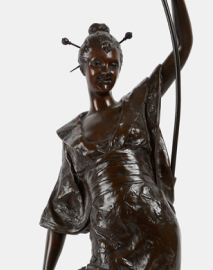
Sculpture, Poseidone - 31 cm - Composite


01
day
01
hour
56
minutes
11
seconds
Current bid
€ 70
Reserve price not met

8 other people are watching this object
 | €70 | |
|---|---|---|
| €50 |
Catawiki Buyer Protection
Your payment’s safe with us until you receive your object.View details
Trustpilot 4.4 | 134559 reviews
Rated Excellent on Trustpilot.
White composite marble sculpture titled Poseidone, unsigned, in antique-inspired style from Italy, measuring 19 cm wide by 31 cm high by 16 cm deep and weighing 5.75 kg.
AI-assisted summary
Description from the seller
Marble composite sculpture depicting Poseidon
This sculpture represents Poseidon, the Greek god of the sea, earthquakes, and horses, known to the Romans as Neptune. Representations of Poseidon in classical art typically depict him with a long, flowing beard and curly hair, symbols of his majesty and his power over the waters. These decorative sculptures are modern reproductions of classical works, made in marble composite to bring the elegance of Greco-Roman art into contemporary spaces. This type of bust has become particularly popular in the 19th and 20th centuries as a decorative element in European and American homes, reflecting the interest in classical culture and neoclassical aesthetics. Such sculptures are highly valued by collectors of classical art, enthusiasts of Greek mythology, interior designers, and students of art history. The charm lies in the ability to evoke the grandeur of ancient classical times and the timeless elegance of sculptural form. These decorative pieces are especially sought after by those who wish to create sophisticated environments with cultural references to Greco-Roman civilization.
Seller's Story
Welcome to our profile. We are antique enthusiasts with a deep passion for art, history, and the charm of the past, cultivated through years of research and dedication. On Catawiki we offer a careful and curated selection of antiques: from period furniture to refined objets d'art, up to paintings and sculptures of quality.
Our goal is to offer collectors and lovers of beauty authentic pieces, selected rigorously for their quality, rarity, and condition. We guarantee maximum transparency in descriptions, detailed photographs, and secure and professional packaging, so that these wonders of the past can reach your homes intact to continue their story.
Translated by Google TranslateMarble composite sculpture depicting Poseidon
This sculpture represents Poseidon, the Greek god of the sea, earthquakes, and horses, known to the Romans as Neptune. Representations of Poseidon in classical art typically depict him with a long, flowing beard and curly hair, symbols of his majesty and his power over the waters. These decorative sculptures are modern reproductions of classical works, made in marble composite to bring the elegance of Greco-Roman art into contemporary spaces. This type of bust has become particularly popular in the 19th and 20th centuries as a decorative element in European and American homes, reflecting the interest in classical culture and neoclassical aesthetics. Such sculptures are highly valued by collectors of classical art, enthusiasts of Greek mythology, interior designers, and students of art history. The charm lies in the ability to evoke the grandeur of ancient classical times and the timeless elegance of sculptural form. These decorative pieces are especially sought after by those who wish to create sophisticated environments with cultural references to Greco-Roman civilization.
Seller's Story
Welcome to our profile. We are antique enthusiasts with a deep passion for art, history, and the charm of the past, cultivated through years of research and dedication. On Catawiki we offer a careful and curated selection of antiques: from period furniture to refined objets d'art, up to paintings and sculptures of quality.
Our goal is to offer collectors and lovers of beauty authentic pieces, selected rigorously for their quality, rarity, and condition. We guarantee maximum transparency in descriptions, detailed photographs, and secure and professional packaging, so that these wonders of the past can reach your homes intact to continue their story.
Translated by Google TranslateDetails
Era
After 2000
Sold by
Owner or reseller
Country of origin
Italy
Style
Antique inspired
Material
Composite
Title of artwork
Poseidone
Signature
Not signed
Colour
White
Condition
Excellent condition
Height
31 cm
Width
19 cm
Depth
16 cm
Weight
5.75 kg
Sold by