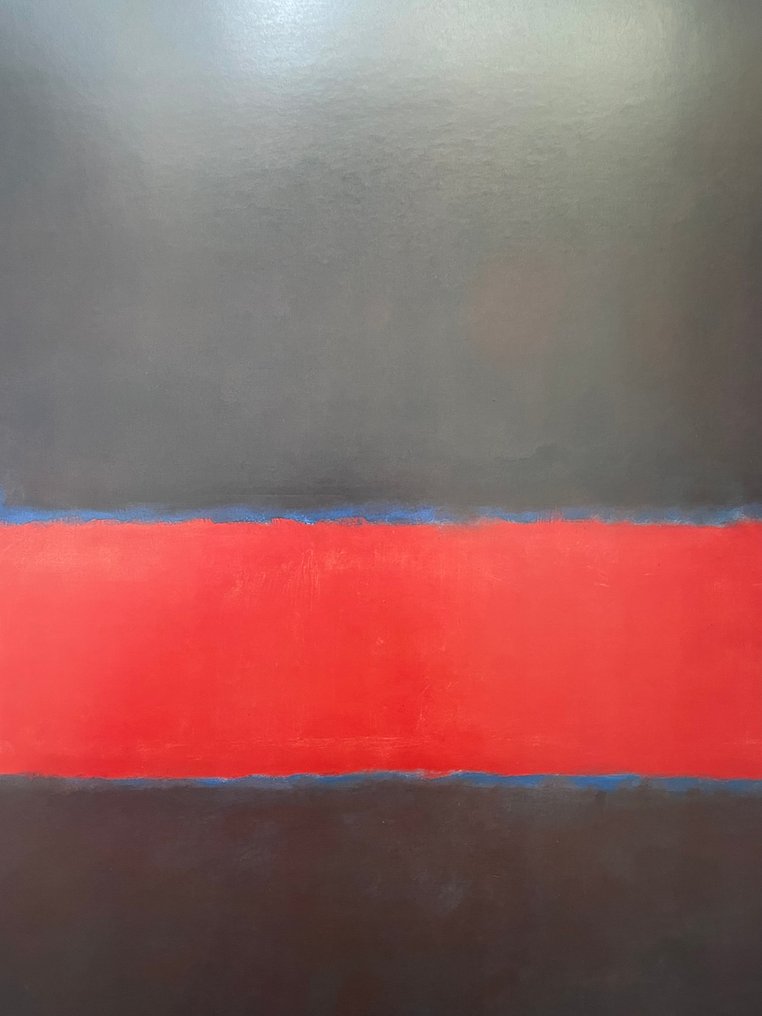
Mark Rothko (after) - Maroon on Blue - Offset lithography - VG licensed print - 2004




06
days
01
hour
29
minutes
49
seconds
Starting bid
€ 1
No reserve price

Expert
Selected by Alexander Fahl
Art historian with over 10 years' experience and expertise in Italian design.
Estimate € 110 - € 160
No bids placed
Catawiki Buyer Protection
Your payment’s safe with us until you receive your object.View details
Trustpilot 4.4 | 135773 reviews
Rated Excellent on Trustpilot.
Description from the seller
Offset Lithography after Mark Rothko (*)
Reproduction of the work “Maroon on Blue” created by Rothko in 1957,
edited on thick Fine Art 200g card stock
Published by VG Bild-Kunst, Bonn in 2004.
Print authorized with copyright by Kate Rothko-Prizel & Christopher Rothko.
Large format.
- Sheet dimensions: 80 x 60 cm
- Year: 2004
- Condition: Excellent (this work has never been framed or exhibited, always kept in a professional art folder, and thus remains in perfect condition).
- Provenance: Private collection.
The work will be carefully handled and packed in a reinforced cardboard package. The shipment will be sent with a tracking number.
The shipment will also include transport insurance for the final value of the work with full reimbursement in case of loss or damage, at no cost to the buyer.
(*) Mark Rothko, together with Pollock, was the leading figure of American abstraction. Through his painting he aimed to achieve an ambitious utopia: to express the most basic universal emotions. And for many he achieved it.
Mark Rothko, born Markus Rothkovitz, was born in Russia. From a clearly Jewish family, he emigrated to Oregon in 1910, probably fleeing the antisemitism that drove many minds away.
He studied art in the 1920s, but considered himself largely self-taught. Before World War II he cultivated Expressionist figuration and absorbed the spirit of the avant-gardes he saw in exhibitions organized by the MoMA.
After the war he began to explore color field painting, gradually abandoning any figurative reference, and in the 1950s, with Abstract Expressionism already established, he began the personal abstraction that would define his painting ever since.
Rothko’s paintings, vast, show broad rectangular fields of color with undefined boundaries between them. They are blurred colors, floating suspended on the canvas, evoking quite fascinating mystical sensations.
From then on, Mark Rothko would become an institution of American art. Protected by Peggy Guggenheim, his successes would be notable. But in the late 1960s, amid a depressive crisis, and after painting a series of works with black acrylic, he would eventually take his own life.
Seller's Story
EsKobARTE carefully selects works and posters from renowned and emerging artists from around the world, to offer them here at affordable prices.
___*** AUTHENTIC WORKS *** We only sell authentic works and posters and legally authorized prints__*** WE ARE PROFESSIONALS ***__You can bid on your items with total confidence. More than 1000 positive reviews from our customers endorse our track record and professionalism on Catawiki__*** PROTECTED, CERTIFIED AND INSURED SHIPMENTS ***__All our items are carefully packed in eco-friendly cardboard packaging. We work with the best shipping companies (UPS-DPD-DHL-FEDEX) to guarantee the best service and tracking. In addition, our shipments include insurance against damage or loss, at no cost to the buyer.__*** IF YOU ACQUIRE MORE THAN ONE ITEM, WE COMBINE SHIPPING ***__Even if they come from different auctions, you will only have to pay the shipping for a single item.__*** ANY DOUBT? CONTACT US ***__You can use the chat to talk to us, we will be happy to assist you as soon as possible.__*** THANKS AND GOOD LUCK WITH YOUR BIDS! ***
Translated by Google TranslateOffset Lithography after Mark Rothko (*)
Reproduction of the work “Maroon on Blue” created by Rothko in 1957,
edited on thick Fine Art 200g card stock
Published by VG Bild-Kunst, Bonn in 2004.
Print authorized with copyright by Kate Rothko-Prizel & Christopher Rothko.
Large format.
- Sheet dimensions: 80 x 60 cm
- Year: 2004
- Condition: Excellent (this work has never been framed or exhibited, always kept in a professional art folder, and thus remains in perfect condition).
- Provenance: Private collection.
The work will be carefully handled and packed in a reinforced cardboard package. The shipment will be sent with a tracking number.
The shipment will also include transport insurance for the final value of the work with full reimbursement in case of loss or damage, at no cost to the buyer.
(*) Mark Rothko, together with Pollock, was the leading figure of American abstraction. Through his painting he aimed to achieve an ambitious utopia: to express the most basic universal emotions. And for many he achieved it.
Mark Rothko, born Markus Rothkovitz, was born in Russia. From a clearly Jewish family, he emigrated to Oregon in 1910, probably fleeing the antisemitism that drove many minds away.
He studied art in the 1920s, but considered himself largely self-taught. Before World War II he cultivated Expressionist figuration and absorbed the spirit of the avant-gardes he saw in exhibitions organized by the MoMA.
After the war he began to explore color field painting, gradually abandoning any figurative reference, and in the 1950s, with Abstract Expressionism already established, he began the personal abstraction that would define his painting ever since.
Rothko’s paintings, vast, show broad rectangular fields of color with undefined boundaries between them. They are blurred colors, floating suspended on the canvas, evoking quite fascinating mystical sensations.
From then on, Mark Rothko would become an institution of American art. Protected by Peggy Guggenheim, his successes would be notable. But in the late 1960s, amid a depressive crisis, and after painting a series of works with black acrylic, he would eventually take his own life.
Seller's Story
EsKobARTE carefully selects works and posters from renowned and emerging artists from around the world, to offer them here at affordable prices.
___*** AUTHENTIC WORKS *** We only sell authentic works and posters and legally authorized prints__*** WE ARE PROFESSIONALS ***__You can bid on your items with total confidence. More than 1000 positive reviews from our customers endorse our track record and professionalism on Catawiki__*** PROTECTED, CERTIFIED AND INSURED SHIPMENTS ***__All our items are carefully packed in eco-friendly cardboard packaging. We work with the best shipping companies (UPS-DPD-DHL-FEDEX) to guarantee the best service and tracking. In addition, our shipments include insurance against damage or loss, at no cost to the buyer.__*** IF YOU ACQUIRE MORE THAN ONE ITEM, WE COMBINE SHIPPING ***__Even if they come from different auctions, you will only have to pay the shipping for a single item.__*** ANY DOUBT? CONTACT US ***__You can use the chat to talk to us, we will be happy to assist you as soon as possible.__*** THANKS AND GOOD LUCK WITH YOUR BIDS! ***
Translated by Google TranslateDetails
Era
1900-2000
Designer/artist
Mark Rothko (after)
Poster title
Maroon on Blue - Offset lithography - VG licensed print - 2004
Subject
Art
Country of origin
Germany
Condition
A (excellent - mint condition)
Height
80 cm
Width
60 cm