Hemba - DR Congo



01
day
20
hours
23
minutes
08
seconds
Starting bid
€ 1
Reserve price not met

Expert
Selected by Julien Gauthier
A decade of experience in historical arms, armour, and African art.
Estimate € 500 - € 550
No bids placed
Catawiki Buyer Protection
Your payment’s safe with us until you receive your object.View details
Trustpilot 4.4 | 135837 reviews
Rated Excellent on Trustpilot.
Description from the seller
Congo RDC
Hemba
Wood on pedestal sculpture
Height: 350mm
Width: 110mm
Length: 120mm
Weight: 1230g
This carved wooden anthropomorphic statue is a ritual artwork from the Luba people (or a related ethnicity such as the Hemba or Zela), a great cultural and historical power established in the southeast of the Democratic Republic of the Congo.
It is more precisely a charged fetish or an ancestral effigy with therapeutic and protective purposes.
1. Stylistic characteristics and morphology
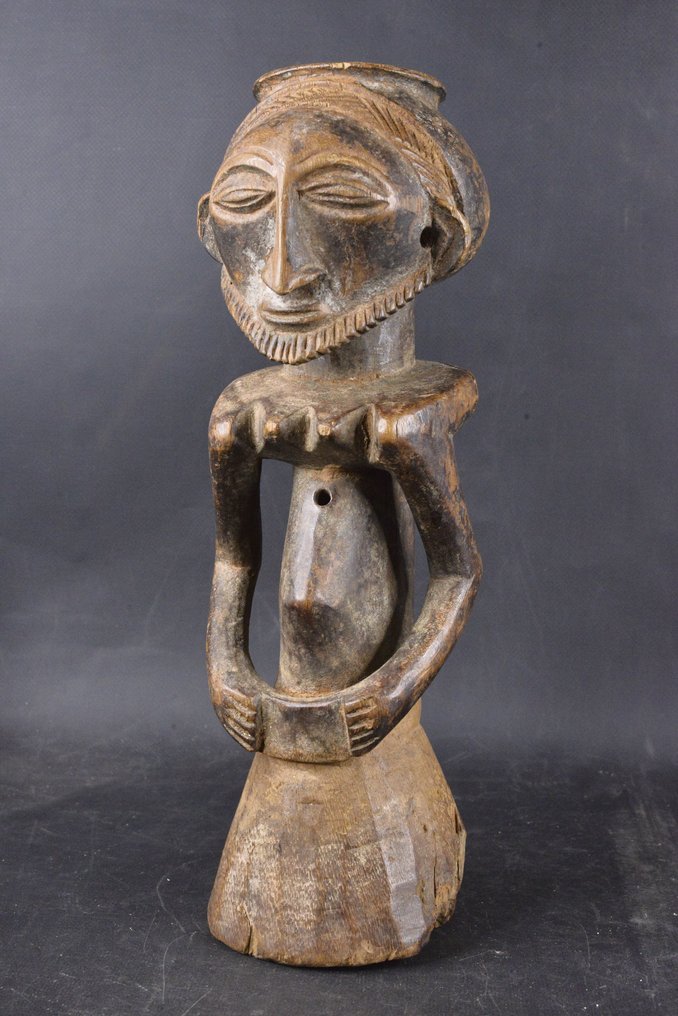
Statuary from the Congo basin, and especially the Luba cultural area, places major importance on the treatment of the head, considered the seat of intelligence, will, and spiritual perception. Front-facing photos reveal the specifics of this piece:
Haircut as cup or receptacle: The top of the skull is crowned with a flared projection in the shape of a cup or small vessel. This hair treatment is not only aesthetic: historically it was used to hold magico-medicinal substances (powders, oils, sacred herbs) intended to activate the statue.
The face and attributes of wisdom: The face bears large almond-shaped eyes finely elongated and half-closed, evoking interiority and the connection with the invisible world. The nose is straight and fine. A stylized beard, sculpted as a band rhythmically lined with fine parallel incisions, borders the jaw and chin. This beard is an attribute of power, maturity, and high social dignity.
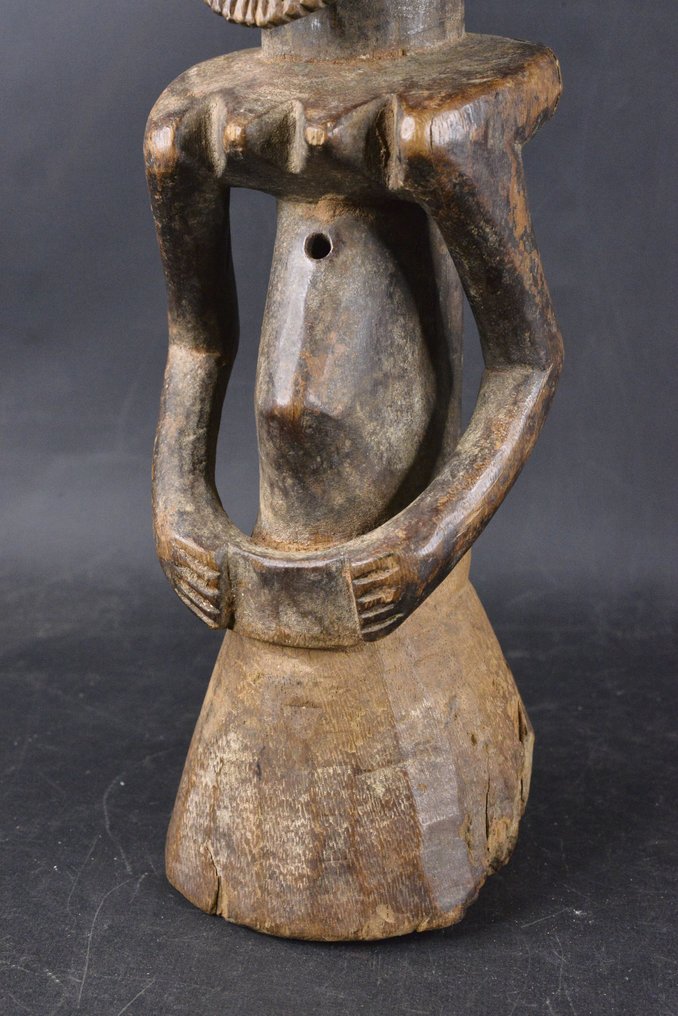
The naval cavity and posture: The torso shows small conical breasts. At the center of the abdomen, there is a neat, circular orifice (visible on file BP014-1.jpg). As with the cranial cup, this excavated navel served as a reliquary to house a magical charge (banga). The long, slender arms bend to bring the hands joined just below the belly, above a massive pedestal-like conical base.
Condition of the wood and traces of insects: The object shows a contrasted patina: dark and satin on the torso and face due to handling, and lighter and rougher on the base. File BP014-2.jpg shows attacks by wood-boring insects (small galleries and perforations) concentrated at the back of the coiffure and the bottom of the base, evidence of natural aging of wood in a tropical environment.
2. Ritual use and magico-religious functions
Among the Luba, statues of this type are not mere decorative objects but active intermediaries between the world of the living, the ancestors (Bankambo), and the spirits of nature (Bavidye).
The receptacle of forces or spirits: In raw form, the sculpture is only a piece of wood. It is the introduction of secret substances by the diviner or healer (Nganga) into the head or navel that "lights" the statue and endows it with its soul and mystical efficacy.
Protection and healing: Once consecrated, the statue is kept by the head of the family or the diviner. It is invoked to overcome specific crises: to heal chronic illnesses, drive away evil spirits, counter sorcery, or ensure prosperity and fertility of the lineage.
Ancestor cult: The position of the hands on the belly recalls lineage and the transmission of life. By honoring the statue with anointings or prayers, the community ensures the benevolence of the ancestor it embodies, who acts as an advocate before higher powers.
3. Symbolic meaning
In Luba thought, the harmony of lines and the serenity of the face reflect moral and spiritual perfection. The cavities intended to receive magical charges remind that power and protection come from both thought (the head) and lineage and origins (the navel). The beard of the dignitary and the statue’s dignified posture affirm the continuity of authority and wisdom of the elders over the community of the living. Ear holes.
Packages are sent Monday to Saturday with insurance and tracking number.
Delivery in 1 to 3 days in France via Chronopost, 2 to 5 days across the European Union.
Delivery in the rest of Europe and worldwide via Colissimo International.
We speak English
Mask African art Afrikanische Maskenkunst arte de máscaras africanas arte delle maschere africane
statue African art Arte de estatuas africanas arte delle statue africane Afrikanische Maskenkunst
Máscara de estatua de galería de arte africano
Seller's Story
Passionate about World Arts and more specifically about African Art, we buy from collectors, former officials, military, health workers, public works staff who have worked in Africa and also in Côte d'Ivoire, from antique dealers and traders who roam across West Africa to find quality objects.
It is with pride that we present works that, beyond their power to beautify spaces, invite our collectors to resonate with the richness and depth of human expression through the most authentic art.
At Arts Ethniques Gallery, we have the privilege of offering our visitors an exclusive selection of artworks, all unique and original. Each piece presented is the outcome of a demanding artistic approach, driven by a singular vision and mastered craftsmanship, all elements that guarantee authenticity and value.
The works we offer are not industrial reproductions. They are individual creations, crafted with sensitivity and precision, each bearing its own story, identity and presence. Originality is the very foundation of our commitment to excellence. Thus, every mask and every statue in our collection is the subject of a rigorous selection, in order to preserve their rarity and singularity.
Acquiring a work from Arts Ethniques Gallery means owning a truly unique piece: a creation that embodies both talent, cultural memory and the expressive force of African art. It is also a lasting investment in a work whose artistic and emotional value transcends time.
We guarantee that every work leaving our gallery is an authentic piece, without replicas, bearing witness to the creativity, heritage and passion of the African artists who shaped them.
We invite you to participate in our gallery’s auctions with confidence. Each presented work is an original, unique and irreplaceable creation, selected with the greatest rigor to guarantee its authenticity and artistic value.
Whether you wish to enrich a personal collection or introduce an exceptional artwork into your space, Arts Ethniques Gallery offers a safe, transparent and professional setting to acquire remarkable pieces.
Art auctions are a privileged moment to discover rare works, capable of becoming the heart of a collection. Acquiring a work at our sales is not just buying an object: it is investing in a creation whose aesthetic value and cultural reach reinforce over time.
The pieces presented by Arts Ethniques Gallery testify not only to the talent and vision of the artists but also possess the ability to transform spaces and enrich the gaze of those who behold them.
Participating in our auctions is taking part in a singular experience, where the passion for art meets the rigors of collecting. Bidding on a work from Arts Ethniques Gallery goes beyond a simple transaction: it is a gesture of commitment and appreciation for art in its most authentic form.
We invite you to bid with passion and to join us in this adventure dedicated to discovery, transmission and celebration of art.
Perhaps your next heart piece is already waiting for you."
Translated by Google TranslateCongo RDC
Hemba
Wood on pedestal sculpture
Height: 350mm
Width: 110mm
Length: 120mm
Weight: 1230g
This carved wooden anthropomorphic statue is a ritual artwork from the Luba people (or a related ethnicity such as the Hemba or Zela), a great cultural and historical power established in the southeast of the Democratic Republic of the Congo.
It is more precisely a charged fetish or an ancestral effigy with therapeutic and protective purposes.
1. Stylistic characteristics and morphology
Statuary from the Congo basin, and especially the Luba cultural area, places major importance on the treatment of the head, considered the seat of intelligence, will, and spiritual perception. Front-facing photos reveal the specifics of this piece:
Haircut as cup or receptacle: The top of the skull is crowned with a flared projection in the shape of a cup or small vessel. This hair treatment is not only aesthetic: historically it was used to hold magico-medicinal substances (powders, oils, sacred herbs) intended to activate the statue.
The face and attributes of wisdom: The face bears large almond-shaped eyes finely elongated and half-closed, evoking interiority and the connection with the invisible world. The nose is straight and fine. A stylized beard, sculpted as a band rhythmically lined with fine parallel incisions, borders the jaw and chin. This beard is an attribute of power, maturity, and high social dignity.
The naval cavity and posture: The torso shows small conical breasts. At the center of the abdomen, there is a neat, circular orifice (visible on file BP014-1.jpg). As with the cranial cup, this excavated navel served as a reliquary to house a magical charge (banga). The long, slender arms bend to bring the hands joined just below the belly, above a massive pedestal-like conical base.
Condition of the wood and traces of insects: The object shows a contrasted patina: dark and satin on the torso and face due to handling, and lighter and rougher on the base. File BP014-2.jpg shows attacks by wood-boring insects (small galleries and perforations) concentrated at the back of the coiffure and the bottom of the base, evidence of natural aging of wood in a tropical environment.
2. Ritual use and magico-religious functions
Among the Luba, statues of this type are not mere decorative objects but active intermediaries between the world of the living, the ancestors (Bankambo), and the spirits of nature (Bavidye).
The receptacle of forces or spirits: In raw form, the sculpture is only a piece of wood. It is the introduction of secret substances by the diviner or healer (Nganga) into the head or navel that "lights" the statue and endows it with its soul and mystical efficacy.
Protection and healing: Once consecrated, the statue is kept by the head of the family or the diviner. It is invoked to overcome specific crises: to heal chronic illnesses, drive away evil spirits, counter sorcery, or ensure prosperity and fertility of the lineage.
Ancestor cult: The position of the hands on the belly recalls lineage and the transmission of life. By honoring the statue with anointings or prayers, the community ensures the benevolence of the ancestor it embodies, who acts as an advocate before higher powers.
3. Symbolic meaning
In Luba thought, the harmony of lines and the serenity of the face reflect moral and spiritual perfection. The cavities intended to receive magical charges remind that power and protection come from both thought (the head) and lineage and origins (the navel). The beard of the dignitary and the statue’s dignified posture affirm the continuity of authority and wisdom of the elders over the community of the living. Ear holes.
Packages are sent Monday to Saturday with insurance and tracking number.
Delivery in 1 to 3 days in France via Chronopost, 2 to 5 days across the European Union.
Delivery in the rest of Europe and worldwide via Colissimo International.
We speak English
Mask African art Afrikanische Maskenkunst arte de máscaras africanas arte delle maschere africane
statue African art Arte de estatuas africanas arte delle statue africane Afrikanische Maskenkunst
Máscara de estatua de galería de arte africano
Seller's Story
Passionate about World Arts and more specifically about African Art, we buy from collectors, former officials, military, health workers, public works staff who have worked in Africa and also in Côte d'Ivoire, from antique dealers and traders who roam across West Africa to find quality objects.
It is with pride that we present works that, beyond their power to beautify spaces, invite our collectors to resonate with the richness and depth of human expression through the most authentic art.
At Arts Ethniques Gallery, we have the privilege of offering our visitors an exclusive selection of artworks, all unique and original. Each piece presented is the outcome of a demanding artistic approach, driven by a singular vision and mastered craftsmanship, all elements that guarantee authenticity and value.
The works we offer are not industrial reproductions. They are individual creations, crafted with sensitivity and precision, each bearing its own story, identity and presence. Originality is the very foundation of our commitment to excellence. Thus, every mask and every statue in our collection is the subject of a rigorous selection, in order to preserve their rarity and singularity.
Acquiring a work from Arts Ethniques Gallery means owning a truly unique piece: a creation that embodies both talent, cultural memory and the expressive force of African art. It is also a lasting investment in a work whose artistic and emotional value transcends time.
We guarantee that every work leaving our gallery is an authentic piece, without replicas, bearing witness to the creativity, heritage and passion of the African artists who shaped them.
We invite you to participate in our gallery’s auctions with confidence. Each presented work is an original, unique and irreplaceable creation, selected with the greatest rigor to guarantee its authenticity and artistic value.
Whether you wish to enrich a personal collection or introduce an exceptional artwork into your space, Arts Ethniques Gallery offers a safe, transparent and professional setting to acquire remarkable pieces.
Art auctions are a privileged moment to discover rare works, capable of becoming the heart of a collection. Acquiring a work at our sales is not just buying an object: it is investing in a creation whose aesthetic value and cultural reach reinforce over time.
The pieces presented by Arts Ethniques Gallery testify not only to the talent and vision of the artists but also possess the ability to transform spaces and enrich the gaze of those who behold them.
Participating in our auctions is taking part in a singular experience, where the passion for art meets the rigors of collecting. Bidding on a work from Arts Ethniques Gallery goes beyond a simple transaction: it is a gesture of commitment and appreciation for art in its most authentic form.
We invite you to bid with passion and to join us in this adventure dedicated to discovery, transmission and celebration of art.
Perhaps your next heart piece is already waiting for you."
Translated by Google TranslateDetails
Ethnic group/ culture
Hemba
Country of Origin
DR Congo
Material
Wood
Sold with stand
No
Condition
Good condition
Sold by
