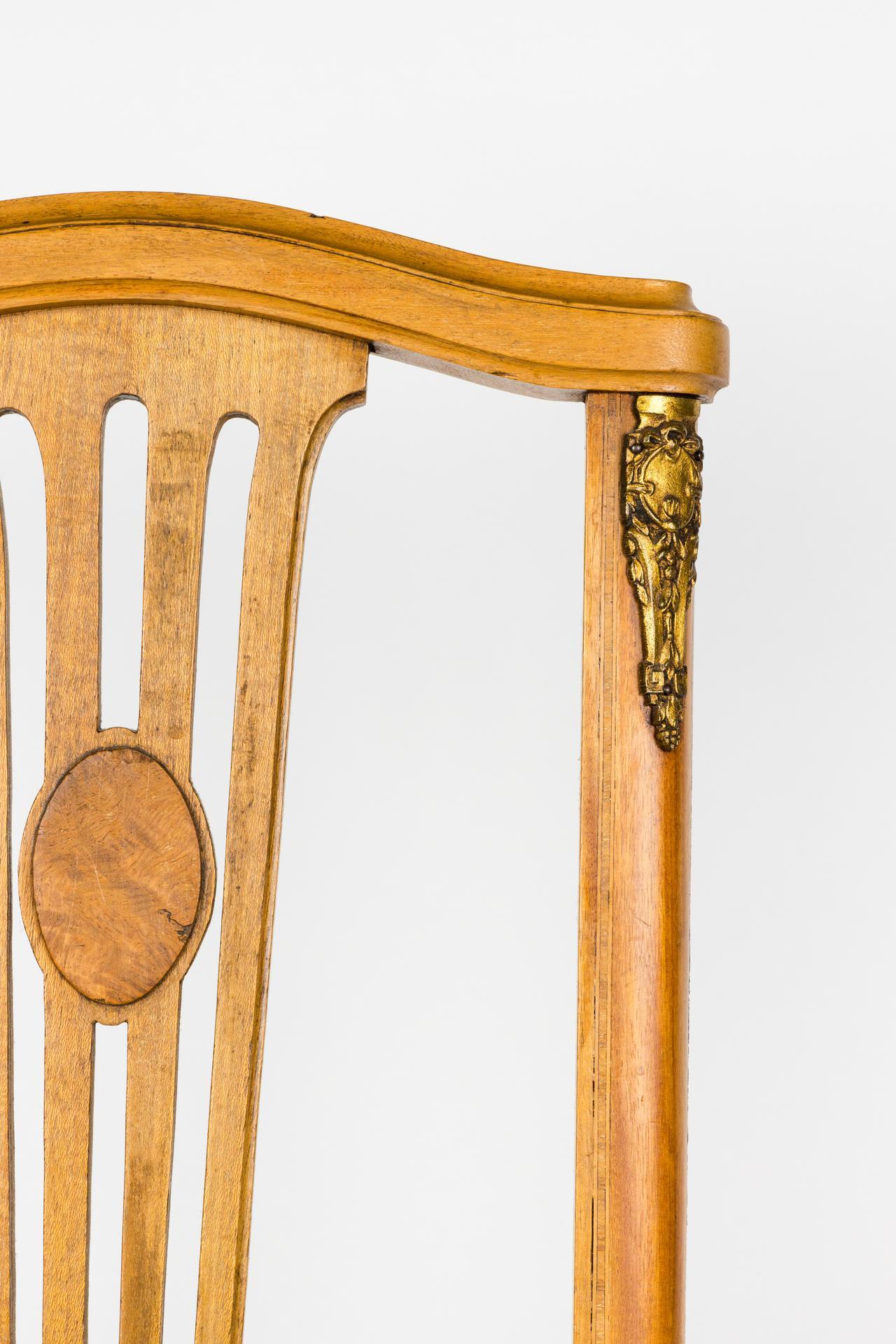
Coiffeuse - Wood


06
days
20
hours
04
minutes
38
seconds
Starting bid
€ 1
Reserve price not met

Expert
Selected by Constance Rousseau
Master marquetry craftswoman with 4 years' expert experience. Trainee auctioneer at Sotheby's Paris.
Estimate € 1,000 - € 1,100
No bids placed
Catawiki Buyer Protection
Your payment’s safe with us until you receive your object.View details
Trustpilot 4.4 | 135696 reviews
Rated Excellent on Trustpilot.
Antique Napoléon III dressing table from France, circa 1850–1900, in wood with fine marquetry and ormolu mounts, dimensions 71 x 56 x 40 cm, weight 20 kg, and able to be locked.
AI-assisted summary
Description from the seller
Dresser / Coiffeuse, wood marquetry and ormolu, Napoleon III, 19th century – France
Style: Napoleon III
Materials: Marquetry of precious woods and ormolu (gilded bronze)
Period: Late 19th century
Country of origin: France
Good condition relative to age and use
Dimensions: 71 x 56 x 40 cm.
Impressive and singular French dresser or coiffeuse, in the Napoleon III style and period, 19th century. In precious woods, rosewood and bloodwood, it features a sinuous profile, and the top surface presents exquisite marquetry with the renowned French Treillage pattern, repeated on the front and sides.
Mounting and hardware in mercury-gilded bronze, ormolu. The entire piece is framed with an ormolu profile, with an ornamental olive branch motif. It rests on four sabre legs with fittings and sablots also in gilded bronze ornamented with vegetal motifs. The lock escutcheon, also gilded bronze, showcases a beautiful ornamentation with small shamrocks of extraordinary craftsmanship. With key. The interior of the dresser is lined with rosewood and features a mirror with a gilded bronze mount. A discreet alcove is found at the bottom.
A piece of magnificent quality and a high level of refinement. Ideal as an auxiliary piece of furniture in any space and setting, it will always stand out for its beauty and elegance.
Napoleon III or Second Empire style and period
The Napoleon III style, or Second Empire, derives its name from its origins in France at that time. Strictly, the Second Empire was proclaimed in 1852 and ended in 1870, led by Louis-Napoleon Bonaparte as Emperor of the French, although in the artistic sense it extends a few years more (to 1880). This style was very popular among the French bourgeoisie. The Emperor himself was involved in the artistic development of the period, though more linked to architecture. However, it is to Empress Eugénie that the evolution of the decorative arts is owed.
Although inspired by past styles, beginning with Classical Antiquity, the Renaissance, even in Louis XVI, much loved by Eugénie, the most representative feature of the style is its sumptuousness and ostentation, always aiming to display wealth and opulence.
It is not a style designed specifically for the Second Empire, but a revival of the different great French styles from previous centuries, a kind of compendium of French decorative trends. Special reference is made to Louis XIV, Louis XV, Baroque and Rococo, and gradually Louis XVI, with an eclectic base. Ultimately, the decorative styles that positioned France at the forefront of interior design and furniture design in Europe, both for quality and originality and beauty.
Shipping of the product will be paid by the buyer according to its dimensions, weight, and destination. We will contact you to arrange it and agree on the budget. Shipping costs include professional custom packaging; and personalized shipping, with tracking number and warranty. DUE TO THE PIECE'S DIMENSIONS, IT IS PREFERRED TO ARRANGE SHIPPING WITH THE BUYER. CURRENT COSTS ARE ESTIMATED.
The buyer will be responsible for paying import duties and related taxes in the destination country, if any. Please note the seller's liability disclaimer regarding possible customs charges, as they are charged in the destination country and the amount payable is determined by that country’s customs. If an export permit is required, the costs are borne by the buyer. The cost depends progressively on the value of the artwork to be exported.
Seller's Story
- ABOUT US - Fragonard Interiors is a company with experience for more than 30 years, with a team of experts specialized in antiques, design pieces, works of art and interior design projects.
We always seek excellence and originality in each of the pieces, chasing as much customer satisfaction as possible.
By giving a new life to the pieces and works of art, we manage to perpetuate their soul and activate a circular economy of objects.
FOLLOW US ON INSTAGRAM: fragonard_interiors
The packaging is professional and adapted to each piece, with tracking number and shipping insurance. 100% AUTHENTICITY AND QUALITY CONTROL. Each item sold is analyzed, studied and authenticated by experts.
WORLD DELIVERY We ship to all countries served by international courier service providers such as DHL, UPS ...
You can also arrange for yourself to pick up at our physical location.
Translated by Google TranslateDresser / Coiffeuse, wood marquetry and ormolu, Napoleon III, 19th century – France
Style: Napoleon III
Materials: Marquetry of precious woods and ormolu (gilded bronze)
Period: Late 19th century
Country of origin: France
Good condition relative to age and use
Dimensions: 71 x 56 x 40 cm.
Impressive and singular French dresser or coiffeuse, in the Napoleon III style and period, 19th century. In precious woods, rosewood and bloodwood, it features a sinuous profile, and the top surface presents exquisite marquetry with the renowned French Treillage pattern, repeated on the front and sides.
Mounting and hardware in mercury-gilded bronze, ormolu. The entire piece is framed with an ormolu profile, with an ornamental olive branch motif. It rests on four sabre legs with fittings and sablots also in gilded bronze ornamented with vegetal motifs. The lock escutcheon, also gilded bronze, showcases a beautiful ornamentation with small shamrocks of extraordinary craftsmanship. With key. The interior of the dresser is lined with rosewood and features a mirror with a gilded bronze mount. A discreet alcove is found at the bottom.
A piece of magnificent quality and a high level of refinement. Ideal as an auxiliary piece of furniture in any space and setting, it will always stand out for its beauty and elegance.
Napoleon III or Second Empire style and period
The Napoleon III style, or Second Empire, derives its name from its origins in France at that time. Strictly, the Second Empire was proclaimed in 1852 and ended in 1870, led by Louis-Napoleon Bonaparte as Emperor of the French, although in the artistic sense it extends a few years more (to 1880). This style was very popular among the French bourgeoisie. The Emperor himself was involved in the artistic development of the period, though more linked to architecture. However, it is to Empress Eugénie that the evolution of the decorative arts is owed.
Although inspired by past styles, beginning with Classical Antiquity, the Renaissance, even in Louis XVI, much loved by Eugénie, the most representative feature of the style is its sumptuousness and ostentation, always aiming to display wealth and opulence.
It is not a style designed specifically for the Second Empire, but a revival of the different great French styles from previous centuries, a kind of compendium of French decorative trends. Special reference is made to Louis XIV, Louis XV, Baroque and Rococo, and gradually Louis XVI, with an eclectic base. Ultimately, the decorative styles that positioned France at the forefront of interior design and furniture design in Europe, both for quality and originality and beauty.
Shipping of the product will be paid by the buyer according to its dimensions, weight, and destination. We will contact you to arrange it and agree on the budget. Shipping costs include professional custom packaging; and personalized shipping, with tracking number and warranty. DUE TO THE PIECE'S DIMENSIONS, IT IS PREFERRED TO ARRANGE SHIPPING WITH THE BUYER. CURRENT COSTS ARE ESTIMATED.
The buyer will be responsible for paying import duties and related taxes in the destination country, if any. Please note the seller's liability disclaimer regarding possible customs charges, as they are charged in the destination country and the amount payable is determined by that country’s customs. If an export permit is required, the costs are borne by the buyer. The cost depends progressively on the value of the artwork to be exported.
Seller's Story
- ABOUT US - Fragonard Interiors is a company with experience for more than 30 years, with a team of experts specialized in antiques, design pieces, works of art and interior design projects.
We always seek excellence and originality in each of the pieces, chasing as much customer satisfaction as possible.
By giving a new life to the pieces and works of art, we manage to perpetuate their soul and activate a circular economy of objects.
FOLLOW US ON INSTAGRAM: fragonard_interiors
The packaging is professional and adapted to each piece, with tracking number and shipping insurance. 100% AUTHENTICITY AND QUALITY CONTROL. Each item sold is analyzed, studied and authenticated by experts.
WORLD DELIVERY We ship to all countries served by international courier service providers such as DHL, UPS ...
You can also arrange for yourself to pick up at our physical location.
Translated by Google TranslateDetails
Era
1400-1900
Weight
20 kg
Style subtype
Napoleon III
Number of objects
1
Country of origin
France
Material
Wood
Style
Antique
Colour
Brown
Condition
Good condition - used with small signs of aging & blemishes
Height
71 cm
Width
56 cm
Depth
40 cm
Estimated period
1850-1900
Can Be Locked
Yes
Sold by