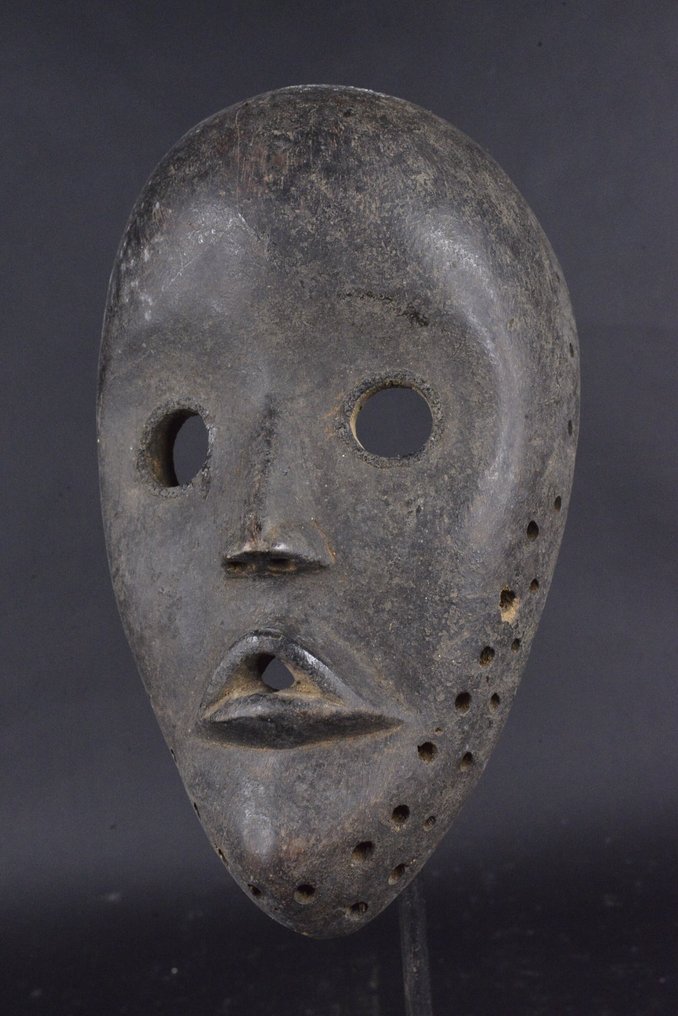
Dance mask - Dan - Côte d'Ivoire


07
days
04
hours
08
minutes
15
seconds
Starting bid
€ 1
Reserve price not met

Expert
Selected by Julien Gauthier
A decade of experience in historical arms, armour, and African art.
Estimate € 220 - € 250
No bids placed
Catawiki Buyer Protection
Your payment’s safe with us until you receive your object.View details
Trustpilot 4.4 | 136274 reviews
Rated Excellent on Trustpilot.
Masque de danse, a Dan wooden mask from Côte d'Ivoire with provenance from Biankouma in the east of the country near the borders with Liberia and Guinea.
AI-assisted summary
Description from the seller
Côte d'Ivoire
Dan
Bois
Height: 220mm
Width: 135mm
Depth: 60mm
Provenance: collected in Biankouma in the eastern Ivory Coast near the town of Man and close to the border with Liberia and Guinea.
1. Geographic and cultural origin
The forest region: The Dan people live in a zone of forests and mountains extending mainly across the western Ivory Coast and the northeast of Liberia, where they are sometimes called Gio.
The bush spirits (Gle): Among the Dan, the mask is not conceived as a human creation meant to hide a face, but as the physical manifestation of a Gle (an invisible bush spirit). This spirit chooses to incarnate itself through wood to communicate with humans and participate in the governance of society.
2. Ritual use and typology
In Dan statuary, the shape of the eyes directly determines the function and character of the mask spirit. Here two main categories are distinguished, with this mask belonging to the second:
Female masks with half-closed eyes (Deangle): Typically gentle, peaceful, and tied to initiation or rejoicings.
The racing or fire mask (Zakpei or Gunyege): The piece features large round, excavated eyes, characteristic of masks with a dynamic, masculine, or warrior function.
The racing mask (Gunyege): Used during inter-district or inter-village foot-race competitions in the dry season. The mask bearer pursues the youths; if he catches them, he strips them of an attribute. It is a means of training the youth and maintaining dynamic social cohesion.
The fire-surveillance mask (Zakpei): During the dry season, when hot winds blow and fire risk is high, this mask travels through the village to ensure that women have extinguished domestic hearths before midday. If a fire is left unattended, the mask fines or confiscates goods.
3. Stylistic characteristics of the piece
The aesthetics of this piece testify to the refined classicism and strong graphic force of Dan art:
The oval face: The mask has an oval form, with a slightly domed forehead and a chin that tapers downward.
Eyes and mouth: The circular, wide, and deeply pierced orbits provide excellent visibility for the dancer (essential for running or rapid movements). The mouth is sculpted in volume, with full lips protruding forward and slightly open, allowing breath to pass.
Peripheral perforations: The numerous circular holes drilled along the lateral and lower edges were used to attach a thick beard (often made of plant fibers or hair) as well as the headdress and the cloth costume that entirely concealed the initiate's body.
Patina and reverse: The outer face bears a dark, matte patina, evidence of traditional application of plant pigments or ceremonial mud. The reverse shows a regular hollow and an internal patina of use that is lighter due to repeated rubbing against the wearer’s face.
Fast and protected shipping. Packages are shipped with tracking number. Delivery in 1 to 3 days in France via Chronopost, 2 to 5 days across the European Union via Chronopost International. Delivery via Colissimo International to the rest of Europe and worldwide.
We speak english.
mask African art African mask art
Afrikanische Maskenkunst arte de máscaras africanas arte delle maschere africane
statue African art Arte de estatuas africanas arte delle statue africane Afrikanische Maskenkunst
Seller's Story
Passionate about World Arts and more specifically about African Art, we buy from collectors, former officials, military, health workers, public works staff who have worked in Africa and also in Côte d'Ivoire, from antique dealers and traders who roam across West Africa to find quality objects.
It is with pride that we present works that, beyond their power to beautify spaces, invite our collectors to resonate with the richness and depth of human expression through the most authentic art.
At Arts Ethniques Gallery, we have the privilege of offering our visitors an exclusive selection of artworks, all unique and original. Each piece presented is the outcome of a demanding artistic approach, driven by a singular vision and mastered craftsmanship, all elements that guarantee authenticity and value.
The works we offer are not industrial reproductions. They are individual creations, crafted with sensitivity and precision, each bearing its own story, identity and presence. Originality is the very foundation of our commitment to excellence. Thus, every mask and every statue in our collection is the subject of a rigorous selection, in order to preserve their rarity and singularity.
Acquiring a work from Arts Ethniques Gallery means owning a truly unique piece: a creation that embodies both talent, cultural memory and the expressive force of African art. It is also a lasting investment in a work whose artistic and emotional value transcends time.
We guarantee that every work leaving our gallery is an authentic piece, without replicas, bearing witness to the creativity, heritage and passion of the African artists who shaped them.
We invite you to participate in our gallery’s auctions with confidence. Each presented work is an original, unique and irreplaceable creation, selected with the greatest rigor to guarantee its authenticity and artistic value.
Whether you wish to enrich a personal collection or introduce an exceptional artwork into your space, Arts Ethniques Gallery offers a safe, transparent and professional setting to acquire remarkable pieces.
Art auctions are a privileged moment to discover rare works, capable of becoming the heart of a collection. Acquiring a work at our sales is not just buying an object: it is investing in a creation whose aesthetic value and cultural reach reinforce over time.
The pieces presented by Arts Ethniques Gallery testify not only to the talent and vision of the artists but also possess the ability to transform spaces and enrich the gaze of those who behold them.
Participating in our auctions is taking part in a singular experience, where the passion for art meets the rigors of collecting. Bidding on a work from Arts Ethniques Gallery goes beyond a simple transaction: it is a gesture of commitment and appreciation for art in its most authentic form.
We invite you to bid with passion and to join us in this adventure dedicated to discovery, transmission and celebration of art.
Perhaps your next heart piece is already waiting for you."
Translated by Google TranslateCôte d'Ivoire
Dan
Bois
Height: 220mm
Width: 135mm
Depth: 60mm
Provenance: collected in Biankouma in the eastern Ivory Coast near the town of Man and close to the border with Liberia and Guinea.
1. Geographic and cultural origin
The forest region: The Dan people live in a zone of forests and mountains extending mainly across the western Ivory Coast and the northeast of Liberia, where they are sometimes called Gio.
The bush spirits (Gle): Among the Dan, the mask is not conceived as a human creation meant to hide a face, but as the physical manifestation of a Gle (an invisible bush spirit). This spirit chooses to incarnate itself through wood to communicate with humans and participate in the governance of society.
2. Ritual use and typology
In Dan statuary, the shape of the eyes directly determines the function and character of the mask spirit. Here two main categories are distinguished, with this mask belonging to the second:
Female masks with half-closed eyes (Deangle): Typically gentle, peaceful, and tied to initiation or rejoicings.
The racing or fire mask (Zakpei or Gunyege): The piece features large round, excavated eyes, characteristic of masks with a dynamic, masculine, or warrior function.
The racing mask (Gunyege): Used during inter-district or inter-village foot-race competitions in the dry season. The mask bearer pursues the youths; if he catches them, he strips them of an attribute. It is a means of training the youth and maintaining dynamic social cohesion.
The fire-surveillance mask (Zakpei): During the dry season, when hot winds blow and fire risk is high, this mask travels through the village to ensure that women have extinguished domestic hearths before midday. If a fire is left unattended, the mask fines or confiscates goods.
3. Stylistic characteristics of the piece
The aesthetics of this piece testify to the refined classicism and strong graphic force of Dan art:
The oval face: The mask has an oval form, with a slightly domed forehead and a chin that tapers downward.
Eyes and mouth: The circular, wide, and deeply pierced orbits provide excellent visibility for the dancer (essential for running or rapid movements). The mouth is sculpted in volume, with full lips protruding forward and slightly open, allowing breath to pass.
Peripheral perforations: The numerous circular holes drilled along the lateral and lower edges were used to attach a thick beard (often made of plant fibers or hair) as well as the headdress and the cloth costume that entirely concealed the initiate's body.
Patina and reverse: The outer face bears a dark, matte patina, evidence of traditional application of plant pigments or ceremonial mud. The reverse shows a regular hollow and an internal patina of use that is lighter due to repeated rubbing against the wearer’s face.
Fast and protected shipping. Packages are shipped with tracking number. Delivery in 1 to 3 days in France via Chronopost, 2 to 5 days across the European Union via Chronopost International. Delivery via Colissimo International to the rest of Europe and worldwide.
We speak english.
mask African art African mask art
Afrikanische Maskenkunst arte de máscaras africanas arte delle maschere africane
statue African art Arte de estatuas africanas arte delle statue africane Afrikanische Maskenkunst
Seller's Story
Passionate about World Arts and more specifically about African Art, we buy from collectors, former officials, military, health workers, public works staff who have worked in Africa and also in Côte d'Ivoire, from antique dealers and traders who roam across West Africa to find quality objects.
It is with pride that we present works that, beyond their power to beautify spaces, invite our collectors to resonate with the richness and depth of human expression through the most authentic art.
At Arts Ethniques Gallery, we have the privilege of offering our visitors an exclusive selection of artworks, all unique and original. Each piece presented is the outcome of a demanding artistic approach, driven by a singular vision and mastered craftsmanship, all elements that guarantee authenticity and value.
The works we offer are not industrial reproductions. They are individual creations, crafted with sensitivity and precision, each bearing its own story, identity and presence. Originality is the very foundation of our commitment to excellence. Thus, every mask and every statue in our collection is the subject of a rigorous selection, in order to preserve their rarity and singularity.
Acquiring a work from Arts Ethniques Gallery means owning a truly unique piece: a creation that embodies both talent, cultural memory and the expressive force of African art. It is also a lasting investment in a work whose artistic and emotional value transcends time.
We guarantee that every work leaving our gallery is an authentic piece, without replicas, bearing witness to the creativity, heritage and passion of the African artists who shaped them.
We invite you to participate in our gallery’s auctions with confidence. Each presented work is an original, unique and irreplaceable creation, selected with the greatest rigor to guarantee its authenticity and artistic value.
Whether you wish to enrich a personal collection or introduce an exceptional artwork into your space, Arts Ethniques Gallery offers a safe, transparent and professional setting to acquire remarkable pieces.
Art auctions are a privileged moment to discover rare works, capable of becoming the heart of a collection. Acquiring a work at our sales is not just buying an object: it is investing in a creation whose aesthetic value and cultural reach reinforce over time.
The pieces presented by Arts Ethniques Gallery testify not only to the talent and vision of the artists but also possess the ability to transform spaces and enrich the gaze of those who behold them.
Participating in our auctions is taking part in a singular experience, where the passion for art meets the rigors of collecting. Bidding on a work from Arts Ethniques Gallery goes beyond a simple transaction: it is a gesture of commitment and appreciation for art in its most authentic form.
We invite you to bid with passion and to join us in this adventure dedicated to discovery, transmission and celebration of art.
Perhaps your next heart piece is already waiting for you."
Translated by Google TranslateDetails
Indigenous object name
Dance mask
Ethnic group/ culture
Dan
Country of Origin
Côte d'Ivoire
Material
Wood
Sold with stand
No
Condition
Excellent condition
Sold by
