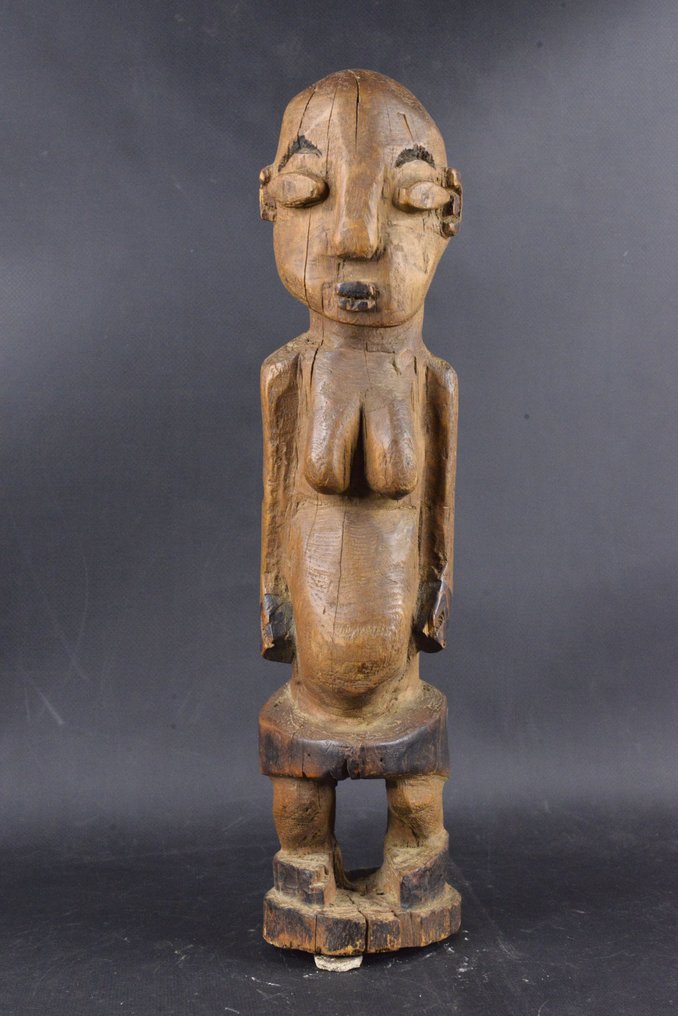
Statue Bateba - Lobi - Mali


07
days
06
hours
44
minutes
31
seconds
Starting bid
€ 1
Reserve price not met

Expert
Selected by Julien Gauthier
A decade of experience in historical arms, armour, and African art.
Estimate € 150 - € 200
No bids placed
Catawiki Buyer Protection
Your payment’s safe with us until you receive your object.View details
Trustpilot 4.4 | 137024 reviews
Rated Excellent on Trustpilot.
Description from the seller
Burkina Faso
Lobi
Wood
Height: 385mm
Width: 285mm
Depth: 90mm
Weight: 960g
This anthropomorphic wooden statuette comes from West Africa. Through its linear formal treatment, its geometric volumes, and the unique structure of its pedestal, it belongs to the art of the Lobi (a people settled at the crossroads of Burkina Faso, Ghana, and northern Ivory Coast).
Called Bateba, this sculpture is not merely a decorative representation or a direct ancestor, but an intermediate being carved to embody and materialize a bush spirit, the Thil (plural Thila).
1. Morphological and stylistic deciphering that highlights the features of Lobi statuary:
Facial treatment: The head is voluminous, oval, and smooth, suspended on a robust cylindrical neck. The eyes are almond-shaped and prominent (in relief “coffee grain”), topped by eyebrows marked here by traces of dark pigment. The nose is wide and straight, while the mouth, small and fleshy, retains traces of black material (sacrificial matter or patina from use).
A hieratic and condensed anatomy: The female figure presents conical, firm breasts projecting forward. The arms are carved parallel to the torso, rigid and straight, ending in simplified hands that embrace the flanks. The abdomen is slightly rounded, evoking lineage and fertility.
The pedestal on an integrated base: The most typic element lies in the lower part. The short, massive legs are bent and seem anchored in a circular monoxyl base. A form of loincloth or rigid buttock block structures the junction between the lower back and the thighs.
The condition of the wood and patina: The wood shows a pale patina, matte and dried-looking, sprinkled with natural drying cracks (notably on the skull and back). This is the result of prolonged exposure to the open air or in interior sanctuaries subjected to the contrasting climates of the sub-Saharan savanna.
2. Ritual use: The Bateba and the family altar
Among the Lobi, society has no centralized chiefs; social order and protection are governed by the Thila spirits through the prescriptions of a diviner (Thildar).
Incarnering on command: The Bateba is never carved by chance. When an individual or family undergoes a crisis (illness, infertility, poor harvests), the diviner identifies which spirit demands a statue to be raised for it. The sculptor then shapes the object so that it can serve as the “body” or receptacle for this entity.
The guardian of the altar (Thilduu): Once consecrated, the 38 cm statuette was placed on the domestic altar, located in the darkest room of the earthen house (soukhala). It received ritual offerings (millet beer, animal blood, porridges) placed directly on its head or base to activate its protective power.
3. Spiritual meaning: An active shield
The word Bateba can literally be translated as “those who counter evil” or “the substitutes.” For the Lobi, these statues are endowed with a form of spiritual life:
A sentinel role: The statuette acts as a metaphysical lightning rod. It intercepts sorceries, drives away nocturnal malevolent spirits, and protects the inhabitants of the house from invisible attacks.
A gateway of communication: It serves as a direct medium to transmit the family’s prayers and sacrifices to the Thil spirit, ensuring balance, health, and the community’s survival in the face of the unpredictable forces of the bush.
Les colis sont envoyés du lundi au samedi avec assurance et numéro de suivi. `
Delivery in 1 to 3 days in France with Chronopost, 2 to 5 days across the European Union.
Delivery to the rest of Europe and worldwide with Colissimo International.
We speak english
Mask african art Afrikanische Maskenkunst arte de máscaras africanas arte delle maschere africane
statue african art Arte de estatuas africanas arte delle statue africane Afrikanische Maskenkunst
Máscara de estatua de galería de arte africano
Seller's Story
Passionate about World Arts and more specifically about African Art, we buy from collectors, former officials, military, health workers, public works staff who have worked in Africa and also in Côte d'Ivoire, from antique dealers and traders who roam across West Africa to find quality objects.
It is with pride that we present works that, beyond their power to beautify spaces, invite our collectors to resonate with the richness and depth of human expression through the most authentic art.
At Arts Ethniques Gallery, we have the privilege of offering our visitors an exclusive selection of artworks, all unique and original. Each piece presented is the outcome of a demanding artistic approach, driven by a singular vision and mastered craftsmanship, all elements that guarantee authenticity and value.
The works we offer are not industrial reproductions. They are individual creations, crafted with sensitivity and precision, each bearing its own story, identity and presence. Originality is the very foundation of our commitment to excellence. Thus, every mask and every statue in our collection is the subject of a rigorous selection, in order to preserve their rarity and singularity.
Acquiring a work from Arts Ethniques Gallery means owning a truly unique piece: a creation that embodies both talent, cultural memory and the expressive force of African art. It is also a lasting investment in a work whose artistic and emotional value transcends time.
We guarantee that every work leaving our gallery is an authentic piece, without replicas, bearing witness to the creativity, heritage and passion of the African artists who shaped them.
We invite you to participate in our gallery’s auctions with confidence. Each presented work is an original, unique and irreplaceable creation, selected with the greatest rigor to guarantee its authenticity and artistic value.
Whether you wish to enrich a personal collection or introduce an exceptional artwork into your space, Arts Ethniques Gallery offers a safe, transparent and professional setting to acquire remarkable pieces.
Art auctions are a privileged moment to discover rare works, capable of becoming the heart of a collection. Acquiring a work at our sales is not just buying an object: it is investing in a creation whose aesthetic value and cultural reach reinforce over time.
The pieces presented by Arts Ethniques Gallery testify not only to the talent and vision of the artists but also possess the ability to transform spaces and enrich the gaze of those who behold them.
Participating in our auctions is taking part in a singular experience, where the passion for art meets the rigors of collecting. Bidding on a work from Arts Ethniques Gallery goes beyond a simple transaction: it is a gesture of commitment and appreciation for art in its most authentic form.
We invite you to bid with passion and to join us in this adventure dedicated to discovery, transmission and celebration of art.
Perhaps your next heart piece is already waiting for you."
Translated by Google TranslateBurkina Faso
Lobi
Wood
Height: 385mm
Width: 285mm
Depth: 90mm
Weight: 960g
This anthropomorphic wooden statuette comes from West Africa. Through its linear formal treatment, its geometric volumes, and the unique structure of its pedestal, it belongs to the art of the Lobi (a people settled at the crossroads of Burkina Faso, Ghana, and northern Ivory Coast).
Called Bateba, this sculpture is not merely a decorative representation or a direct ancestor, but an intermediate being carved to embody and materialize a bush spirit, the Thil (plural Thila).
1. Morphological and stylistic deciphering that highlights the features of Lobi statuary:
Facial treatment: The head is voluminous, oval, and smooth, suspended on a robust cylindrical neck. The eyes are almond-shaped and prominent (in relief “coffee grain”), topped by eyebrows marked here by traces of dark pigment. The nose is wide and straight, while the mouth, small and fleshy, retains traces of black material (sacrificial matter or patina from use).
A hieratic and condensed anatomy: The female figure presents conical, firm breasts projecting forward. The arms are carved parallel to the torso, rigid and straight, ending in simplified hands that embrace the flanks. The abdomen is slightly rounded, evoking lineage and fertility.
The pedestal on an integrated base: The most typic element lies in the lower part. The short, massive legs are bent and seem anchored in a circular monoxyl base. A form of loincloth or rigid buttock block structures the junction between the lower back and the thighs.
The condition of the wood and patina: The wood shows a pale patina, matte and dried-looking, sprinkled with natural drying cracks (notably on the skull and back). This is the result of prolonged exposure to the open air or in interior sanctuaries subjected to the contrasting climates of the sub-Saharan savanna.
2. Ritual use: The Bateba and the family altar
Among the Lobi, society has no centralized chiefs; social order and protection are governed by the Thila spirits through the prescriptions of a diviner (Thildar).
Incarnering on command: The Bateba is never carved by chance. When an individual or family undergoes a crisis (illness, infertility, poor harvests), the diviner identifies which spirit demands a statue to be raised for it. The sculptor then shapes the object so that it can serve as the “body” or receptacle for this entity.
The guardian of the altar (Thilduu): Once consecrated, the 38 cm statuette was placed on the domestic altar, located in the darkest room of the earthen house (soukhala). It received ritual offerings (millet beer, animal blood, porridges) placed directly on its head or base to activate its protective power.
3. Spiritual meaning: An active shield
The word Bateba can literally be translated as “those who counter evil” or “the substitutes.” For the Lobi, these statues are endowed with a form of spiritual life:
A sentinel role: The statuette acts as a metaphysical lightning rod. It intercepts sorceries, drives away nocturnal malevolent spirits, and protects the inhabitants of the house from invisible attacks.
A gateway of communication: It serves as a direct medium to transmit the family’s prayers and sacrifices to the Thil spirit, ensuring balance, health, and the community’s survival in the face of the unpredictable forces of the bush.
Les colis sont envoyés du lundi au samedi avec assurance et numéro de suivi. `
Delivery in 1 to 3 days in France with Chronopost, 2 to 5 days across the European Union.
Delivery to the rest of Europe and worldwide with Colissimo International.
We speak english
Mask african art Afrikanische Maskenkunst arte de máscaras africanas arte delle maschere africane
statue african art Arte de estatuas africanas arte delle statue africane Afrikanische Maskenkunst
Máscara de estatua de galería de arte africano
Seller's Story
Passionate about World Arts and more specifically about African Art, we buy from collectors, former officials, military, health workers, public works staff who have worked in Africa and also in Côte d'Ivoire, from antique dealers and traders who roam across West Africa to find quality objects.
It is with pride that we present works that, beyond their power to beautify spaces, invite our collectors to resonate with the richness and depth of human expression through the most authentic art.
At Arts Ethniques Gallery, we have the privilege of offering our visitors an exclusive selection of artworks, all unique and original. Each piece presented is the outcome of a demanding artistic approach, driven by a singular vision and mastered craftsmanship, all elements that guarantee authenticity and value.
The works we offer are not industrial reproductions. They are individual creations, crafted with sensitivity and precision, each bearing its own story, identity and presence. Originality is the very foundation of our commitment to excellence. Thus, every mask and every statue in our collection is the subject of a rigorous selection, in order to preserve their rarity and singularity.
Acquiring a work from Arts Ethniques Gallery means owning a truly unique piece: a creation that embodies both talent, cultural memory and the expressive force of African art. It is also a lasting investment in a work whose artistic and emotional value transcends time.
We guarantee that every work leaving our gallery is an authentic piece, without replicas, bearing witness to the creativity, heritage and passion of the African artists who shaped them.
We invite you to participate in our gallery’s auctions with confidence. Each presented work is an original, unique and irreplaceable creation, selected with the greatest rigor to guarantee its authenticity and artistic value.
Whether you wish to enrich a personal collection or introduce an exceptional artwork into your space, Arts Ethniques Gallery offers a safe, transparent and professional setting to acquire remarkable pieces.
Art auctions are a privileged moment to discover rare works, capable of becoming the heart of a collection. Acquiring a work at our sales is not just buying an object: it is investing in a creation whose aesthetic value and cultural reach reinforce over time.
The pieces presented by Arts Ethniques Gallery testify not only to the talent and vision of the artists but also possess the ability to transform spaces and enrich the gaze of those who behold them.
Participating in our auctions is taking part in a singular experience, where the passion for art meets the rigors of collecting. Bidding on a work from Arts Ethniques Gallery goes beyond a simple transaction: it is a gesture of commitment and appreciation for art in its most authentic form.
We invite you to bid with passion and to join us in this adventure dedicated to discovery, transmission and celebration of art.
Perhaps your next heart piece is already waiting for you."
Translated by Google TranslateDetails
Indigenous object name
Statue Bateba
Ethnic group/ culture
Lobi
Country of Origin
Mali
Material
Wood
Sold with stand
No
Condition
Good condition
Sold by
