Bobo / Bwa - Burkina Faso


06
days
01
hour
08
minutes
49
seconds
Starting bid
€ 1
Reserve price not met

Expert
Selected by Julien Gauthier
A decade of experience in historical arms, armour, and African art.
Estimate € 170 - € 200
No bids placed
Catawiki Buyer Protection
Your payment’s safe with us until you receive your object.View details
Trustpilot 4.4 | 137094 reviews
Rated Excellent on Trustpilot.
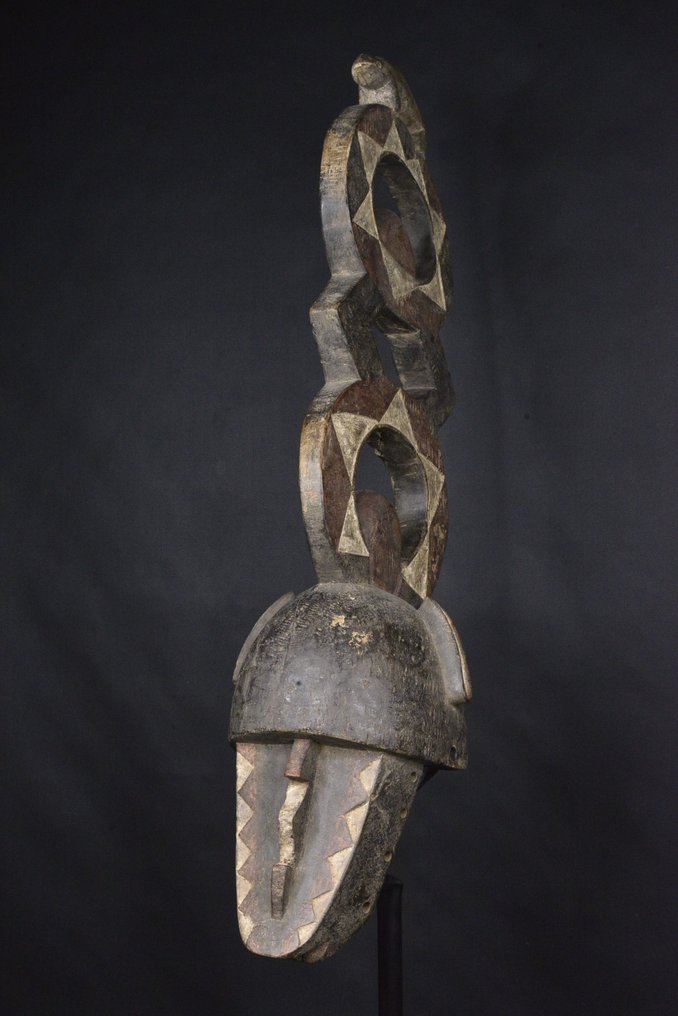
Wood cimier mask from the Bwa/Bobo of Burkina Faso, in good condition, sold with a tall stand; total height about 1400 mm on the stand (800 mm without), width 200 mm and depth 280 mm.
AI-assisted summary
Description from the seller
Burkina Faso
Bobo / Bwa
Wood
Height excluding base: 800mm - Height on base: 1400mm
Width: 200mm
Depth: 280mm
Delivered with a large, tall base that can be placed on the floor.
This piece is not a traditional facial mask, but a mask-crest (worn on the top of the head) originating from the Bwa people, a cultural community located on a territory straddling the center-west of Burkina Faso and southeast of Mali.
Although the file titles mention the Bwa ethnicity, this sculpture displays geometric stylization and a checkered polychrome work that shares strong affinities with the art of their direct neighbors: the Dogon (notably for the helmet structure) and the Bobo.
Here is the complete analysis of its stylistic origin, symbolism, and ritual use:
1. Stylistic characteristics and morphology
The art of the peoples of the Niger bend and the Sudanian savanna in Burkina Faso is renowned for geometric abstraction and the use of two- or three-color graphic motifs. The files cimier_bwa-CI279.jpg and cimier_bwa-CI279-14.jpg highlight a highly architectural construction:
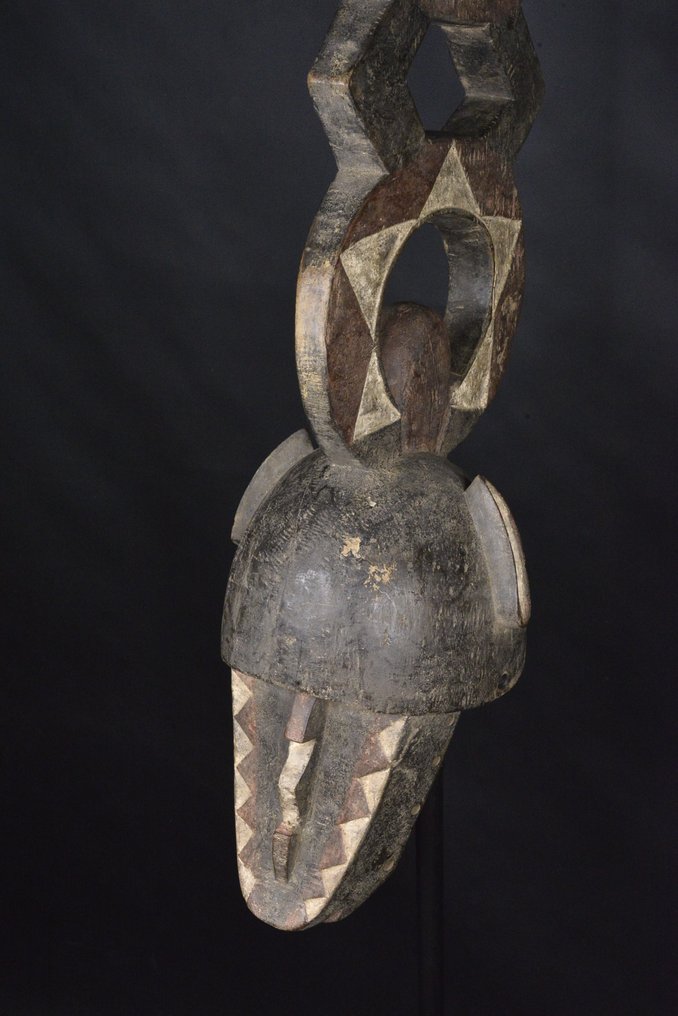
The hemispherical helmet base: The lower part is sculpted into a calotte shape that fits the dancer’s head. It extends downward with a stylized, flat, polygonal face, divided vertically by a relief nasal ridge. The perimeter of this face is accentuated by a frieze of triangle teeth-painted zigzags.
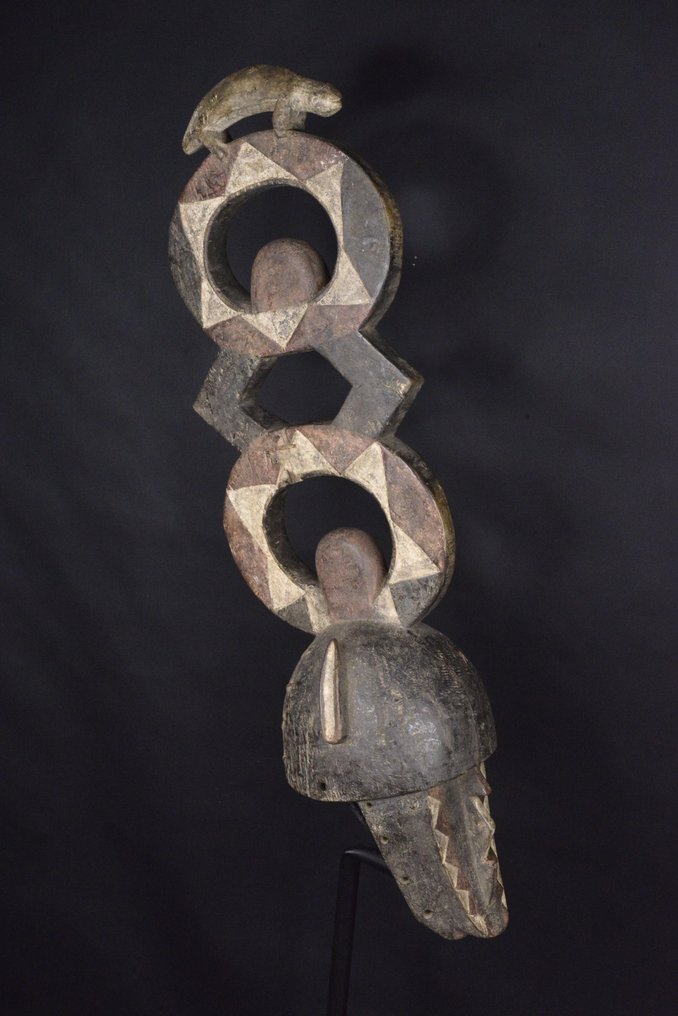
The high perforated superstructure: What makes this crest distinctive is the large vertical monoxylous piece that crowns the helmet. It consists of two large discs stacked, largely perforated at their center. This vertical section adopts a zigzag or successive wave profile.
The checkerboard and triangular motifs: The discs and the upper structure are entirely painted with rhythmic geometric patterns. You can discern alternating triangles and checkers using traditional pigments: white (kaolin-based), red-brown (lateritic soil), and black (plant or carbon-based substances).
Totemic bird at the summit: The file cimier_bwa-CI279-14.jpg allows a detailed view of the sculpture’s peak. The structure is crowned by a horizontally carved stylized animal, very likely a calao (hornbill) or a savanna bird with a plunging beak, a protective motif recurring in the region.
2. Ritual use: Initiations and agricultural cult
Among the Bwa and neighboring populations, carved and painted wooden masks (like the famous plank masks) participate in pivotal moments of community life, mainly managed by smith families or mask societies.
Initiation rites for youths (Do): These crests are shown during initiation ceremonies marking the passage to adulthood. Young initiates learn to decode the secret language of the geometric motifs painted on the wood. Wearing the mask and mastering its dance is a physical test that proves the initiate’s maturity.
The cult of nature spirits: Unlike leaf masks which directly embody the deity Do, wooden masks represent spirits of the bush (Nuna) or totemic animals that interceded on behalf of the clan’s founding ancestors in origin myths.
Harvest festivals and funerals: The crest also appears in agricultural rituals before the first rains to solicit the fertility of the earth from invisible forces, as well as at the funerals of notable persons to honor their status and guide their souls.
3. Meaning of the geometric motifs
In this savanna cultural zone, nothing is purely decorative; each painted motif is a graphic sign conveying a moral or religious teaching:
The zigzag and broken lines: They often evoke the winding path of ancestors, the course of the nourishing water, or the lightning that heralds the life-granting rain.
Alternating white and dark triangles: They symbolize the duality of the world and the balance needed for life: day and night, the dry season and the rainy season, the ignorance of the profane (white/light that must be educated) and the knowledge of the initiate.
The top bird: An intermediary between sky and earth, it embodies vigilance, spiritual protection, and the constant link between the world of the living and the spirits of the bush.
The packages are shipped Monday to Saturday with insurance and tracking number. Delivery in 1 to 3 days in France via Chronopost, 2 to 5 days within the European Union. Delivery to the rest of Europe and worldwide via Colissimo International.
We speak english
Mask african art Afro-asiatic mask art arte de máscaras africanas arte delle maschere africane
statue african art Arte de estatuas africanas arte delle statue africane Afrokanische Maskenkunst
Máscara de estatua de galería de arte africano
Seller's Story
Passionate about World Arts and more specifically about African Art, we buy from collectors, former officials, military, health workers, public works staff who have worked in Africa and also in Côte d'Ivoire, from antique dealers and traders who roam across West Africa to find quality objects.
It is with pride that we present works that, beyond their power to beautify spaces, invite our collectors to resonate with the richness and depth of human expression through the most authentic art.
At Arts Ethniques Gallery, we have the privilege of offering our visitors an exclusive selection of artworks, all unique and original. Each piece presented is the outcome of a demanding artistic approach, driven by a singular vision and mastered craftsmanship, all elements that guarantee authenticity and value.
The works we offer are not industrial reproductions. They are individual creations, crafted with sensitivity and precision, each bearing its own story, identity and presence. Originality is the very foundation of our commitment to excellence. Thus, every mask and every statue in our collection is the subject of a rigorous selection, in order to preserve their rarity and singularity.
Acquiring a work from Arts Ethniques Gallery means owning a truly unique piece: a creation that embodies both talent, cultural memory and the expressive force of African art. It is also a lasting investment in a work whose artistic and emotional value transcends time.
We guarantee that every work leaving our gallery is an authentic piece, without replicas, bearing witness to the creativity, heritage and passion of the African artists who shaped them.
We invite you to participate in our gallery’s auctions with confidence. Each presented work is an original, unique and irreplaceable creation, selected with the greatest rigor to guarantee its authenticity and artistic value.
Whether you wish to enrich a personal collection or introduce an exceptional artwork into your space, Arts Ethniques Gallery offers a safe, transparent and professional setting to acquire remarkable pieces.
Art auctions are a privileged moment to discover rare works, capable of becoming the heart of a collection. Acquiring a work at our sales is not just buying an object: it is investing in a creation whose aesthetic value and cultural reach reinforce over time.
The pieces presented by Arts Ethniques Gallery testify not only to the talent and vision of the artists but also possess the ability to transform spaces and enrich the gaze of those who behold them.
Participating in our auctions is taking part in a singular experience, where the passion for art meets the rigors of collecting. Bidding on a work from Arts Ethniques Gallery goes beyond a simple transaction: it is a gesture of commitment and appreciation for art in its most authentic form.
We invite you to bid with passion and to join us in this adventure dedicated to discovery, transmission and celebration of art.
Perhaps your next heart piece is already waiting for you."
Translated by Google TranslateBurkina Faso
Bobo / Bwa
Wood
Height excluding base: 800mm - Height on base: 1400mm
Width: 200mm
Depth: 280mm
Delivered with a large, tall base that can be placed on the floor.
This piece is not a traditional facial mask, but a mask-crest (worn on the top of the head) originating from the Bwa people, a cultural community located on a territory straddling the center-west of Burkina Faso and southeast of Mali.
Although the file titles mention the Bwa ethnicity, this sculpture displays geometric stylization and a checkered polychrome work that shares strong affinities with the art of their direct neighbors: the Dogon (notably for the helmet structure) and the Bobo.
Here is the complete analysis of its stylistic origin, symbolism, and ritual use:
1. Stylistic characteristics and morphology
The art of the peoples of the Niger bend and the Sudanian savanna in Burkina Faso is renowned for geometric abstraction and the use of two- or three-color graphic motifs. The files cimier_bwa-CI279.jpg and cimier_bwa-CI279-14.jpg highlight a highly architectural construction:
The hemispherical helmet base: The lower part is sculpted into a calotte shape that fits the dancer’s head. It extends downward with a stylized, flat, polygonal face, divided vertically by a relief nasal ridge. The perimeter of this face is accentuated by a frieze of triangle teeth-painted zigzags.
The high perforated superstructure: What makes this crest distinctive is the large vertical monoxylous piece that crowns the helmet. It consists of two large discs stacked, largely perforated at their center. This vertical section adopts a zigzag or successive wave profile.
The checkerboard and triangular motifs: The discs and the upper structure are entirely painted with rhythmic geometric patterns. You can discern alternating triangles and checkers using traditional pigments: white (kaolin-based), red-brown (lateritic soil), and black (plant or carbon-based substances).
Totemic bird at the summit: The file cimier_bwa-CI279-14.jpg allows a detailed view of the sculpture’s peak. The structure is crowned by a horizontally carved stylized animal, very likely a calao (hornbill) or a savanna bird with a plunging beak, a protective motif recurring in the region.
2. Ritual use: Initiations and agricultural cult
Among the Bwa and neighboring populations, carved and painted wooden masks (like the famous plank masks) participate in pivotal moments of community life, mainly managed by smith families or mask societies.
Initiation rites for youths (Do): These crests are shown during initiation ceremonies marking the passage to adulthood. Young initiates learn to decode the secret language of the geometric motifs painted on the wood. Wearing the mask and mastering its dance is a physical test that proves the initiate’s maturity.
The cult of nature spirits: Unlike leaf masks which directly embody the deity Do, wooden masks represent spirits of the bush (Nuna) or totemic animals that interceded on behalf of the clan’s founding ancestors in origin myths.
Harvest festivals and funerals: The crest also appears in agricultural rituals before the first rains to solicit the fertility of the earth from invisible forces, as well as at the funerals of notable persons to honor their status and guide their souls.
3. Meaning of the geometric motifs
In this savanna cultural zone, nothing is purely decorative; each painted motif is a graphic sign conveying a moral or religious teaching:
The zigzag and broken lines: They often evoke the winding path of ancestors, the course of the nourishing water, or the lightning that heralds the life-granting rain.
Alternating white and dark triangles: They symbolize the duality of the world and the balance needed for life: day and night, the dry season and the rainy season, the ignorance of the profane (white/light that must be educated) and the knowledge of the initiate.
The top bird: An intermediary between sky and earth, it embodies vigilance, spiritual protection, and the constant link between the world of the living and the spirits of the bush.
The packages are shipped Monday to Saturday with insurance and tracking number. Delivery in 1 to 3 days in France via Chronopost, 2 to 5 days within the European Union. Delivery to the rest of Europe and worldwide via Colissimo International.
We speak english
Mask african art Afro-asiatic mask art arte de máscaras africanas arte delle maschere africane
statue african art Arte de estatuas africanas arte delle statue africane Afrokanische Maskenkunst
Máscara de estatua de galería de arte africano
Seller's Story
Passionate about World Arts and more specifically about African Art, we buy from collectors, former officials, military, health workers, public works staff who have worked in Africa and also in Côte d'Ivoire, from antique dealers and traders who roam across West Africa to find quality objects.
It is with pride that we present works that, beyond their power to beautify spaces, invite our collectors to resonate with the richness and depth of human expression through the most authentic art.
At Arts Ethniques Gallery, we have the privilege of offering our visitors an exclusive selection of artworks, all unique and original. Each piece presented is the outcome of a demanding artistic approach, driven by a singular vision and mastered craftsmanship, all elements that guarantee authenticity and value.
The works we offer are not industrial reproductions. They are individual creations, crafted with sensitivity and precision, each bearing its own story, identity and presence. Originality is the very foundation of our commitment to excellence. Thus, every mask and every statue in our collection is the subject of a rigorous selection, in order to preserve their rarity and singularity.
Acquiring a work from Arts Ethniques Gallery means owning a truly unique piece: a creation that embodies both talent, cultural memory and the expressive force of African art. It is also a lasting investment in a work whose artistic and emotional value transcends time.
We guarantee that every work leaving our gallery is an authentic piece, without replicas, bearing witness to the creativity, heritage and passion of the African artists who shaped them.
We invite you to participate in our gallery’s auctions with confidence. Each presented work is an original, unique and irreplaceable creation, selected with the greatest rigor to guarantee its authenticity and artistic value.
Whether you wish to enrich a personal collection or introduce an exceptional artwork into your space, Arts Ethniques Gallery offers a safe, transparent and professional setting to acquire remarkable pieces.
Art auctions are a privileged moment to discover rare works, capable of becoming the heart of a collection. Acquiring a work at our sales is not just buying an object: it is investing in a creation whose aesthetic value and cultural reach reinforce over time.
The pieces presented by Arts Ethniques Gallery testify not only to the talent and vision of the artists but also possess the ability to transform spaces and enrich the gaze of those who behold them.
Participating in our auctions is taking part in a singular experience, where the passion for art meets the rigors of collecting. Bidding on a work from Arts Ethniques Gallery goes beyond a simple transaction: it is a gesture of commitment and appreciation for art in its most authentic form.
We invite you to bid with passion and to join us in this adventure dedicated to discovery, transmission and celebration of art.
Perhaps your next heart piece is already waiting for you."
Translated by Google TranslateDetails
Ethnic group/ culture
Bobo / Bwa
Country of Origin
Burkina Faso
Material
Wood
Sold with stand
Yes
Condition
Good condition
Sold by
