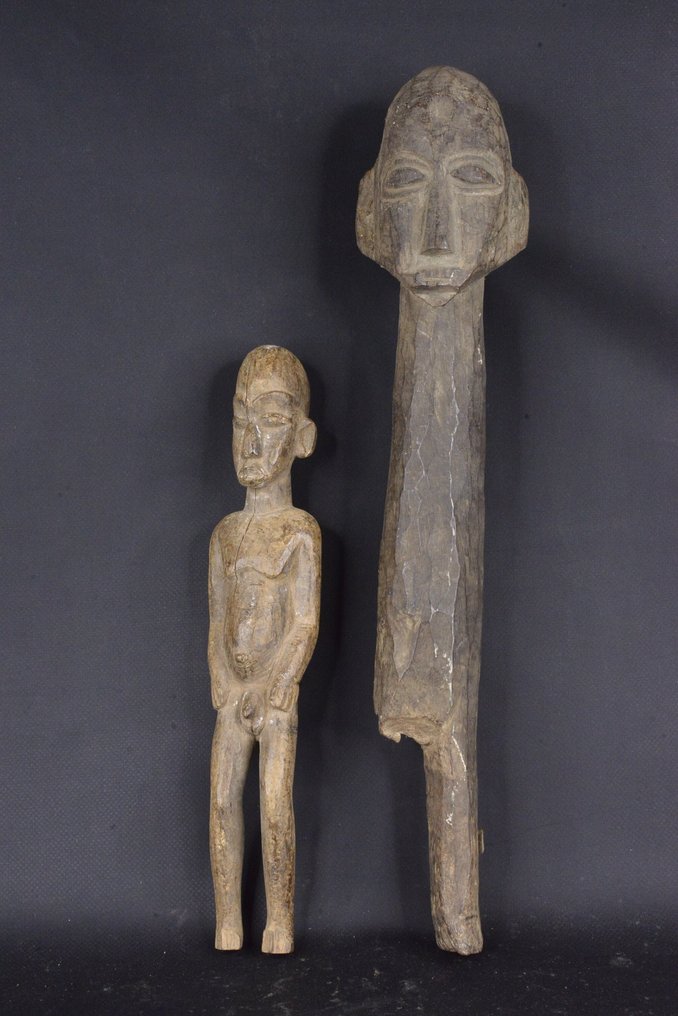
Pair of statues - Lobi - Mali


06
days
02
hours
21
minutes
02
seconds
Current bid
€ 100
Reserve price met

Expert
Selected by Julien Gauthier
A decade of experience in historical arms, armour, and African art.
Estimate € 150 - € 200
 | €100 | |
|---|---|---|
| €50 |
Catawiki Buyer Protection
Your payment’s safe with us until you receive your object.View details
Trustpilot 4.4 | 137094 reviews
Rated Excellent on Trustpilot.
Description from the seller
Burkina Faso
Lobi
Wood
Dimensions :
The small figure: on the left height: 315mm width: 60mm - depth: 45mm
The large figure: height: 445mm width: 85mm - depth: 95mm
Small figure: feet missing
Large figure: one leg missing
1. Origin and stylistic analysis: Two distinct pieces
The visual examination shows that this is not a pair of ancestors carved by the same hand, but two objects with different functions and styles.
The left statuette (31 cm): A classic Lobi Bateba
Morphology: It is a standing male figure with fully exposed anatomy. It bears the distinctive traits of Lobi statuary: an oval head, a long straight nose, protruding ears, and a grave-faced expression. The arms frame the torso in a hieratic manner and the hands rest discreetly on the top of the thighs.
Patina: It presents a light, matte, dried surface, characteristic of wood exposed to the dry savanna air or on an inner altar.
The right sculpture (44 cm): A sanctuary stake or pole figure
Morphology: This piece radically breaks with the first. The body of the statue is not differentiated: it is reduced to a long rough wooden shaft, faceted vertically with a polisher, ending in a rough base (seemingly broken or intended to be planted in the ground). Only the head is sculpted at the top, bearing a stylized face with eyes ringed by a double rim and large rectangular ears.
Cultural affinity: This type of anthropomorphic statuette on a stake or “fetish pole” is found among the Lobi, but also very common among their neighbors the Moba (Togo/Burkina Faso, under the name Chidigo) or the Oron/Ekoi in ritual pole contexts. It is a form of radical sacred abstraction.
2. Ritual use: Intercession and grounding in the sanctuary
These two objects were designed to occupy the spiritual heart of the traditional home (the soukhala) or an outdoor sanctuary:
The role of the Bateba (left): Among the Lobi, this piece is commissioned from a sculptor by a diviner to materialize a bush spirit (Thil). Placed on the family altar, it serves as an invisible sentinel to absorb illness, counter curses and intercept attacks from sorcerers.
The role of the anthropomorphic stake (right): The stake/pillar structure of the large piece indicates a foundation or grounding function. These pieces were either planted directly in the sacred courtyard ground or inserted in the middle of a mound of earth and sacrificial clay forming the clan’s main altar. Libations of millet beer or bloody sacrifices were regularly poured here to honor the residing entity.
3. Meaning: The protection of the family territory
Although morphologically very different, these two sculptures share the same metaphysical purpose within the Vaolo (voltaic) societies:
A shield against disorder: For these peoples, the bush world is peopled with invisible forces potentially dangerous. Introducing these figures into the domestic space helps domesticate these forces to turn them into allies.
Dialogue with the invisible: When gathered or placed on the same altar space, the figurative statuette and the pole-column form a communication hub. They recall the absolute dependence of the living on the decrees of protective spirits and the memory of the founders of the place, thereby ensuring health, descendant, and peace for the household.
Packages are shipped from Monday to Saturday with a tracking number.
Delivery via Chronopost within 1 to 3 days in France and 2 to 5 days across the European Union. Delivery to the rest of Europe and the world via Colissimo International.
We speak english.
mask african art Afrikanische Maskenkunst arte de máscaras africanas arte delle maschere africane
statue african art Arte de estatuas africanas arte delle statue africane Afrikanische Maskenkunst
Seller's Story
Passionate about World Arts and more specifically about African Art, we buy from collectors, former officials, military, health workers, public works staff who have worked in Africa and also in Côte d'Ivoire, from antique dealers and traders who roam across West Africa to find quality objects.
It is with pride that we present works that, beyond their power to beautify spaces, invite our collectors to resonate with the richness and depth of human expression through the most authentic art.
At Arts Ethniques Gallery, we have the privilege of offering our visitors an exclusive selection of artworks, all unique and original. Each piece presented is the outcome of a demanding artistic approach, driven by a singular vision and mastered craftsmanship, all elements that guarantee authenticity and value.
The works we offer are not industrial reproductions. They are individual creations, crafted with sensitivity and precision, each bearing its own story, identity and presence. Originality is the very foundation of our commitment to excellence. Thus, every mask and every statue in our collection is the subject of a rigorous selection, in order to preserve their rarity and singularity.
Acquiring a work from Arts Ethniques Gallery means owning a truly unique piece: a creation that embodies both talent, cultural memory and the expressive force of African art. It is also a lasting investment in a work whose artistic and emotional value transcends time.
We guarantee that every work leaving our gallery is an authentic piece, without replicas, bearing witness to the creativity, heritage and passion of the African artists who shaped them.
We invite you to participate in our gallery’s auctions with confidence. Each presented work is an original, unique and irreplaceable creation, selected with the greatest rigor to guarantee its authenticity and artistic value.
Whether you wish to enrich a personal collection or introduce an exceptional artwork into your space, Arts Ethniques Gallery offers a safe, transparent and professional setting to acquire remarkable pieces.
Art auctions are a privileged moment to discover rare works, capable of becoming the heart of a collection. Acquiring a work at our sales is not just buying an object: it is investing in a creation whose aesthetic value and cultural reach reinforce over time.
The pieces presented by Arts Ethniques Gallery testify not only to the talent and vision of the artists but also possess the ability to transform spaces and enrich the gaze of those who behold them.
Participating in our auctions is taking part in a singular experience, where the passion for art meets the rigors of collecting. Bidding on a work from Arts Ethniques Gallery goes beyond a simple transaction: it is a gesture of commitment and appreciation for art in its most authentic form.
We invite you to bid with passion and to join us in this adventure dedicated to discovery, transmission and celebration of art.
Perhaps your next heart piece is already waiting for you."
Translated by Google TranslateBurkina Faso
Lobi
Wood
Dimensions :
The small figure: on the left height: 315mm width: 60mm - depth: 45mm
The large figure: height: 445mm width: 85mm - depth: 95mm
Small figure: feet missing
Large figure: one leg missing
1. Origin and stylistic analysis: Two distinct pieces
The visual examination shows that this is not a pair of ancestors carved by the same hand, but two objects with different functions and styles.
The left statuette (31 cm): A classic Lobi Bateba
Morphology: It is a standing male figure with fully exposed anatomy. It bears the distinctive traits of Lobi statuary: an oval head, a long straight nose, protruding ears, and a grave-faced expression. The arms frame the torso in a hieratic manner and the hands rest discreetly on the top of the thighs.
Patina: It presents a light, matte, dried surface, characteristic of wood exposed to the dry savanna air or on an inner altar.
The right sculpture (44 cm): A sanctuary stake or pole figure
Morphology: This piece radically breaks with the first. The body of the statue is not differentiated: it is reduced to a long rough wooden shaft, faceted vertically with a polisher, ending in a rough base (seemingly broken or intended to be planted in the ground). Only the head is sculpted at the top, bearing a stylized face with eyes ringed by a double rim and large rectangular ears.
Cultural affinity: This type of anthropomorphic statuette on a stake or “fetish pole” is found among the Lobi, but also very common among their neighbors the Moba (Togo/Burkina Faso, under the name Chidigo) or the Oron/Ekoi in ritual pole contexts. It is a form of radical sacred abstraction.
2. Ritual use: Intercession and grounding in the sanctuary
These two objects were designed to occupy the spiritual heart of the traditional home (the soukhala) or an outdoor sanctuary:
The role of the Bateba (left): Among the Lobi, this piece is commissioned from a sculptor by a diviner to materialize a bush spirit (Thil). Placed on the family altar, it serves as an invisible sentinel to absorb illness, counter curses and intercept attacks from sorcerers.
The role of the anthropomorphic stake (right): The stake/pillar structure of the large piece indicates a foundation or grounding function. These pieces were either planted directly in the sacred courtyard ground or inserted in the middle of a mound of earth and sacrificial clay forming the clan’s main altar. Libations of millet beer or bloody sacrifices were regularly poured here to honor the residing entity.
3. Meaning: The protection of the family territory
Although morphologically very different, these two sculptures share the same metaphysical purpose within the Vaolo (voltaic) societies:
A shield against disorder: For these peoples, the bush world is peopled with invisible forces potentially dangerous. Introducing these figures into the domestic space helps domesticate these forces to turn them into allies.
Dialogue with the invisible: When gathered or placed on the same altar space, the figurative statuette and the pole-column form a communication hub. They recall the absolute dependence of the living on the decrees of protective spirits and the memory of the founders of the place, thereby ensuring health, descendant, and peace for the household.
Packages are shipped from Monday to Saturday with a tracking number.
Delivery via Chronopost within 1 to 3 days in France and 2 to 5 days across the European Union. Delivery to the rest of Europe and the world via Colissimo International.
We speak english.
mask african art Afrikanische Maskenkunst arte de máscaras africanas arte delle maschere africane
statue african art Arte de estatuas africanas arte delle statue africane Afrikanische Maskenkunst
Seller's Story
Passionate about World Arts and more specifically about African Art, we buy from collectors, former officials, military, health workers, public works staff who have worked in Africa and also in Côte d'Ivoire, from antique dealers and traders who roam across West Africa to find quality objects.
It is with pride that we present works that, beyond their power to beautify spaces, invite our collectors to resonate with the richness and depth of human expression through the most authentic art.
At Arts Ethniques Gallery, we have the privilege of offering our visitors an exclusive selection of artworks, all unique and original. Each piece presented is the outcome of a demanding artistic approach, driven by a singular vision and mastered craftsmanship, all elements that guarantee authenticity and value.
The works we offer are not industrial reproductions. They are individual creations, crafted with sensitivity and precision, each bearing its own story, identity and presence. Originality is the very foundation of our commitment to excellence. Thus, every mask and every statue in our collection is the subject of a rigorous selection, in order to preserve their rarity and singularity.
Acquiring a work from Arts Ethniques Gallery means owning a truly unique piece: a creation that embodies both talent, cultural memory and the expressive force of African art. It is also a lasting investment in a work whose artistic and emotional value transcends time.
We guarantee that every work leaving our gallery is an authentic piece, without replicas, bearing witness to the creativity, heritage and passion of the African artists who shaped them.
We invite you to participate in our gallery’s auctions with confidence. Each presented work is an original, unique and irreplaceable creation, selected with the greatest rigor to guarantee its authenticity and artistic value.
Whether you wish to enrich a personal collection or introduce an exceptional artwork into your space, Arts Ethniques Gallery offers a safe, transparent and professional setting to acquire remarkable pieces.
Art auctions are a privileged moment to discover rare works, capable of becoming the heart of a collection. Acquiring a work at our sales is not just buying an object: it is investing in a creation whose aesthetic value and cultural reach reinforce over time.
The pieces presented by Arts Ethniques Gallery testify not only to the talent and vision of the artists but also possess the ability to transform spaces and enrich the gaze of those who behold them.
Participating in our auctions is taking part in a singular experience, where the passion for art meets the rigors of collecting. Bidding on a work from Arts Ethniques Gallery goes beyond a simple transaction: it is a gesture of commitment and appreciation for art in its most authentic form.
We invite you to bid with passion and to join us in this adventure dedicated to discovery, transmission and celebration of art.
Perhaps your next heart piece is already waiting for you."
Translated by Google TranslateDetails
Indigenous object name
Pair of statues
Ethnic group/ culture
Lobi
Country of Origin
Mali
Material
Wood
Sold with stand
No
Condition
Fair condition
Sold by
