Baule - Côte d'Ivoire



06
days
14
hours
36
minutes
13
seconds
Starting bid
€ 1
Reserve price not met

Expert
Selected by Julien Gauthier
A decade of experience in historical arms, armour, and African art.
Estimate € 150 - € 200
No bids placed
Catawiki Buyer Protection
Your payment’s safe with us until you receive your object.View details
Trustpilot 4.4 | 137024 reviews
Rated Excellent on Trustpilot.
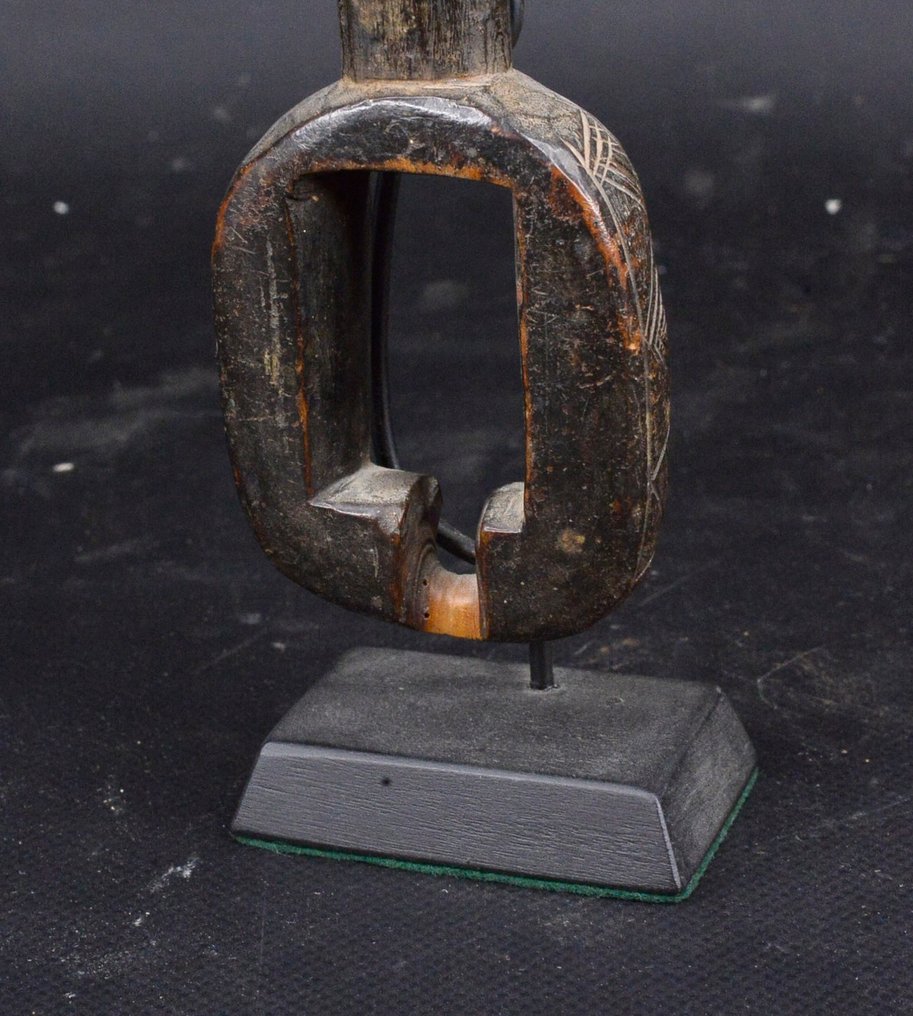
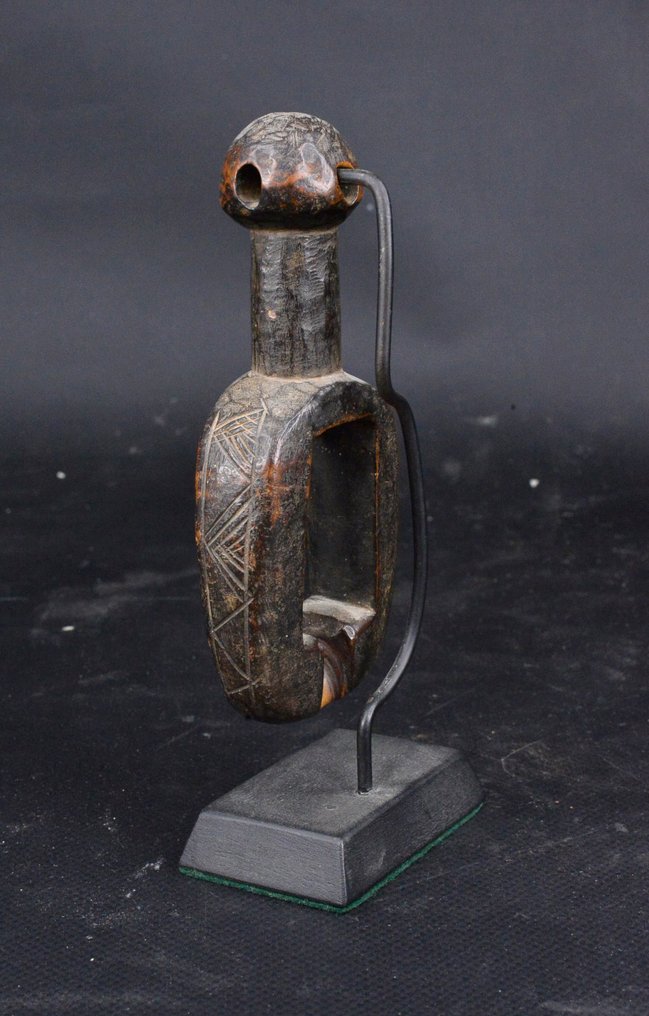
Wooden weaving loom pulley from the Baoulé people of Côte d'Ivoire, sold with stand, dimensions 135 mm height plus 10 mm base, 60 mm width and 3 mm depth, in excellent condition.
AI-assisted summary
Description from the seller
Ivory Coast
Baoulé
Dimension:
Height: 135mm + base 10mm
Width: 60mm
Depth: 3mm
This carved wooden piece is a loom pulley, an emblematic mobile art and utilitarian object of the Baoulé people, living in Ivory Coast.
Among the Baoulé and other Akan cultural area groups, weaving tools are not only functional: they are almost always sculpted with great refinement to incorporate anthropomorphic or zoomorphic figures.
1. Formal characteristics and analysis of the piece
Visual examination of the files poulie_baoule-BP094.jpg and poulie_baoule-BP094-7.jpg allows appreciation of the technical structure and wear of this tool:
The stylized anthropomorphic head: The top of the pulley takes the shape of a simplified head or a rounded cephalic button. You can discern neat, circular perforations. These openings were used to pass the suspension cord that connected the pulley to the upper frame of the horizontal loom.
The body of the pulley (shank): The central part forms an oval or rectangular hollowed frame. On the sides of this frame, discreet geometric motifs, made of fine incised lines in chevrons, decorate the surface of the wood.
The axle and the wheel are missing: At the base of the frame, there is a rounded, worn notch. It is exactly here that the removable axle (often wood or metal) that held the small wheel (the flyer) on which the string linking the heddles slid used to fit. On this old piece, the original flyer is no longer present, which is very common on collectible objects that have been used.
The wear patina: The object shows a dark, dense, oily patina typical of woods long handled by weavers. The inner base of the frame reveals a lighter, eroded area clearly visible in the photos, caused by the constant friction of the cords and the moving flyer during weaving.
2. Functional use on the loom
Weaving is traditionally an activity exclusively masculine among the Baoulé. The pulley plays a key mechanical role in this process:
The up-and-down motion of the heddles: The weaver sits in front of a long, narrow loom. His feet operate pedals connected to the heddles (the frames that separate the warp threads). The pulley, suspended above the loom, serves as a return axle: when the weaver presses a pedal to lower a heddle, the pulley allows the second heddle to rise alternately.
A visual and spiritual comfort: Weaving is a long, repetitive, and meticulous task. By placing a sculpted figure right before his eyes, at eye level, the weaver breaks the monotony of the task. The object serves as a visual working companion.
3. Symbolic and aesthetic meaning
Beyond its mechanical function, the beauty of the pulley reflects the status of its owner. A skilled artisan was expected to own refined tools to showcase his know-how to his clients.
Moreover, in local cosmology, the act of weaving — interlacing threads to create a unified structure — is often likened to speech, social fabric, and world creation. Decorating a pulley with a human head or a protective spirit allowed summoning the blessing of ancestors on the work in progress, ensuring that the fabric produced is of good quality and brings protection to the wearer.
Packages are shipped Monday through Saturday with insurance and tracking number.
Delivery in 1 to 3 days in France with Chronopost, 2 to 5 days across the European Union.
Delivery in the rest of Europe and worldwide with Colissimo international.
We speak english
Mask african art Afrikanische Maskenkunst arte de máscaras africanas arte delle maschere africane
statue african art Arte de estatuas africanas arte delle statue africane Afrikanische Maskenkunst
Máscara de estatua de galería de arte africano
Seller's Story
Passionate about World Arts and more specifically about African Art, we buy from collectors, former officials, military, health workers, public works staff who have worked in Africa and also in Côte d'Ivoire, from antique dealers and traders who roam across West Africa to find quality objects.
It is with pride that we present works that, beyond their power to beautify spaces, invite our collectors to resonate with the richness and depth of human expression through the most authentic art.
At Arts Ethniques Gallery, we have the privilege of offering our visitors an exclusive selection of artworks, all unique and original. Each piece presented is the outcome of a demanding artistic approach, driven by a singular vision and mastered craftsmanship, all elements that guarantee authenticity and value.
The works we offer are not industrial reproductions. They are individual creations, crafted with sensitivity and precision, each bearing its own story, identity and presence. Originality is the very foundation of our commitment to excellence. Thus, every mask and every statue in our collection is the subject of a rigorous selection, in order to preserve their rarity and singularity.
Acquiring a work from Arts Ethniques Gallery means owning a truly unique piece: a creation that embodies both talent, cultural memory and the expressive force of African art. It is also a lasting investment in a work whose artistic and emotional value transcends time.
We guarantee that every work leaving our gallery is an authentic piece, without replicas, bearing witness to the creativity, heritage and passion of the African artists who shaped them.
We invite you to participate in our gallery’s auctions with confidence. Each presented work is an original, unique and irreplaceable creation, selected with the greatest rigor to guarantee its authenticity and artistic value.
Whether you wish to enrich a personal collection or introduce an exceptional artwork into your space, Arts Ethniques Gallery offers a safe, transparent and professional setting to acquire remarkable pieces.
Art auctions are a privileged moment to discover rare works, capable of becoming the heart of a collection. Acquiring a work at our sales is not just buying an object: it is investing in a creation whose aesthetic value and cultural reach reinforce over time.
The pieces presented by Arts Ethniques Gallery testify not only to the talent and vision of the artists but also possess the ability to transform spaces and enrich the gaze of those who behold them.
Participating in our auctions is taking part in a singular experience, where the passion for art meets the rigors of collecting. Bidding on a work from Arts Ethniques Gallery goes beyond a simple transaction: it is a gesture of commitment and appreciation for art in its most authentic form.
We invite you to bid with passion and to join us in this adventure dedicated to discovery, transmission and celebration of art.
Perhaps your next heart piece is already waiting for you."
Translated by Google TranslateIvory Coast
Baoulé
Dimension:
Height: 135mm + base 10mm
Width: 60mm
Depth: 3mm
This carved wooden piece is a loom pulley, an emblematic mobile art and utilitarian object of the Baoulé people, living in Ivory Coast.
Among the Baoulé and other Akan cultural area groups, weaving tools are not only functional: they are almost always sculpted with great refinement to incorporate anthropomorphic or zoomorphic figures.
1. Formal characteristics and analysis of the piece
Visual examination of the files poulie_baoule-BP094.jpg and poulie_baoule-BP094-7.jpg allows appreciation of the technical structure and wear of this tool:
The stylized anthropomorphic head: The top of the pulley takes the shape of a simplified head or a rounded cephalic button. You can discern neat, circular perforations. These openings were used to pass the suspension cord that connected the pulley to the upper frame of the horizontal loom.
The body of the pulley (shank): The central part forms an oval or rectangular hollowed frame. On the sides of this frame, discreet geometric motifs, made of fine incised lines in chevrons, decorate the surface of the wood.
The axle and the wheel are missing: At the base of the frame, there is a rounded, worn notch. It is exactly here that the removable axle (often wood or metal) that held the small wheel (the flyer) on which the string linking the heddles slid used to fit. On this old piece, the original flyer is no longer present, which is very common on collectible objects that have been used.
The wear patina: The object shows a dark, dense, oily patina typical of woods long handled by weavers. The inner base of the frame reveals a lighter, eroded area clearly visible in the photos, caused by the constant friction of the cords and the moving flyer during weaving.
2. Functional use on the loom
Weaving is traditionally an activity exclusively masculine among the Baoulé. The pulley plays a key mechanical role in this process:
The up-and-down motion of the heddles: The weaver sits in front of a long, narrow loom. His feet operate pedals connected to the heddles (the frames that separate the warp threads). The pulley, suspended above the loom, serves as a return axle: when the weaver presses a pedal to lower a heddle, the pulley allows the second heddle to rise alternately.
A visual and spiritual comfort: Weaving is a long, repetitive, and meticulous task. By placing a sculpted figure right before his eyes, at eye level, the weaver breaks the monotony of the task. The object serves as a visual working companion.
3. Symbolic and aesthetic meaning
Beyond its mechanical function, the beauty of the pulley reflects the status of its owner. A skilled artisan was expected to own refined tools to showcase his know-how to his clients.
Moreover, in local cosmology, the act of weaving — interlacing threads to create a unified structure — is often likened to speech, social fabric, and world creation. Decorating a pulley with a human head or a protective spirit allowed summoning the blessing of ancestors on the work in progress, ensuring that the fabric produced is of good quality and brings protection to the wearer.
Packages are shipped Monday through Saturday with insurance and tracking number.
Delivery in 1 to 3 days in France with Chronopost, 2 to 5 days across the European Union.
Delivery in the rest of Europe and worldwide with Colissimo international.
We speak english
Mask african art Afrikanische Maskenkunst arte de máscaras africanas arte delle maschere africane
statue african art Arte de estatuas africanas arte delle statue africane Afrikanische Maskenkunst
Máscara de estatua de galería de arte africano
Seller's Story
Passionate about World Arts and more specifically about African Art, we buy from collectors, former officials, military, health workers, public works staff who have worked in Africa and also in Côte d'Ivoire, from antique dealers and traders who roam across West Africa to find quality objects.
It is with pride that we present works that, beyond their power to beautify spaces, invite our collectors to resonate with the richness and depth of human expression through the most authentic art.
At Arts Ethniques Gallery, we have the privilege of offering our visitors an exclusive selection of artworks, all unique and original. Each piece presented is the outcome of a demanding artistic approach, driven by a singular vision and mastered craftsmanship, all elements that guarantee authenticity and value.
The works we offer are not industrial reproductions. They are individual creations, crafted with sensitivity and precision, each bearing its own story, identity and presence. Originality is the very foundation of our commitment to excellence. Thus, every mask and every statue in our collection is the subject of a rigorous selection, in order to preserve their rarity and singularity.
Acquiring a work from Arts Ethniques Gallery means owning a truly unique piece: a creation that embodies both talent, cultural memory and the expressive force of African art. It is also a lasting investment in a work whose artistic and emotional value transcends time.
We guarantee that every work leaving our gallery is an authentic piece, without replicas, bearing witness to the creativity, heritage and passion of the African artists who shaped them.
We invite you to participate in our gallery’s auctions with confidence. Each presented work is an original, unique and irreplaceable creation, selected with the greatest rigor to guarantee its authenticity and artistic value.
Whether you wish to enrich a personal collection or introduce an exceptional artwork into your space, Arts Ethniques Gallery offers a safe, transparent and professional setting to acquire remarkable pieces.
Art auctions are a privileged moment to discover rare works, capable of becoming the heart of a collection. Acquiring a work at our sales is not just buying an object: it is investing in a creation whose aesthetic value and cultural reach reinforce over time.
The pieces presented by Arts Ethniques Gallery testify not only to the talent and vision of the artists but also possess the ability to transform spaces and enrich the gaze of those who behold them.
Participating in our auctions is taking part in a singular experience, where the passion for art meets the rigors of collecting. Bidding on a work from Arts Ethniques Gallery goes beyond a simple transaction: it is a gesture of commitment and appreciation for art in its most authentic form.
We invite you to bid with passion and to join us in this adventure dedicated to discovery, transmission and celebration of art.
Perhaps your next heart piece is already waiting for you."
Translated by Google TranslateDetails
Ethnic group/ culture
Baule
Country of Origin
Côte d'Ivoire
Material
Wood
Sold with stand
Yes
Condition
Excellent condition
Sold by
