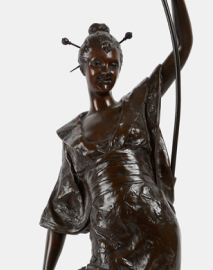
Statue, De omhelzing - 9.5 cm - Bronze


02
days
15
hours
41
minutes
15
seconds

 | €1 |
|---|
Catawiki Buyer Protection
Your payment’s safe with us until you receive your object.View details
Trustpilot 4.4 | 137514 reviews
Rated Excellent on Trustpilot.
Bronze sculpture titled 'De omhelzing', attributed to a post-war Western European artist, measuring 9.5 × 5.5 × 5 cm and weighing 830 g, made in Austria, unsigned and in excellent condition, with a rough as-cast base from lost-wax casting and a green patina.
AI-assisted summary
Description from the seller
Splendidly designed modernist expressionist work titled 'The Embrace' which is made of solid bronze by a post-war West European artist.
The bottom shows a rough, unfinished casting surface typical of the lost-wax method (cire perdue). The small round hole in the center is a casting gate or vent hole that has later been partially closed. The greenish oxidation (patina) in the deeper veins confirms the presence of copper (the main component of bronze).
There is no signature or foundry stamp visible on the base. Many small, expressive studio sculptures from the early to mid-century period (ca. 1950–1980) were produced in small editions or as unique pieces (proefgieting) by the artist themselves or at a local foundry without a clear brand added.
Stylistically, it is a modernist expressionist work. It shares the raw, emotional vocabulary of well-known Central European and Dutch expressionists who depicted the human figure in intimate or struggling poses, such as Alfred Hrdlicka or his contemporaries. Without a signature it should officially be categorized as "Attributed to a post-war West European artist".
Dimensions: 9.5 x 5.5 x 5 cm
Weight: 830 g
Splendidly designed modernist expressionist work titled 'The Embrace' which is made of solid bronze by a post-war West European artist.
The bottom shows a rough, unfinished casting surface typical of the lost-wax method (cire perdue). The small round hole in the center is a casting gate or vent hole that has later been partially closed. The greenish oxidation (patina) in the deeper veins confirms the presence of copper (the main component of bronze).
There is no signature or foundry stamp visible on the base. Many small, expressive studio sculptures from the early to mid-century period (ca. 1950–1980) were produced in small editions or as unique pieces (proefgieting) by the artist themselves or at a local foundry without a clear brand added.
Stylistically, it is a modernist expressionist work. It shares the raw, emotional vocabulary of well-known Central European and Dutch expressionists who depicted the human figure in intimate or struggling poses, such as Alfred Hrdlicka or his contemporaries. Without a signature it should officially be categorized as "Attributed to a post-war West European artist".
Dimensions: 9.5 x 5.5 x 5 cm
Weight: 830 g
Details
Era
1900-2000
Country of origin
Austria
Material
Bronze
Title of artwork
De omhelzing
Signature
Not signed
Condition
Excellent condition
Height
9.5 cm
Width
5.5 cm
Depth
5 cm
Weight
830 g