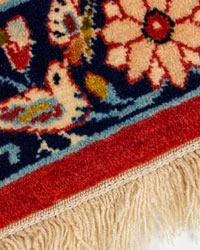
Yahyahli - Carpet - 192 cm - 177 cm - Turkish Kilim, 1970s


02
days
17
hours
25
minutes
47
seconds
Starting bid
€ 1
Reserve price not met

Expert
Selected by Richard Ebbers
Certified appraiser at Federation TMV with 30 years' professional antiques experience.
Estimate € 550 - € 650
No bids placed
Catawiki Buyer Protection
Your payment’s safe with us until you receive your object.View details
Trustpilot 4.4 | 137988 reviews
Rated Excellent on Trustpilot.
Description from the seller
This large vintage Turkish kilim is handmade in wool with a distinctive Life Tree motif on a red background.
This artifact is a Yahyali Prayer Kilim (Yahyalı Kilim in Turkish), a type of flatwoven rug from the Kayseri region (Central Anatolia, Turkey).
Design Features
The Prayer Niche (Mihrab):
The large brick-red pointed geometric profile symbolizes the mihrab, the niche in mosques that indicates the direction of Mecca.
The Tree of Life:
The central branching motif that runs vertically across the red field represents the Tree of Life, a traditional Anatolian symbol of immortality, continuity, and spiritual connection between earth and sky.
Protective Symbols:
Along the sides and at the top are small geometric motifs and stylized elements, such as talismans (muska), historically inserted by the weavers to ward off the evil eye.
Protective Motifs
Triangles and Hooks:
The sawtooth shapes along the edges of the central field (often called 'hooks' or 'wolves') serve a protective function against the evil eye.
Eye Symbol (Göz):
Within the branches of the tree there are small diamonds or central shapes that stylize the eye, another amulet against misfortune.
Symbolism of Abundance (Bereket):
Many of the scattered geometric elements, such as small stylized flowers or X motifs, are variants of the Bereket symbol, invoking fertility and abundance for the family.
Unlike knotted carpets, this is a flatweave (plain weave).
Absence of Pile: It has no pile (no fur), which creates a clean, purely geometric design due to the perpendicular interlacing of warp and weft threads.
Material:
Typically made of natural-dyed wool (predominantly red and blue in this specimen).
These artifacts are not mere decorations, but true 'visual texts' that tell the story and hopes of the nomadic and semi-nomadic tribes that produced them.
This large vintage Turkish kilim is handmade in wool with a distinctive Life Tree motif on a red background.
This artifact is a Yahyali Prayer Kilim (Yahyalı Kilim in Turkish), a type of flatwoven rug from the Kayseri region (Central Anatolia, Turkey).
Design Features
The Prayer Niche (Mihrab):
The large brick-red pointed geometric profile symbolizes the mihrab, the niche in mosques that indicates the direction of Mecca.
The Tree of Life:
The central branching motif that runs vertically across the red field represents the Tree of Life, a traditional Anatolian symbol of immortality, continuity, and spiritual connection between earth and sky.
Protective Symbols:
Along the sides and at the top are small geometric motifs and stylized elements, such as talismans (muska), historically inserted by the weavers to ward off the evil eye.
Protective Motifs
Triangles and Hooks:
The sawtooth shapes along the edges of the central field (often called 'hooks' or 'wolves') serve a protective function against the evil eye.
Eye Symbol (Göz):
Within the branches of the tree there are small diamonds or central shapes that stylize the eye, another amulet against misfortune.
Symbolism of Abundance (Bereket):
Many of the scattered geometric elements, such as small stylized flowers or X motifs, are variants of the Bereket symbol, invoking fertility and abundance for the family.
Unlike knotted carpets, this is a flatweave (plain weave).
Absence of Pile: It has no pile (no fur), which creates a clean, purely geometric design due to the perpendicular interlacing of warp and weft threads.
Material:
Typically made of natural-dyed wool (predominantly red and blue in this specimen).
These artifacts are not mere decorations, but true 'visual texts' that tell the story and hopes of the nomadic and semi-nomadic tribes that produced them.
Details
Era
1900-2000
Title additional information
Turkish Kilim, 1970s
Model
Yahyahli
Colour
Red
Length
192 cm
Width
177 cm
Material
Wool on wool
Country of origin
Türkiye
Condition
In very good condition
Professionally cleaned
Yes
Manufacturing period
Mid 20th century
Sold by