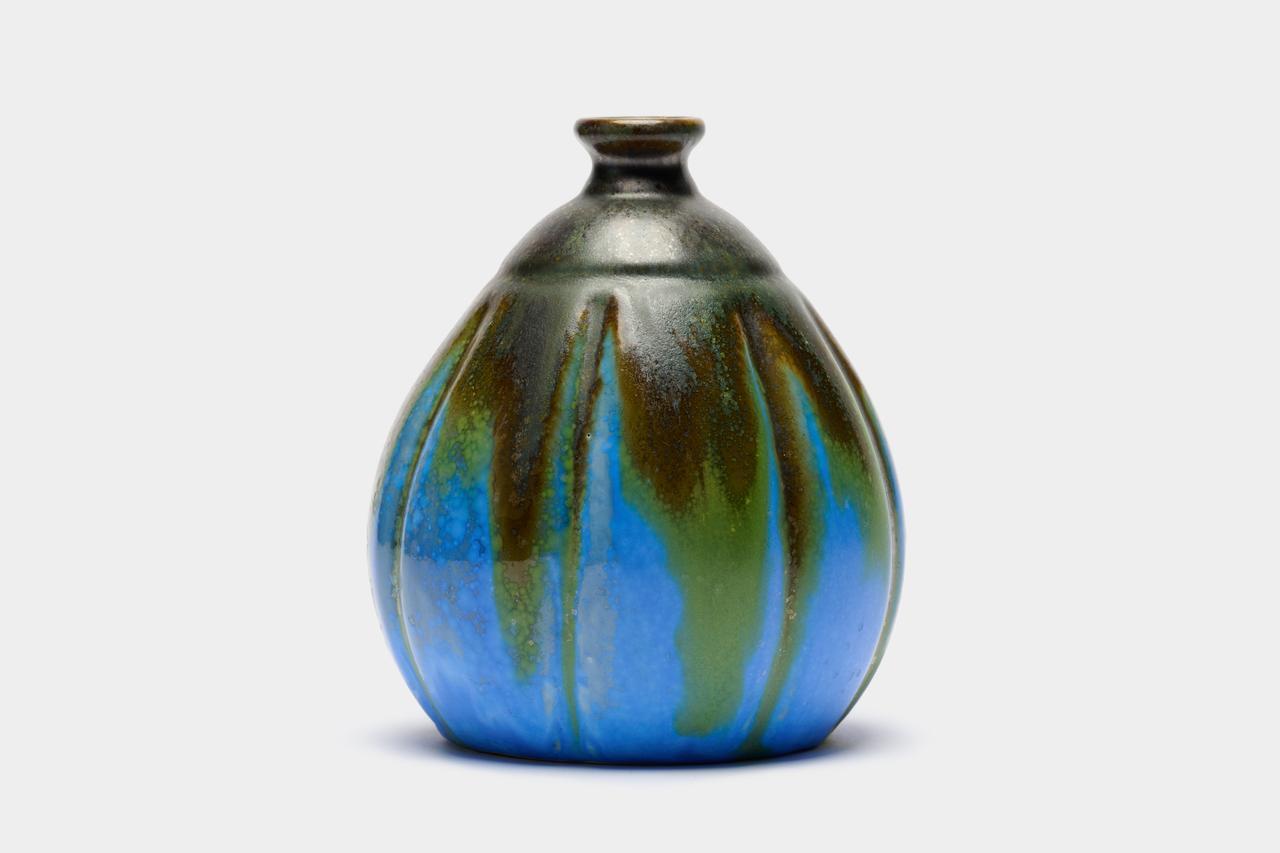
Serving dish - Ceramic - Ceramica Kashan


04
days
14
hours
11
minutes
15
seconds
Starting bid
€ 1
Reserve price not met

Expert
Selected by John Laurance
Thirty years' experience in decorative objects and two decades as shop owner.
Estimate € 280 - € 330
No bids placed
Catawiki Buyer Protection
Your payment’s safe with us until you receive your object.View details
Trustpilot 4.4 | 137727 reviews
Rated Excellent on Trustpilot.
Description from the seller
A large serving dish or parade basin, of Middle Eastern or Silk Road production, with strong stylistic and structural affinities to Kashan (Persia) ceramics or those of Central Asia dating to the XII– XIV centuries. The foot with the raised ring and the central part of the base are devoid of turquoise glaze, leaving exposed the siliceous or clay ceramic paste. This technical choice prevented the object from fusing to or sticking to the kiln supports during high-temperature firing. Along the outer circular band there are irregular drips of blue-tblue glaze. This uneven thickness and the translucent effect are typical of hand-applied immersion or pouring glaze, characteristic of medieval Islamic ceramic workshops. The three glaze-free dots arranged in a triangle indicate the use of “rooster’s feet” (refractory tripods). They were used to stack the dishes in the kiln without them sticking together during the glass-fusion firing. The jagged profile, although compromised by chips and glaze loss, shows a lively, undulating rim consistent with models of parade or banqueting wares.
Seller's Story
I am an antiques dealer who has closed his shops (3) with a large remainder of pieces including paintings, porcelain, sculptures, furniture, etc.
I am dispersing all these works at prices very often lower than my purchase prices. They are all guaranteed and original works of great quality and value. Furthermore, through my thirty years of contacts, I continue to buy and offer extraordinary works at unbeatable prices, but only online.
robertoloriaantiques
Translated by Google TranslateA large serving dish or parade basin, of Middle Eastern or Silk Road production, with strong stylistic and structural affinities to Kashan (Persia) ceramics or those of Central Asia dating to the XII– XIV centuries. The foot with the raised ring and the central part of the base are devoid of turquoise glaze, leaving exposed the siliceous or clay ceramic paste. This technical choice prevented the object from fusing to or sticking to the kiln supports during high-temperature firing. Along the outer circular band there are irregular drips of blue-tblue glaze. This uneven thickness and the translucent effect are typical of hand-applied immersion or pouring glaze, characteristic of medieval Islamic ceramic workshops. The three glaze-free dots arranged in a triangle indicate the use of “rooster’s feet” (refractory tripods). They were used to stack the dishes in the kiln without them sticking together during the glass-fusion firing. The jagged profile, although compromised by chips and glaze loss, shows a lively, undulating rim consistent with models of parade or banqueting wares.
Seller's Story
I am an antiques dealer who has closed his shops (3) with a large remainder of pieces including paintings, porcelain, sculptures, furniture, etc.
I am dispersing all these works at prices very often lower than my purchase prices. They are all guaranteed and original works of great quality and value. Furthermore, through my thirty years of contacts, I continue to buy and offer extraordinary works at unbeatable prices, but only online.
robertoloriaantiques
Translated by Google TranslateDetails
Era
Before 1400
Specific region of origin
Persia
Culture
Kashan
Title additional information
Ceramica Kashan
Century/timeframe
XII-XIV Secolo
Acquired from
Auction house
Country of origin
Asia
Year acquired
2014
Country acquired from
Italy
Material
Ceramic
Previous owner acquired from
Auction house
Previous owner - year acquired
2015
Previous owner - country acquired from
Italy
Condition
Poor - heavily used with major cracks, damages or major parts missing
I verify that I have obtained this object legally and that I am allowed to sell it
Yes
Height
32 cm
Width
32 cm
Depth
9 cm
Sold by