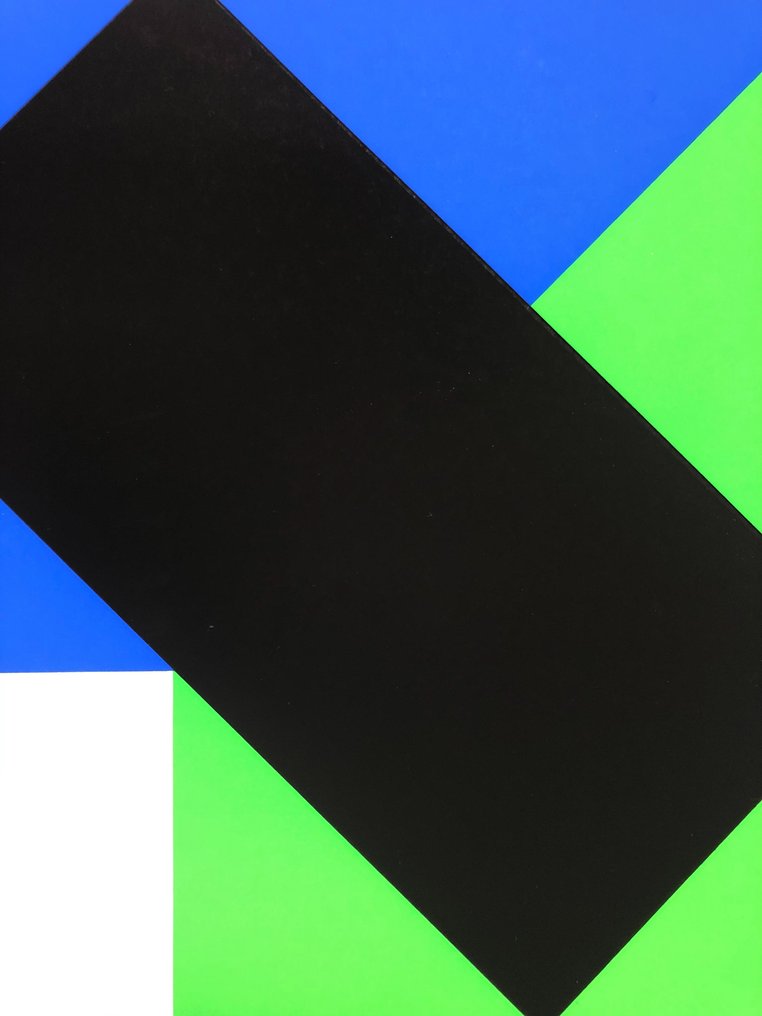
Max Bill - Komposition Mit Weißem Zentrum - Original Silkscreen Print


03
days
03
hours
44
minutes
38
seconds
Starting bid
€ 1
No reserve price

Expert
Selected by Alexander Fahl
Art historian with over 10 years' experience and expertise in Italian design.
Estimate € 160 - € 200
No bids placed
Catawiki Buyer Protection
Your payment’s safe with us until you receive your object.View details
Trustpilot 4.4 | 138166 reviews
Rated Excellent on Trustpilot.
Max Bill, a German artist, presents the original limited edition silkscreen Komposition Mit Weißem Zentrum, 67 × 67 cm sheet with a 58 × 58 cm motif, dating from the 1970s, unsigned and in excellent condition, sold by Galería with a COA.
AI-assisted summary
Description from the seller
Original serigraphy by Max Bill (*)
This work was published by Galerie Thomas (Munich) on the occasion of the exhibition “Look At.”
Printed on fine vellum paper.
Unsigned.
Attached Certificate of Authenticity (COA).
Specifications:
Sheet dimensions: 67 x 67 cm.
Motif dimensions: 58 x 58 cm.
Year: 1972
Edition: unknown.
Publisher: Galerie Thomas (Munich)
Condition: Excellent (this work has never been framed or exhibited, always kept in a professional art folder, and is therefore in very good condition)
The work will be carefully handled and packed. The shipment will be sent by insured mail with a tracking number.
The shipment will be sent by insured mail with a tracking number. The shipment will also include transport insurance with full reimbursement in case of loss or damage at no cost to the buyer.
(*) Max Bill was a Swiss architect, painter, sculptor, graphic, typographic and industrial designer, advertiser and educator.
Born in Winterthur (Switzerland). From 1924 to 1927 he studied at the Kunstgewerbeschule in Zurich, where he was influenced by Dadaism and Cubism. From 1927 to 1929 he studied arts at the Bauhaus in Dessau, where he approached the functionalism of design. When he finished his studies he returned to Zurich to devote himself to painting, architecture and graphic design.
In 1930 he created his own architecture studio and as a member of the Deutscher Werkbund he carried out the Nuebühl house in a modern style, near Zurich.
In 1931 he adopted Theo van Doesburg’s theory of “concrete art,” according to which universality could be achieved with clarity.
In 1932 he worked as a sculptor and joined some artistic organizations such as Abstraction-Creation, and Switzerland’s Allianz group of artists.
In 1944 Bill ventured into industrial design, with the design of an aluminum clock for Junghans, a company with which he collaborated for several years designing wall clocks, kitchen clocks and wrist watches with a rationalist style and industrial aesthetics. He organized the exhibition "Die gute industrieform," which aimed to promote the high quality of industrial design objects. He also designed a minimalist stool, the Ulmer Hocker (1954), one of his best-known designs.
In 1951 he founded the Hochschule für Gestaltung in Ulm, Germany, a school continuing the Bauhaus tradition. At this institution he was rector and head of the architecture and production design departments from 1951 to 1956. At this school Bill defended Bauhaus functionalism, as he believed that forms based on mathematical laws possessed aesthetic purity, and therefore universality.
In 1957, after leaving the Ulm HfG, he founded his own studio in Zurich and dedicated himself to sculpture, painting and architecture.
From 1967 to 1971 he served as a member of the Swiss National Council, and later became a professor at the Staatliche Hochschule für Bildende Künste in Hamburg.
In 1976 he became a member of the Berlin Academy of Arts.
Max Bill passed away in 1994 in Berlin.
Seller's Story
EsKobARTE carefully selects works and posters from renowned and emerging artists from around the world, to offer them here at affordable prices.
___*** AUTHENTIC WORKS *** We only sell authentic works and posters and legally authorized prints__*** WE ARE PROFESSIONALS ***__You can bid on your items with total confidence. More than 1000 positive reviews from our customers endorse our track record and professionalism on Catawiki__*** PROTECTED, CERTIFIED AND INSURED SHIPMENTS ***__All our items are carefully packed in eco-friendly cardboard packaging. We work with the best shipping companies (UPS-DPD-DHL-FEDEX) to guarantee the best service and tracking. In addition, our shipments include insurance against damage or loss, at no cost to the buyer.__*** IF YOU ACQUIRE MORE THAN ONE ITEM, WE COMBINE SHIPPING ***__Even if they come from different auctions, you will only have to pay the shipping for a single item.__*** ANY DOUBT? CONTACT US ***__You can use the chat to talk to us, we will be happy to assist you as soon as possible.__*** THANKS AND GOOD LUCK WITH YOUR BIDS! ***
Translated by Google TranslateOriginal serigraphy by Max Bill (*)
This work was published by Galerie Thomas (Munich) on the occasion of the exhibition “Look At.”
Printed on fine vellum paper.
Unsigned.
Attached Certificate of Authenticity (COA).
Specifications:
Sheet dimensions: 67 x 67 cm.
Motif dimensions: 58 x 58 cm.
Year: 1972
Edition: unknown.
Publisher: Galerie Thomas (Munich)
Condition: Excellent (this work has never been framed or exhibited, always kept in a professional art folder, and is therefore in very good condition)
The work will be carefully handled and packed. The shipment will be sent by insured mail with a tracking number.
The shipment will be sent by insured mail with a tracking number. The shipment will also include transport insurance with full reimbursement in case of loss or damage at no cost to the buyer.
(*) Max Bill was a Swiss architect, painter, sculptor, graphic, typographic and industrial designer, advertiser and educator.
Born in Winterthur (Switzerland). From 1924 to 1927 he studied at the Kunstgewerbeschule in Zurich, where he was influenced by Dadaism and Cubism. From 1927 to 1929 he studied arts at the Bauhaus in Dessau, where he approached the functionalism of design. When he finished his studies he returned to Zurich to devote himself to painting, architecture and graphic design.
In 1930 he created his own architecture studio and as a member of the Deutscher Werkbund he carried out the Nuebühl house in a modern style, near Zurich.
In 1931 he adopted Theo van Doesburg’s theory of “concrete art,” according to which universality could be achieved with clarity.
In 1932 he worked as a sculptor and joined some artistic organizations such as Abstraction-Creation, and Switzerland’s Allianz group of artists.
In 1944 Bill ventured into industrial design, with the design of an aluminum clock for Junghans, a company with which he collaborated for several years designing wall clocks, kitchen clocks and wrist watches with a rationalist style and industrial aesthetics. He organized the exhibition "Die gute industrieform," which aimed to promote the high quality of industrial design objects. He also designed a minimalist stool, the Ulmer Hocker (1954), one of his best-known designs.
In 1951 he founded the Hochschule für Gestaltung in Ulm, Germany, a school continuing the Bauhaus tradition. At this institution he was rector and head of the architecture and production design departments from 1951 to 1956. At this school Bill defended Bauhaus functionalism, as he believed that forms based on mathematical laws possessed aesthetic purity, and therefore universality.
In 1957, after leaving the Ulm HfG, he founded his own studio in Zurich and dedicated himself to sculpture, painting and architecture.
From 1967 to 1971 he served as a member of the Swiss National Council, and later became a professor at the Staatliche Hochschule für Bildende Künste in Hamburg.
In 1976 he became a member of the Berlin Academy of Arts.
Max Bill passed away in 1994 in Berlin.
Seller's Story
EsKobARTE carefully selects works and posters from renowned and emerging artists from around the world, to offer them here at affordable prices.
___*** AUTHENTIC WORKS *** We only sell authentic works and posters and legally authorized prints__*** WE ARE PROFESSIONALS ***__You can bid on your items with total confidence. More than 1000 positive reviews from our customers endorse our track record and professionalism on Catawiki__*** PROTECTED, CERTIFIED AND INSURED SHIPMENTS ***__All our items are carefully packed in eco-friendly cardboard packaging. We work with the best shipping companies (UPS-DPD-DHL-FEDEX) to guarantee the best service and tracking. In addition, our shipments include insurance against damage or loss, at no cost to the buyer.__*** IF YOU ACQUIRE MORE THAN ONE ITEM, WE COMBINE SHIPPING ***__Even if they come from different auctions, you will only have to pay the shipping for a single item.__*** ANY DOUBT? CONTACT US ***__You can use the chat to talk to us, we will be happy to assist you as soon as possible.__*** THANKS AND GOOD LUCK WITH YOUR BIDS! ***
Translated by Google TranslateDetails
Artist
Max Bill
Sold by
Gallery
Edition
Limited edition
Title of artwork
Komposition Mit Weißem Zentrum - Original Silkscreen Print
Technique
Silkscreen
Signature
Not signed
Country of origin
Germany
Condition
Excellent condition
Height
67 cm
Width
67 cm
Style
Abstract
Period
1970-1980
Sold with frame
No