Ceremonial mask - Dogon - Mali



Starting bid
€ 1
Add to your favourites to get an alert when the auction starts.

Expert
Selected by Julien Gauthier
A decade of experience in historical arms, armour, and African art.
Estimate € 150 - € 200
Catawiki Buyer Protection
Your payment’s safe with us until you receive your object.View details
Trustpilot 4.4 | 137727 reviews
Rated Excellent on Trustpilot.
Description from the seller
Mali
Dogon
Bois
Height: 500mm
Width: 200mm
Depth: 170mm
Height on base: 1110mm
This wooden mask comes from the Dogon people, an ethnic group living mainly in the Bandiagara Escarpment region of Mali. Dogon art is deeply linked to their complex cosmogony and ancestral rituals.
Here is the analysis of its stylistic origin and traditional use:
1. Stylistic Characteristics
By observing the object shown in the files masque_dogon-CI247.jpg and masque_kwele-BP022-10.jpg (referenced here as masque_dogon-CI247-10.jpg), one finds the characteristics of statuary and masks from this region:
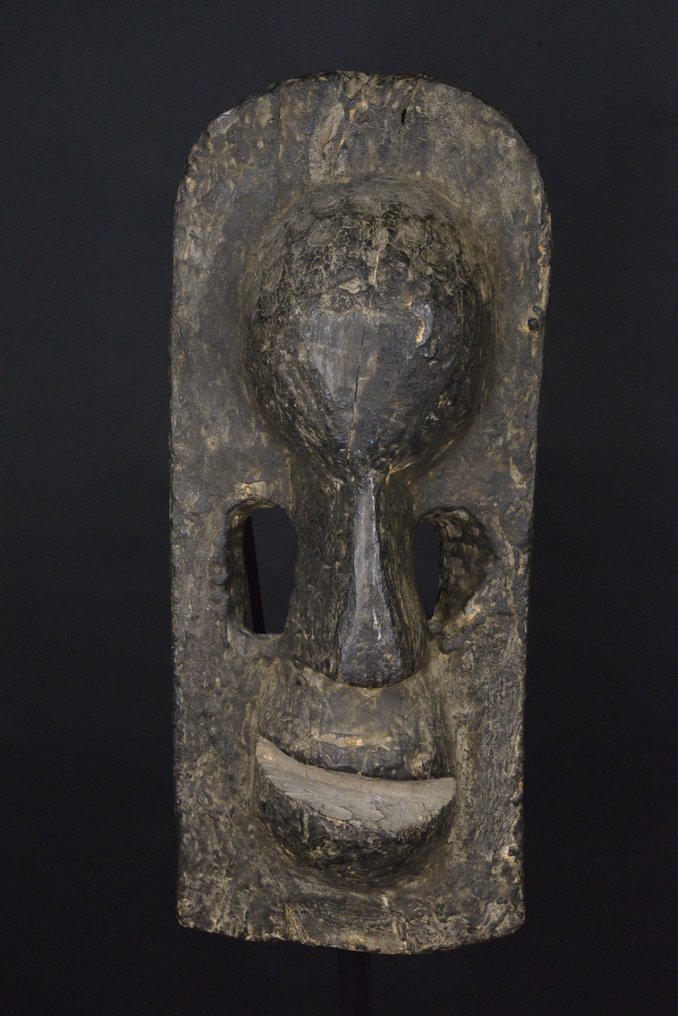
The geometric and rectangular structure: The mask is carved from a solid block of wood, adopting a general parallelepiped or elongated box shape. The face is framed by a relief border, creating a concave structure.
The treatment of the nose and eyes: A vertical, straight nasal ridge divides the face. On either side, the orbits are deeply hollowed as rectangular or square windows, a recurring plastic signature among the Dogon.
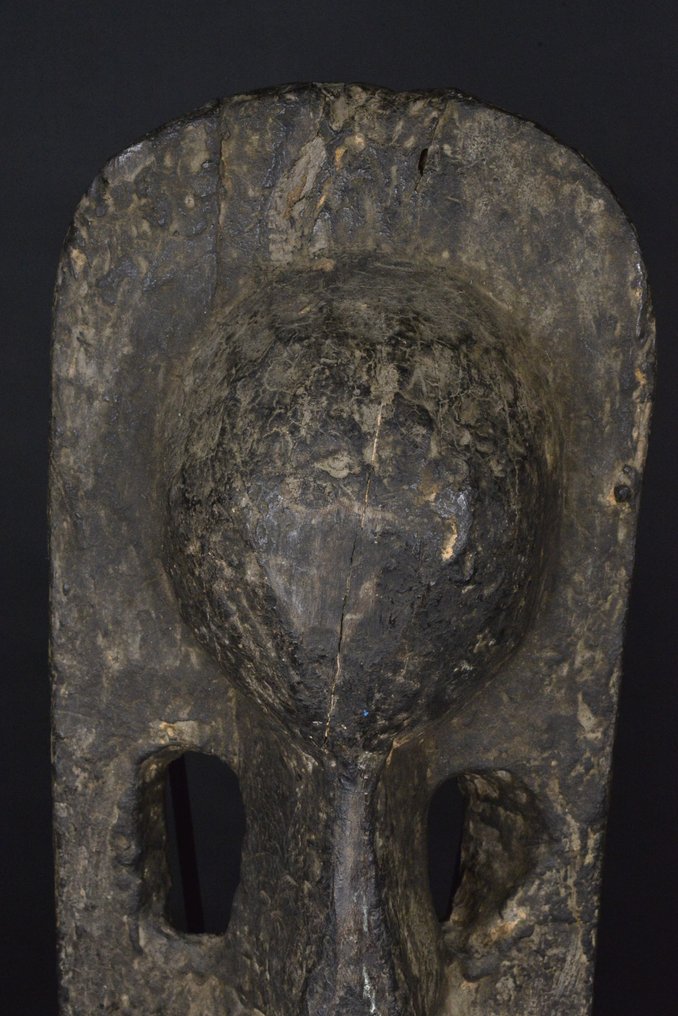
The forehead and mouth: The forehead is high and bulging, while the lower part ends with a schematically shaped mouth, sculpted in a horizontally projecting relief forward.
The crusty patina: The surface of the wood presents a dark, dense, irregular patina. This appearance testifies to the piece’s age and to the libations or ritual sacrifices (mixtures of animal blood, millet beer and earth) poured onto the object over generations to activate its spiritual power.
2. Ritual Use and Significance
In Dogon traditional society, masks belong to the male secret society of the Awa. They are not decorative objects but major ritual tools used mainly during funerary ceremonies:
The Dama ceremonies: The Dama is a collective mourning-relief festival held several years after the death of notable villagers. During these rituals, dozens of types of masks emerge to dance. The aim of the Dama is to guide the souls of the deceased (nyama) out of the world of the living so they join the realm of the ancestors, thereby restoring the cosmic and social balance disturbed by death.
The link with the bush and creation: Each Dogon mask represents a specific entity (an animal, a social figure, a spirit or a cosmogonic concept). Through their rhythmic dances on the village square (tege), the mask bearers mime the story of the world’s creation and the forces of the wild nature (the bush) in opposition to the orderly village.
Community protection: Outside ritual outings, these masks are kept away from prying eyes in rock shelters or sacred caves located in the cliff. They act as energy accumulators meant to protect the community from misfortune, drought, and disease.
Fast and protected shipping. Packages are sent with insurance and tracking number.
Delivery via Chronopost between 1 to 3 days in France, 2 to 5 days in the European Union. Delivery to the rest of Europe, worldwide and to islands with Colissimo International.
We speak English.
mask African art African mask art
Afrikanische Maskenkunst African mask art
arte de máscaras africanas Art of African masks
arte delle maschere africane Art of African masks
Afrikanische Maskenkunst
Seller's Story
Passionate about World Arts and more specifically about African Art, we buy from collectors, former officials, military, health workers, public works staff who have worked in Africa and also in Côte d'Ivoire, from antique dealers and traders who roam across West Africa to find quality objects.
It is with pride that we present works that, beyond their power to beautify spaces, invite our collectors to resonate with the richness and depth of human expression through the most authentic art.
At Arts Ethniques Gallery, we have the privilege of offering our visitors an exclusive selection of artworks, all unique and original. Each piece presented is the outcome of a demanding artistic approach, driven by a singular vision and mastered craftsmanship, all elements that guarantee authenticity and value.
The works we offer are not industrial reproductions. They are individual creations, crafted with sensitivity and precision, each bearing its own story, identity and presence. Originality is the very foundation of our commitment to excellence. Thus, every mask and every statue in our collection is the subject of a rigorous selection, in order to preserve their rarity and singularity.
Acquiring a work from Arts Ethniques Gallery means owning a truly unique piece: a creation that embodies both talent, cultural memory and the expressive force of African art. It is also a lasting investment in a work whose artistic and emotional value transcends time.
We guarantee that every work leaving our gallery is an authentic piece, without replicas, bearing witness to the creativity, heritage and passion of the African artists who shaped them.
We invite you to participate in our gallery’s auctions with confidence. Each presented work is an original, unique and irreplaceable creation, selected with the greatest rigor to guarantee its authenticity and artistic value.
Whether you wish to enrich a personal collection or introduce an exceptional artwork into your space, Arts Ethniques Gallery offers a safe, transparent and professional setting to acquire remarkable pieces.
Art auctions are a privileged moment to discover rare works, capable of becoming the heart of a collection. Acquiring a work at our sales is not just buying an object: it is investing in a creation whose aesthetic value and cultural reach reinforce over time.
The pieces presented by Arts Ethniques Gallery testify not only to the talent and vision of the artists but also possess the ability to transform spaces and enrich the gaze of those who behold them.
Participating in our auctions is taking part in a singular experience, where the passion for art meets the rigors of collecting. Bidding on a work from Arts Ethniques Gallery goes beyond a simple transaction: it is a gesture of commitment and appreciation for art in its most authentic form.
We invite you to bid with passion and to join us in this adventure dedicated to discovery, transmission and celebration of art.
Perhaps your next heart piece is already waiting for you."
Translated by Google TranslateMali
Dogon
Bois
Height: 500mm
Width: 200mm
Depth: 170mm
Height on base: 1110mm
This wooden mask comes from the Dogon people, an ethnic group living mainly in the Bandiagara Escarpment region of Mali. Dogon art is deeply linked to their complex cosmogony and ancestral rituals.
Here is the analysis of its stylistic origin and traditional use:
1. Stylistic Characteristics
By observing the object shown in the files masque_dogon-CI247.jpg and masque_kwele-BP022-10.jpg (referenced here as masque_dogon-CI247-10.jpg), one finds the characteristics of statuary and masks from this region:
The geometric and rectangular structure: The mask is carved from a solid block of wood, adopting a general parallelepiped or elongated box shape. The face is framed by a relief border, creating a concave structure.
The treatment of the nose and eyes: A vertical, straight nasal ridge divides the face. On either side, the orbits are deeply hollowed as rectangular or square windows, a recurring plastic signature among the Dogon.
The forehead and mouth: The forehead is high and bulging, while the lower part ends with a schematically shaped mouth, sculpted in a horizontally projecting relief forward.
The crusty patina: The surface of the wood presents a dark, dense, irregular patina. This appearance testifies to the piece’s age and to the libations or ritual sacrifices (mixtures of animal blood, millet beer and earth) poured onto the object over generations to activate its spiritual power.
2. Ritual Use and Significance
In Dogon traditional society, masks belong to the male secret society of the Awa. They are not decorative objects but major ritual tools used mainly during funerary ceremonies:
The Dama ceremonies: The Dama is a collective mourning-relief festival held several years after the death of notable villagers. During these rituals, dozens of types of masks emerge to dance. The aim of the Dama is to guide the souls of the deceased (nyama) out of the world of the living so they join the realm of the ancestors, thereby restoring the cosmic and social balance disturbed by death.
The link with the bush and creation: Each Dogon mask represents a specific entity (an animal, a social figure, a spirit or a cosmogonic concept). Through their rhythmic dances on the village square (tege), the mask bearers mime the story of the world’s creation and the forces of the wild nature (the bush) in opposition to the orderly village.
Community protection: Outside ritual outings, these masks are kept away from prying eyes in rock shelters or sacred caves located in the cliff. They act as energy accumulators meant to protect the community from misfortune, drought, and disease.
Fast and protected shipping. Packages are sent with insurance and tracking number.
Delivery via Chronopost between 1 to 3 days in France, 2 to 5 days in the European Union. Delivery to the rest of Europe, worldwide and to islands with Colissimo International.
We speak English.
mask African art African mask art
Afrikanische Maskenkunst African mask art
arte de máscaras africanas Art of African masks
arte delle maschere africane Art of African masks
Afrikanische Maskenkunst
Seller's Story
Passionate about World Arts and more specifically about African Art, we buy from collectors, former officials, military, health workers, public works staff who have worked in Africa and also in Côte d'Ivoire, from antique dealers and traders who roam across West Africa to find quality objects.
It is with pride that we present works that, beyond their power to beautify spaces, invite our collectors to resonate with the richness and depth of human expression through the most authentic art.
At Arts Ethniques Gallery, we have the privilege of offering our visitors an exclusive selection of artworks, all unique and original. Each piece presented is the outcome of a demanding artistic approach, driven by a singular vision and mastered craftsmanship, all elements that guarantee authenticity and value.
The works we offer are not industrial reproductions. They are individual creations, crafted with sensitivity and precision, each bearing its own story, identity and presence. Originality is the very foundation of our commitment to excellence. Thus, every mask and every statue in our collection is the subject of a rigorous selection, in order to preserve their rarity and singularity.
Acquiring a work from Arts Ethniques Gallery means owning a truly unique piece: a creation that embodies both talent, cultural memory and the expressive force of African art. It is also a lasting investment in a work whose artistic and emotional value transcends time.
We guarantee that every work leaving our gallery is an authentic piece, without replicas, bearing witness to the creativity, heritage and passion of the African artists who shaped them.
We invite you to participate in our gallery’s auctions with confidence. Each presented work is an original, unique and irreplaceable creation, selected with the greatest rigor to guarantee its authenticity and artistic value.
Whether you wish to enrich a personal collection or introduce an exceptional artwork into your space, Arts Ethniques Gallery offers a safe, transparent and professional setting to acquire remarkable pieces.
Art auctions are a privileged moment to discover rare works, capable of becoming the heart of a collection. Acquiring a work at our sales is not just buying an object: it is investing in a creation whose aesthetic value and cultural reach reinforce over time.
The pieces presented by Arts Ethniques Gallery testify not only to the talent and vision of the artists but also possess the ability to transform spaces and enrich the gaze of those who behold them.
Participating in our auctions is taking part in a singular experience, where the passion for art meets the rigors of collecting. Bidding on a work from Arts Ethniques Gallery goes beyond a simple transaction: it is a gesture of commitment and appreciation for art in its most authentic form.
We invite you to bid with passion and to join us in this adventure dedicated to discovery, transmission and celebration of art.
Perhaps your next heart piece is already waiting for you."
Translated by Google TranslateDetails
Ethnic group/ culture
Dogon
Country of Origin
Mali
Material
Wood
Sold with stand
Yes
Condition
Good condition
Title of artwork
Ceremonial mask
Sold by
