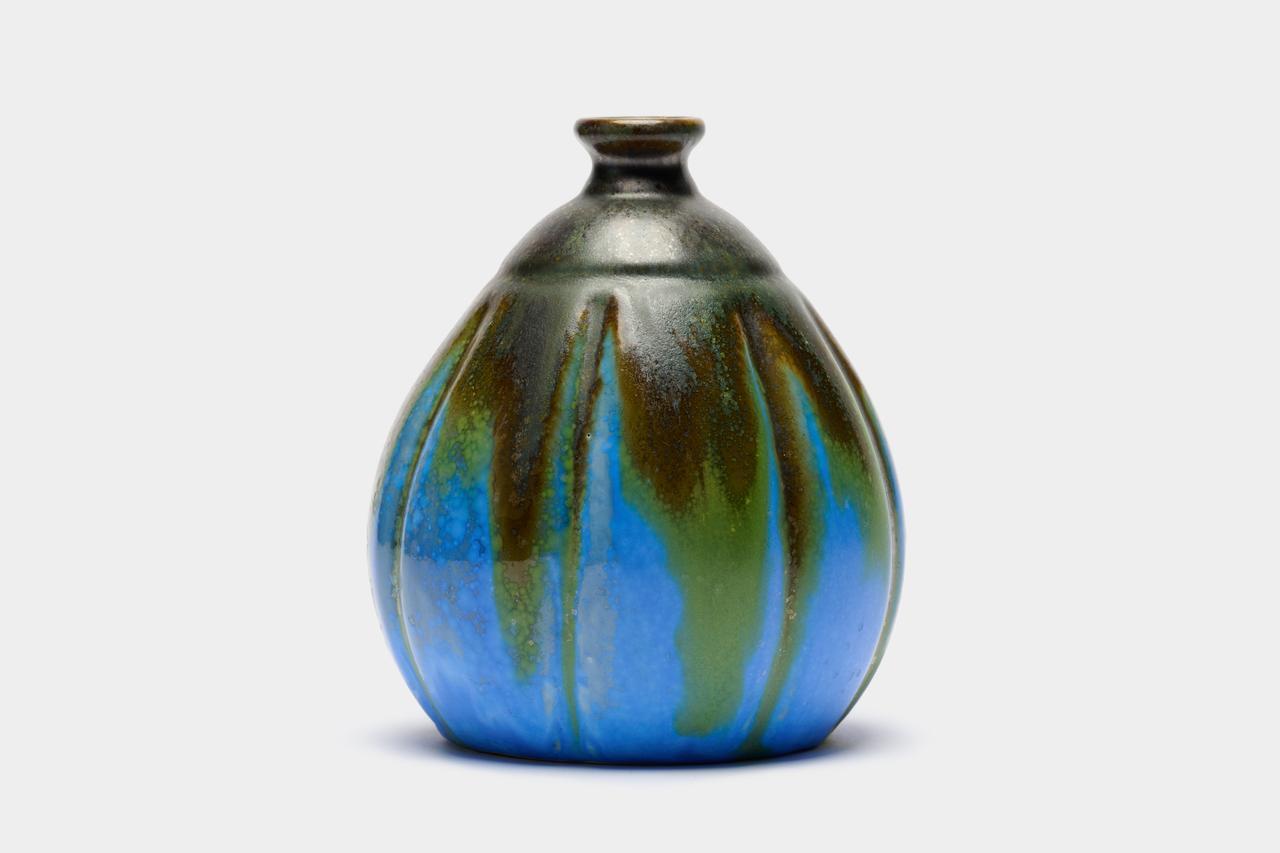
Vase - Stoneware - Pitcher and Beaker Vase 1938


05
days
13
hours
44
minutes
28
seconds
Starting bid
€ 1
No reserve price

Expert
Selected by Michel Karis
Art historian with extensive experience working at various auction houses in antiques.
Estimate € 180 - € 220
No bids placed
Catawiki Buyer Protection
Your payment’s safe with us until you receive your object.View details
Trustpilot 4.4 | 138076 reviews
Rated Excellent on Trustpilot.
A Bauhaus-style stoneware jug and beaker vase from Germany (Hannover), dating to 1930–1940 and signed with the workshop crest of the crossed horse heads, featuring a zinc-reduction glaze on the jug (21 cm high, 12 cm wide) and a copper-reduction glaze on the beaker vase (14.5 cm high, 9 cm diameter), in near‑new condition.
AI-assisted summary
Description from the seller
Around 1920 he visited the School of Arts and Crafts in Hanover, later trained as a sculptor under Ludwig Vierthaler. He modeled in the Göttingen and Hanover area a number of facades made of clay on new buildings. Securing a livelihood by founding a trading company for ceramic art, which he continued after establishing his own workshop in 1935. This trading operation flourished and was converted into wholesale business in the early 1930s. Uhlemeyer thereby built contacts with many ceramic companies. His greatest interest lay in the productions of Friedrich (Fritz) Hudler, which he distributed as general representative. He also wrote for various professional journals. His most interesting essay appeared in 1924 in Ceramic Review, where he provides an overview of what he believed were the best German pottery centers. This orientation also served as a guide for his own production. Two potters worked for him, Neumann and Hödl, the latter having helped develop the extremely difficult glazes in Theodor Keerl’s laboratory at the Landshut Vocational School. And there lay the focus of Uhlemeyer’s work in his own workshop: the hairline crack network structures and the vivid painting colors, as we know them from his more developed production. The small amounts of lead oxide in the glaze contribute to crackling tension and the eventual reduction lines visible on the finished products. A large portion of Uhlemeyer’s vessels can be recognized by this feature. It also sometimes leads to confusion with the productions of Paul Dresler, who worked in a similar manner. As a politically unburdened person, he became president of the Hannover Chamber of Skilled Crafts in 1945 and in 1949 even headed the Central Association of German Handicrafts. Unfortunately, his early death put an end to his plans for his own company. Existing models were still produced through October 1961.
KRUG: ZINKREDUKTIONSGLASUR 21 CM HÖHE. 12 CM DURCHMESS E
BECHERVASE: KUPFERREDUKTIONSGLASUR 14,5 CM HÖHE 9CM DURCHMESSER
BEIDE SIND SIGNIERT MIT DEM WERKSTATTZEICHEN DEN GEKREUZTEN PFERDEKÖPFEN
Around 1920 he visited the School of Arts and Crafts in Hanover, later trained as a sculptor under Ludwig Vierthaler. He modeled in the Göttingen and Hanover area a number of facades made of clay on new buildings. Securing a livelihood by founding a trading company for ceramic art, which he continued after establishing his own workshop in 1935. This trading operation flourished and was converted into wholesale business in the early 1930s. Uhlemeyer thereby built contacts with many ceramic companies. His greatest interest lay in the productions of Friedrich (Fritz) Hudler, which he distributed as general representative. He also wrote for various professional journals. His most interesting essay appeared in 1924 in Ceramic Review, where he provides an overview of what he believed were the best German pottery centers. This orientation also served as a guide for his own production. Two potters worked for him, Neumann and Hödl, the latter having helped develop the extremely difficult glazes in Theodor Keerl’s laboratory at the Landshut Vocational School. And there lay the focus of Uhlemeyer’s work in his own workshop: the hairline crack network structures and the vivid painting colors, as we know them from his more developed production. The small amounts of lead oxide in the glaze contribute to crackling tension and the eventual reduction lines visible on the finished products. A large portion of Uhlemeyer’s vessels can be recognized by this feature. It also sometimes leads to confusion with the productions of Paul Dresler, who worked in a similar manner. As a politically unburdened person, he became president of the Hannover Chamber of Skilled Crafts in 1945 and in 1949 even headed the Central Association of German Handicrafts. Unfortunately, his early death put an end to his plans for his own company. Existing models were still produced through October 1961.
KRUG: ZINKREDUKTIONSGLASUR 21 CM HÖHE. 12 CM DURCHMESS E
BECHERVASE: KUPFERREDUKTIONSGLASUR 14,5 CM HÖHE 9CM DURCHMESSER
BEIDE SIND SIGNIERT MIT DEM WERKSTATTZEICHEN DEN GEKREUZTEN PFERDEKÖPFEN
Details
Era
1900-2000
Ceramics type
Stoneware
Specific region of origin
HANNOVER
Title additional information
Pitcher and Beaker Vase 1938
Country of origin
Germany
Material
Ceramic
Style
Bauhaus
Condition
As new - unused
Height
21 cm
Width
12 cm
Depth
12 cm
Estimated period
1930-1940
Sold by