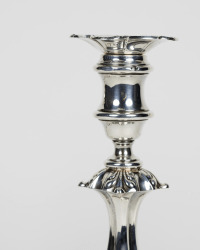
Centrepiece (4) - .835 silver


04
days
12
hours
03
minutes
00
seconds
Current bid
€ 320
Reserve price not met

Expert
Selected by Jeroen Zoetmulder
Has over 30 years of experience in archaeology and is an appraiser specialising in archaeological objects.
Estimate € 700 - € 800
 | €320 | |
|---|---|---|
 | €300 |
Catawiki Buyer Protection
Your payment’s safe with us until you receive your object.View details
Trustpilot 4.4 | 138658 reviews
Rated Excellent on Trustpilot.
A vintage two-pair silver cabinet sculpture set titled European Fighting Cocks, comprising four items: two large Belgian 835-silver cocks (total 266 g) and two small Portuguese 833-silver miniatures (total 66 g), dating to 1950–1970 with dimensions 15 cm high, 15 cm wide and 5 cm deep, in excellent condition with natural patina.
AI-assisted summary
Description from the seller
Collection of Cabinet Sculptures “European Fighting Cocks”
A distinguished sculptural set consisting of two separate pairs of fighting roosters (Fighting Cocks). The collection represents two remarkable and esteemed European jewelry schools, characterized by a high content of pure precious metal in continental silver alloys.
PAIR I: LARGE FIGHTING ROOSTERS (TOP LEVEL)
Construction and style: Dynamic, multi-element sculpture. A scene full of expression – one rooster charges from above, the other (with a raised left leg in the shape of a shield) assumes a defensive-countering stance, balancing on the tail and wings. Neck feathers and deeply cut, wavy tail feathers are mounted and hand-soldered.
Total mass of the pair: 266 grams (2 x 133 g)
Metal alloy: Silver of assay 835
Stamping (Punts on the legs and elements):
Official state assay mark of Belgium: the letter “A” and the assay “835” enclosed in an integrated oval frame (pattern officially used from 1942–1990).
Hand-stamped mounting number “7” on the inner sides of the wings, legs and body – evidence of individual, workshop-fitting of parts for a single specimen.
Country of origin: Belgium
Dating: Late 1950s–1970s (mid period of the oval war and post-war assay validity, which perfectly confirms traditional manual assembly technology).
Condition: Excellent, cabinet-grade. A deep, natural patina in the crevices of the feathers creates ideal light and shadow, enhancing the three-dimensionality of the relief.
PAIR II: SMALL MINIATURE ROOSTERS (BOTTOM LEVEL)
Construction and style: Exclusive cabinet miniatures cast using monolithic technique (solid). Birds in a fighting pose with wings spread wide and heads proudly raised. Outstanding, meticulous, and dense detailing of the plumage texture on the wings and the porous structure of the comb.
Total mass of the pair: 66 grams (2 x 33 g)
Metal alloy: Silver of assay 833 (so-called second title / 2º toque)
Stamping (Fully, rare 3-element set of punches on the leg):
State assay guarantee mark of the Provisional Assay Office in Porto: eagle head facing left, enclosed in a vertical square with beveled corners (b design for the Porto region).
Independent numerical assay hallmark: digits “833” in a rectangular frame.
Author’s name/signature of the master jeweler: rare workshop stamp in the form of a stylized anchor/lyre (resembling the letter “J” in parentheses or an open umbrella).
Country of origin: Portugal (Porto)
Dating: Post-1938 period, Art Deco era.
Condition: Excellent. Sharp edge cutting grooves and intact, century-old fiery patina.
Collection of Cabinet Sculptures “European Fighting Cocks”
A distinguished sculptural set consisting of two separate pairs of fighting roosters (Fighting Cocks). The collection represents two remarkable and esteemed European jewelry schools, characterized by a high content of pure precious metal in continental silver alloys.
PAIR I: LARGE FIGHTING ROOSTERS (TOP LEVEL)
Construction and style: Dynamic, multi-element sculpture. A scene full of expression – one rooster charges from above, the other (with a raised left leg in the shape of a shield) assumes a defensive-countering stance, balancing on the tail and wings. Neck feathers and deeply cut, wavy tail feathers are mounted and hand-soldered.
Total mass of the pair: 266 grams (2 x 133 g)
Metal alloy: Silver of assay 835
Stamping (Punts on the legs and elements):
Official state assay mark of Belgium: the letter “A” and the assay “835” enclosed in an integrated oval frame (pattern officially used from 1942–1990).
Hand-stamped mounting number “7” on the inner sides of the wings, legs and body – evidence of individual, workshop-fitting of parts for a single specimen.
Country of origin: Belgium
Dating: Late 1950s–1970s (mid period of the oval war and post-war assay validity, which perfectly confirms traditional manual assembly technology).
Condition: Excellent, cabinet-grade. A deep, natural patina in the crevices of the feathers creates ideal light and shadow, enhancing the three-dimensionality of the relief.
PAIR II: SMALL MINIATURE ROOSTERS (BOTTOM LEVEL)
Construction and style: Exclusive cabinet miniatures cast using monolithic technique (solid). Birds in a fighting pose with wings spread wide and heads proudly raised. Outstanding, meticulous, and dense detailing of the plumage texture on the wings and the porous structure of the comb.
Total mass of the pair: 66 grams (2 x 33 g)
Metal alloy: Silver of assay 833 (so-called second title / 2º toque)
Stamping (Fully, rare 3-element set of punches on the leg):
State assay guarantee mark of the Provisional Assay Office in Porto: eagle head facing left, enclosed in a vertical square with beveled corners (b design for the Porto region).
Independent numerical assay hallmark: digits “833” in a rectangular frame.
Author’s name/signature of the master jeweler: rare workshop stamp in the form of a stylized anchor/lyre (resembling the letter “J” in parentheses or an open umbrella).
Country of origin: Portugal (Porto)
Dating: Post-1938 period, Art Deco era.
Condition: Excellent. Sharp edge cutting grooves and intact, century-old fiery patina.
Details
Era
1900-2000
Gross weight
332 g
Silver type
.835 silver
Number of objects
4
Country of origin
Belgium
Material
Silver
Style
Vintage
Colour
Silver
Condition
Good condition - used with small signs of ageing
Height
15 cm
Width
15 cm
Depth
5 cm
Estimated period
1960-1970
Sold by