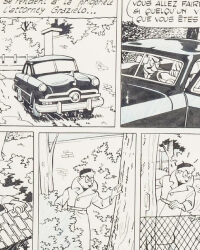
Doeve, Eppo - 1 Original strip - Het Mannetje Bagatel - 1946


06
days
02
hours
20
minutes
47
seconds

No bids placed
Catawiki Buyer Protection
Your payment’s safe with us until you receive your object.View details
Trustpilot 4.4 | 138365 reviews
Rated Excellent on Trustpilot.
Original daily strip panel from Het Mannetje Bagatel (1946) by Eppo Doeve; a single item, 37.5 × 10.5 cm, in excellent condition.
AI-assisted summary
Description from the seller
Eppo Doeve (born in 1907) was a famous (Indonesian) illustrator and cartoonist who spent his youth under Dutch colonial rule in his homeland, but during his adult life largely lived in the Netherlands. He was a political cartoonist and illustrated many book covers, advertisements and Dutch banknotes. Doeve also developed a renowned reputation as a painter.
He made several illustrations for the magazine of the Wageningen Student Corps. Unfortunately, in 1929 the Wall Street Crash occurred, bringing a severe global economic crisis. The Great Depression also caused the collapse of the Indonesian tea market, which completely changed Doeve's life path. Given his love for the Netherlands, he wanted to stay and therefore chose a graphic career. He had already done some work for the Amsterdam advertising agency De la Mar and continued to illustrate advertisements for them.
In 1933 Doeve became a political cartoonist for the magazine De Groene Amsterdammer. After three years he moved, as a freelancer, to De Haagsche Post. His illustrations also appeared in De Radiobode, the official magazine of the Dutch radio broadcaster AVRO. One of his colleagues there was Eelco ten Harmsen van der Beek, from whom he learned many valuable skills. Doeve illustrated alternately with Henk Gijsbers and Henk Albers the 'Paul van Vlaanderen' series. His graphic work also appeared in Het Handelsblad and De Telegraaf, and after World War II further in Vrij Nederland. His longest collaboration was with Elseviers Weekblad (later Elsevier), for which he drew cartoons from 1946 until his death in 1983.
Doeve designed murals, stage sets and costumes, stamps, portraits, paintings and sculptures. He produced beautiful advertising posters for various companies. Two of the most famous were the waiter carrying a tray with Heineken beer and a drawing with penguins for the Amsterdam zoo Artis. Doeve's drawings adorned the covers of many Prisma pocket novels. Yet most Dutch people in the 1950s knew him as the designer of a new series of banknotes. Each banknote showed the head of a famous historical figure from Dutch history, such as Hugo Grotius (10 guilders), Herman Boerhaave (20 guilders), Christiaan Huygens (25 guilders), Desiderius Erasmus (100 guilders) and Rembrandt van Rijn (1000 guilders). Later in his life Doeve even designed parodies of these notes with the heads of football champion Johan Cruyff or Zwarte Piet. Doeve was an exceptionally graphic talent, despite never having attended an art academy. He was ambidextrous and could even draw upside down if necessary. Doeve received so many commissions that he never had to worry about his income. The only drawback was that he usually worked for other people rather than creating his own work.
As a comic strip artist, he conceived two text strips ('Het Mannetje Bagatel', 1946, and 'Kleine Isar, de Vierde Koning', 1962), with text by novelist Bertus Aafjes. The versatile artist could count on much appreciation from colleagues, although he never had any formal academic art training.
In 1946 their fairy-tale strip 'Het Mannetje Bagatel' appeared in De Volkskrant. It ran from 4 June to 7 October 1946 (from 17 September under the title 'Bagatel's Kinder-cabaret').
Quite unusual for a self-taught artist, he also won several prizes for his work. In 1955 he received the National Outdoor Advertising Award and in 1973 he was knighted in the Order of Orange-Nassau.
Doeve died on 11 June 1981 at the age of 73. He was held in high esteem by fellow artists and had a strong influence on people such as Marten Toonder, Rudy van Giffen, Jan Kruis, Martin Lodewijk, Peter van Straaten and Fiep Westendorp. For those interested in his life and career, the book 'Ter Herinnering Eppo Doeve' (1907-1981) by Jop Euwijk is warmly recommended.
This lot contains an original daily strip from Het Mannetje Bagatel, one of only two text strips that Doeve created. The daily strip is beautifully drawn in the recognizable style that Eppo Doeve so typified. Original drawings by Eppo Doeve are extremely rare.
On the reverse also a drawing (see image 5)
See also the photographs that form part of the description and give a good impression of the offering.
This gem will be well packaged and shipped by registered post.
Eppo Doeve (born in 1907) was a famous (Indonesian) illustrator and cartoonist who spent his youth under Dutch colonial rule in his homeland, but during his adult life largely lived in the Netherlands. He was a political cartoonist and illustrated many book covers, advertisements and Dutch banknotes. Doeve also developed a renowned reputation as a painter.
He made several illustrations for the magazine of the Wageningen Student Corps. Unfortunately, in 1929 the Wall Street Crash occurred, bringing a severe global economic crisis. The Great Depression also caused the collapse of the Indonesian tea market, which completely changed Doeve's life path. Given his love for the Netherlands, he wanted to stay and therefore chose a graphic career. He had already done some work for the Amsterdam advertising agency De la Mar and continued to illustrate advertisements for them.
In 1933 Doeve became a political cartoonist for the magazine De Groene Amsterdammer. After three years he moved, as a freelancer, to De Haagsche Post. His illustrations also appeared in De Radiobode, the official magazine of the Dutch radio broadcaster AVRO. One of his colleagues there was Eelco ten Harmsen van der Beek, from whom he learned many valuable skills. Doeve illustrated alternately with Henk Gijsbers and Henk Albers the 'Paul van Vlaanderen' series. His graphic work also appeared in Het Handelsblad and De Telegraaf, and after World War II further in Vrij Nederland. His longest collaboration was with Elseviers Weekblad (later Elsevier), for which he drew cartoons from 1946 until his death in 1983.
Doeve designed murals, stage sets and costumes, stamps, portraits, paintings and sculptures. He produced beautiful advertising posters for various companies. Two of the most famous were the waiter carrying a tray with Heineken beer and a drawing with penguins for the Amsterdam zoo Artis. Doeve's drawings adorned the covers of many Prisma pocket novels. Yet most Dutch people in the 1950s knew him as the designer of a new series of banknotes. Each banknote showed the head of a famous historical figure from Dutch history, such as Hugo Grotius (10 guilders), Herman Boerhaave (20 guilders), Christiaan Huygens (25 guilders), Desiderius Erasmus (100 guilders) and Rembrandt van Rijn (1000 guilders). Later in his life Doeve even designed parodies of these notes with the heads of football champion Johan Cruyff or Zwarte Piet. Doeve was an exceptionally graphic talent, despite never having attended an art academy. He was ambidextrous and could even draw upside down if necessary. Doeve received so many commissions that he never had to worry about his income. The only drawback was that he usually worked for other people rather than creating his own work.
As a comic strip artist, he conceived two text strips ('Het Mannetje Bagatel', 1946, and 'Kleine Isar, de Vierde Koning', 1962), with text by novelist Bertus Aafjes. The versatile artist could count on much appreciation from colleagues, although he never had any formal academic art training.
In 1946 their fairy-tale strip 'Het Mannetje Bagatel' appeared in De Volkskrant. It ran from 4 June to 7 October 1946 (from 17 September under the title 'Bagatel's Kinder-cabaret').
Quite unusual for a self-taught artist, he also won several prizes for his work. In 1955 he received the National Outdoor Advertising Award and in 1973 he was knighted in the Order of Orange-Nassau.
Doeve died on 11 June 1981 at the age of 73. He was held in high esteem by fellow artists and had a strong influence on people such as Marten Toonder, Rudy van Giffen, Jan Kruis, Martin Lodewijk, Peter van Straaten and Fiep Westendorp. For those interested in his life and career, the book 'Ter Herinnering Eppo Doeve' (1907-1981) by Jop Euwijk is warmly recommended.
This lot contains an original daily strip from Het Mannetje Bagatel, one of only two text strips that Doeve created. The daily strip is beautifully drawn in the recognizable style that Eppo Doeve so typified. Original drawings by Eppo Doeve are extremely rare.
On the reverse also a drawing (see image 5)
See also the photographs that form part of the description and give a good impression of the offering.
This gem will be well packaged and shipped by registered post.
Details
Item
Original strip
Number of objects
1
Series
Het Mannetje Bagatel
Condition
Excellent condition
Artist
Doeve, Eppo
Year
1946
Width
37.5 cm
Height
10.5 cm