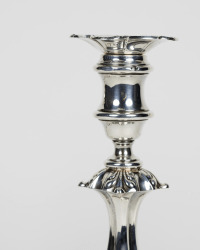
Unknown artist - Spice tower - Silver


04
days
19
hours
35
minutes
34
seconds
Starting bid
€ 1
Reserve price not met

Expert
Selected by Jeroen Zoetmulder
Has over 30 years of experience in archaeology and is an appraiser specialising in archaeological objects.
Estimate € 220 - € 250
No bids placed
Catawiki Buyer Protection
Your payment’s safe with us until you receive your object.View details
Trustpilot 4.4 | 138800 reviews
Rated Excellent on Trustpilot.
Besamim spice tower in hand-twisted silver filigree, Austrian origin, dating to the 19th century (1850–1900), height 13.2 cm, base diameter 4.3 cm, weight 39 g, in good condition with age patina and no maker's mark.
AI-assisted summary
Description from the seller
A Besamim spice tower made entirely of hand-twisted silver filigree wire, used in the Havdalah ceremony that closes the Jewish Sabbath. The form follows the classic Central European tower model: a round base rising through openwork filigree tiers to a small flag finial at the top, a design associated with the silversmithing traditions of Bohemia and Moravia and suggesting a probable origin in the Prague area of the Austro-Hungarian Empire. The piece dates to the 19th century and was worked by hand using a highly skilled wire-twisting technique particularly associated with Central European Jewish silversmiths of that period. No maker's mark, hallmark, or date letter is present; the attribution to the Prague region is stylistic only, based on the form and filigree style, and should be treated as tentative. Silver content was confirmed by acid test alone. Height 13.2 cm, base diameter 4.3 cm, weight 39 g. Condition is Good: the piece carries an age patina throughout consistent with its period, and a slight curvature to the tower body is present and visible in the photographs. No losses to the filigree wire elements, solder repairs, or breaks were detected.
A Besamim spice tower made entirely of hand-twisted silver filigree wire, used in the Havdalah ceremony that closes the Jewish Sabbath. The form follows the classic Central European tower model: a round base rising through openwork filigree tiers to a small flag finial at the top, a design associated with the silversmithing traditions of Bohemia and Moravia and suggesting a probable origin in the Prague area of the Austro-Hungarian Empire. The piece dates to the 19th century and was worked by hand using a highly skilled wire-twisting technique particularly associated with Central European Jewish silversmiths of that period. No maker's mark, hallmark, or date letter is present; the attribution to the Prague region is stylistic only, based on the form and filigree style, and should be treated as tentative. Silver content was confirmed by acid test alone. Height 13.2 cm, base diameter 4.3 cm, weight 39 g. Condition is Good: the piece carries an age patina throughout consistent with its period, and a slight curvature to the tower body is present and visible in the photographs. No losses to the filigree wire elements, solder repairs, or breaks were detected.
Details
Era
1900-2000
Gross weight
39 g
Number of objects
1
Country of origin
Austria
Material
Silver
Designer/artist/maker
Unknown artist
Condition
Good condition - used with small signs of ageing
Height
13.2 cm
Width
4.3 cm
Depth
4.3 cm
Estimated period
1850-1900
Sold by