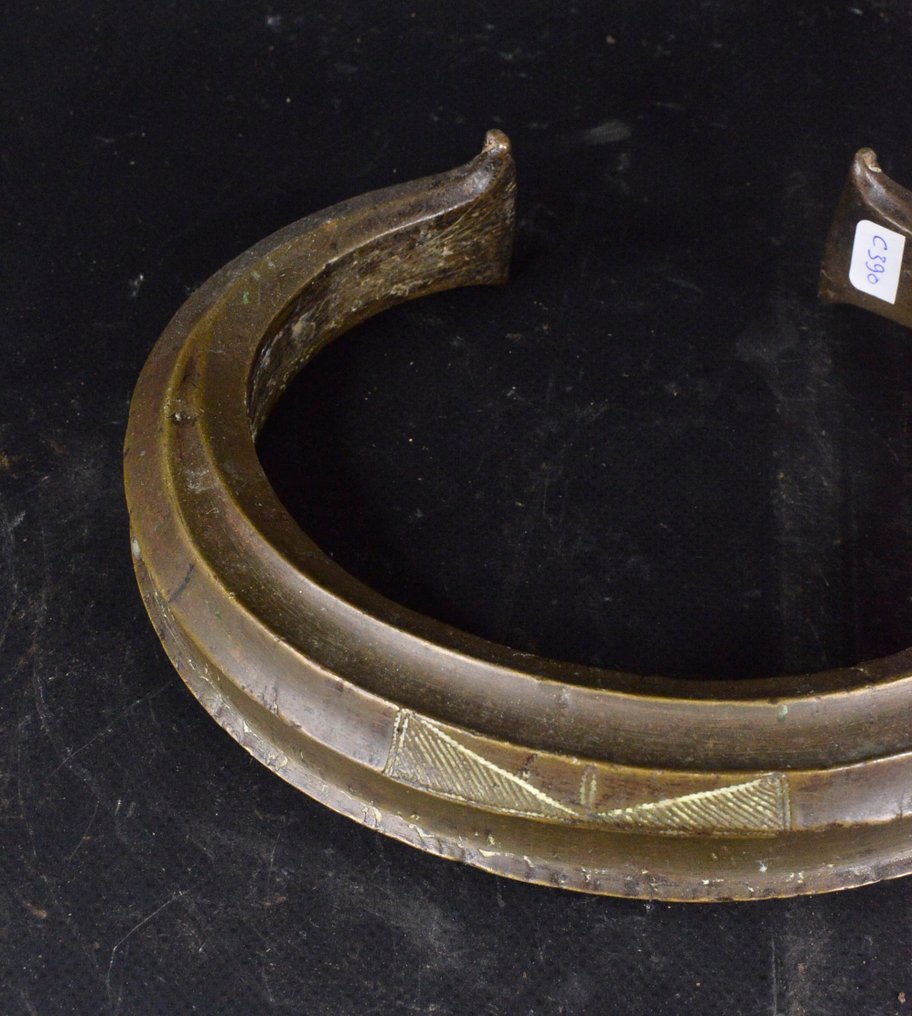
Torc / necklace / choker - Fang - Gabon




02
days
13
hours
02
minutes
29
seconds
Current bid
€ 1
Reserve price not met

Expert
Selected by Dimitri André
Holds a postgraduate degree in African studies and 15 years experience in African art.
Estimate € 280 - € 330
 | €1 |
|---|
Catawiki Buyer Protection
Your payment’s safe with us until you receive your object.View details
Trustpilot 4.4 | 139188 reviews
Rated Excellent on Trustpilot.
Fang bronze torque from Gabon, an open neck collar dating from the late 19th to early 20th century, original and in excellent condition, weighing 2460 g with dimensions 40 mm height, 205 mm width and 160 mm depth.
AI-assisted summary
Description from the seller
Gabon
Fang
Bronze
Height 40mm
Width: 205mm
Depth: 160mm
Weight: 2460g
This superb object in copper alloy cast using lost-wax technique invites your collection into the fascinating world of exchange currencies and prestige adornments of Central Africa.
Its craftsmanship and fine geometric decorations attribute it to the Fang ethnic group (a major cultural group spread across Gabon, Equatorial Guinea, southern Cameroon and the west of the Republic of Congo). More precisely, this rigid and open object is a neck torque (or torque necklace).
1. Origin and stylistic characteristics
A study of this torque highlights the Fang smiths’ and founders’ mastery:
A complex molded section: The necklace features a massive semi-circular shape, curved to fit the base of the neck. The external face is relief-carved with a pronounced midline ridge (a crest), framed by two concave grooves. This rigid geometry beautifully catches the light.
The incised decoration: On the central lower part, the sculptor integrated a rectangular cartouche adorned with triangles engraved in fine parallel hatch marks (chevron or hourglass motifs). This type of geometric motif is very often found on the shafts of the Byeri reliquaries or on Fang blades.
The upright ends: The torque ends with two flat rims flared upward. These stops not only prevent the necklace from slipping when worn, but they also served to firmly bind the two ends with a cord or leather strap if necessary.
2. Double use: Prestige adornment and exchange currency
In Central Africa, bronze, copper and brass were precious metals, imported from afar or mined at the cost of hard labor. Such a torque thus had a double function:
An emblem of power and high status (Adornment): This heavy necklace was worn exclusively by the wives of notable men, the wives of clan chiefs, or prominent warriors during major ritual ceremonies or alliance councils. It was an ostentatious mark of wealth, protection, and social prestige within the village.
A bride-price and transaction currency (Exchange currency): Just like manillas, ngindas or the spearheads of mandjong, these massive torques served as a store of value and marriage currency. They were hoarded by family heads and taken out of the chest to seal marriages (dot payment), settle judicial compensations between clans, or finalize the purchase of high-value goods.
3. Symbolic meaning
Among the Fang, molten and brilliant metal is intimately linked to the forge, a sacred art whose master (the blacksmith) is seen as a magician capable of taming fire and earthly elements.
Wearing this torque in bronze or brass around the neck equates to surrounding oneself with a spiritual shield. The metal was reputed to ward off bad influences, while the central engraved geometric motifs reaffirmed the individual’s cultural grounding in their clan and respect for the social order established by the ancestors. Its brown, smooth patina bears witness to a distinguished age and prolonged handling.
Ancient object (potentially late 19th century or early 20th century).
Packages are sent from Monday to Saturday with insurance and tracking number.
Delivery 1 to 3 days in France via Chronopost, 2 to 5 days across the European Union.
Delivery to the rest of Europe and worldwide via Colissimo International.
We speak english
Mask african art Afrikanische Maskenkunst arte de máscaras africanas arte delle maschere africane
statue african art Arte de estatuas africanas arte delle statue africane Afrikanische Maskenkunst
Máscara de estatua de galería de arte africano
Seller's Story
Passionate about World Arts and more specifically about African Art, we buy from collectors, former officials, military, health workers, public works staff who have worked in Africa and also in Côte d'Ivoire, from antique dealers and traders who roam across West Africa to find quality objects.
It is with pride that we present works that, beyond their power to beautify spaces, invite our collectors to resonate with the richness and depth of human expression through the most authentic art.
At Arts Ethniques Gallery, we have the privilege of offering our visitors an exclusive selection of artworks, all unique and original. Each piece presented is the outcome of a demanding artistic approach, driven by a singular vision and mastered craftsmanship, all elements that guarantee authenticity and value.
The works we offer are not industrial reproductions. They are individual creations, crafted with sensitivity and precision, each bearing its own story, identity and presence. Originality is the very foundation of our commitment to excellence. Thus, every mask and every statue in our collection is the subject of a rigorous selection, in order to preserve their rarity and singularity.
Acquiring a work from Arts Ethniques Gallery means owning a truly unique piece: a creation that embodies both talent, cultural memory and the expressive force of African art. It is also a lasting investment in a work whose artistic and emotional value transcends time.
We guarantee that every work leaving our gallery is an authentic piece, without replicas, bearing witness to the creativity, heritage and passion of the African artists who shaped them.
We invite you to participate in our gallery’s auctions with confidence. Each presented work is an original, unique and irreplaceable creation, selected with the greatest rigor to guarantee its authenticity and artistic value.
Whether you wish to enrich a personal collection or introduce an exceptional artwork into your space, Arts Ethniques Gallery offers a safe, transparent and professional setting to acquire remarkable pieces.
Art auctions are a privileged moment to discover rare works, capable of becoming the heart of a collection. Acquiring a work at our sales is not just buying an object: it is investing in a creation whose aesthetic value and cultural reach reinforce over time.
The pieces presented by Arts Ethniques Gallery testify not only to the talent and vision of the artists but also possess the ability to transform spaces and enrich the gaze of those who behold them.
Participating in our auctions is taking part in a singular experience, where the passion for art meets the rigors of collecting. Bidding on a work from Arts Ethniques Gallery goes beyond a simple transaction: it is a gesture of commitment and appreciation for art in its most authentic form.
We invite you to bid with passion and to join us in this adventure dedicated to discovery, transmission and celebration of art.
Perhaps your next heart piece is already waiting for you."
Translated by Google TranslateGabon
Fang
Bronze
Height 40mm
Width: 205mm
Depth: 160mm
Weight: 2460g
This superb object in copper alloy cast using lost-wax technique invites your collection into the fascinating world of exchange currencies and prestige adornments of Central Africa.
Its craftsmanship and fine geometric decorations attribute it to the Fang ethnic group (a major cultural group spread across Gabon, Equatorial Guinea, southern Cameroon and the west of the Republic of Congo). More precisely, this rigid and open object is a neck torque (or torque necklace).
1. Origin and stylistic characteristics
A study of this torque highlights the Fang smiths’ and founders’ mastery:
A complex molded section: The necklace features a massive semi-circular shape, curved to fit the base of the neck. The external face is relief-carved with a pronounced midline ridge (a crest), framed by two concave grooves. This rigid geometry beautifully catches the light.
The incised decoration: On the central lower part, the sculptor integrated a rectangular cartouche adorned with triangles engraved in fine parallel hatch marks (chevron or hourglass motifs). This type of geometric motif is very often found on the shafts of the Byeri reliquaries or on Fang blades.
The upright ends: The torque ends with two flat rims flared upward. These stops not only prevent the necklace from slipping when worn, but they also served to firmly bind the two ends with a cord or leather strap if necessary.
2. Double use: Prestige adornment and exchange currency
In Central Africa, bronze, copper and brass were precious metals, imported from afar or mined at the cost of hard labor. Such a torque thus had a double function:
An emblem of power and high status (Adornment): This heavy necklace was worn exclusively by the wives of notable men, the wives of clan chiefs, or prominent warriors during major ritual ceremonies or alliance councils. It was an ostentatious mark of wealth, protection, and social prestige within the village.
A bride-price and transaction currency (Exchange currency): Just like manillas, ngindas or the spearheads of mandjong, these massive torques served as a store of value and marriage currency. They were hoarded by family heads and taken out of the chest to seal marriages (dot payment), settle judicial compensations between clans, or finalize the purchase of high-value goods.
3. Symbolic meaning
Among the Fang, molten and brilliant metal is intimately linked to the forge, a sacred art whose master (the blacksmith) is seen as a magician capable of taming fire and earthly elements.
Wearing this torque in bronze or brass around the neck equates to surrounding oneself with a spiritual shield. The metal was reputed to ward off bad influences, while the central engraved geometric motifs reaffirmed the individual’s cultural grounding in their clan and respect for the social order established by the ancestors. Its brown, smooth patina bears witness to a distinguished age and prolonged handling.
Ancient object (potentially late 19th century or early 20th century).
Packages are sent from Monday to Saturday with insurance and tracking number.
Delivery 1 to 3 days in France via Chronopost, 2 to 5 days across the European Union.
Delivery to the rest of Europe and worldwide via Colissimo International.
We speak english
Mask african art Afrikanische Maskenkunst arte de máscaras africanas arte delle maschere africane
statue african art Arte de estatuas africanas arte delle statue africane Afrikanische Maskenkunst
Máscara de estatua de galería de arte africano
Seller's Story
Passionate about World Arts and more specifically about African Art, we buy from collectors, former officials, military, health workers, public works staff who have worked in Africa and also in Côte d'Ivoire, from antique dealers and traders who roam across West Africa to find quality objects.
It is with pride that we present works that, beyond their power to beautify spaces, invite our collectors to resonate with the richness and depth of human expression through the most authentic art.
At Arts Ethniques Gallery, we have the privilege of offering our visitors an exclusive selection of artworks, all unique and original. Each piece presented is the outcome of a demanding artistic approach, driven by a singular vision and mastered craftsmanship, all elements that guarantee authenticity and value.
The works we offer are not industrial reproductions. They are individual creations, crafted with sensitivity and precision, each bearing its own story, identity and presence. Originality is the very foundation of our commitment to excellence. Thus, every mask and every statue in our collection is the subject of a rigorous selection, in order to preserve their rarity and singularity.
Acquiring a work from Arts Ethniques Gallery means owning a truly unique piece: a creation that embodies both talent, cultural memory and the expressive force of African art. It is also a lasting investment in a work whose artistic and emotional value transcends time.
We guarantee that every work leaving our gallery is an authentic piece, without replicas, bearing witness to the creativity, heritage and passion of the African artists who shaped them.
We invite you to participate in our gallery’s auctions with confidence. Each presented work is an original, unique and irreplaceable creation, selected with the greatest rigor to guarantee its authenticity and artistic value.
Whether you wish to enrich a personal collection or introduce an exceptional artwork into your space, Arts Ethniques Gallery offers a safe, transparent and professional setting to acquire remarkable pieces.
Art auctions are a privileged moment to discover rare works, capable of becoming the heart of a collection. Acquiring a work at our sales is not just buying an object: it is investing in a creation whose aesthetic value and cultural reach reinforce over time.
The pieces presented by Arts Ethniques Gallery testify not only to the talent and vision of the artists but also possess the ability to transform spaces and enrich the gaze of those who behold them.
Participating in our auctions is taking part in a singular experience, where the passion for art meets the rigors of collecting. Bidding on a work from Arts Ethniques Gallery goes beyond a simple transaction: it is a gesture of commitment and appreciation for art in its most authentic form.
We invite you to bid with passion and to join us in this adventure dedicated to discovery, transmission and celebration of art.
Perhaps your next heart piece is already waiting for you."
Translated by Google TranslateDetails
Indigenous object name
Torc / necklace / choker
Ethnic group/ culture
Fang
Country of Origin
Gabon
Material
Bronze
Sold with stand
No
Condition
Excellent condition
Authenticity
Original/official
Sold by
