Stool - Baule - Côte d'Ivoire


03
days
02
hours
56
minutes
46
seconds
Starting bid
€ 1
Reserve price not met

Expert
Selected by Julien Gauthier
A decade of experience in historical arms, armour, and African art.
Estimate € 150 - € 200
No bids placed
Catawiki Buyer Protection
Your payment’s safe with us until you receive your object.View details
Trustpilot 4.4 | 141384 reviews
Rated Excellent on Trustpilot.
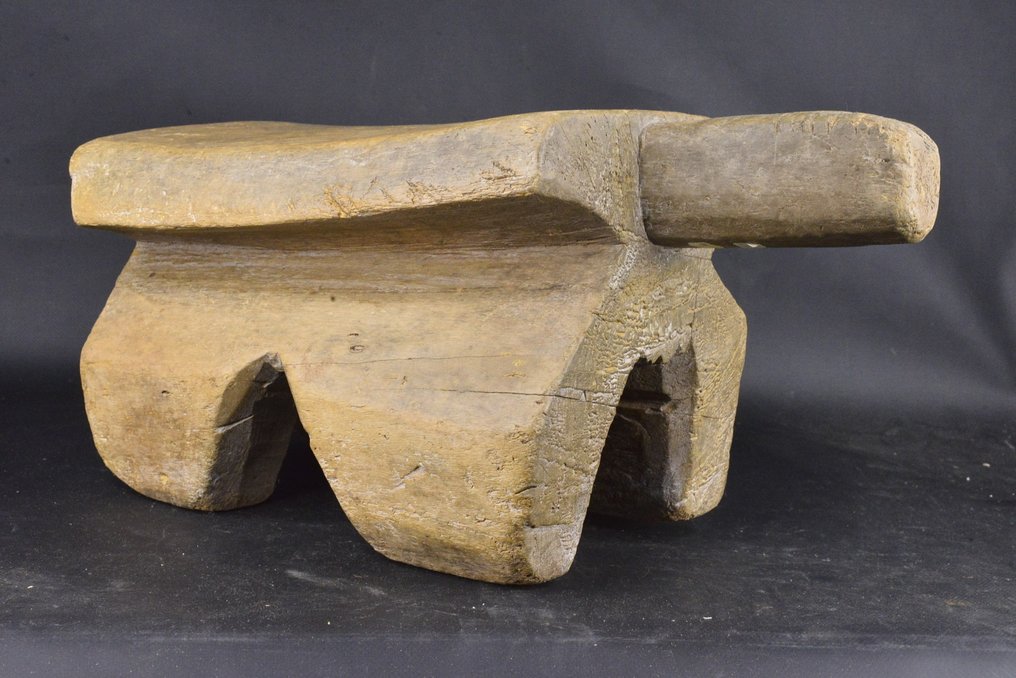
Baoulé wooden tabouret from Côte d'Ivoire, carved from a single block of wood with a low, curved seat, dimensions 475 × 220 × 220 mm, in good condition.
AI-assisted summary
Description from the seller
Ivory Coast
Baoulé
Wood
Height: 220 mm
Width: 220 mm
Length: 475 mm
The low carved wooden furniture piece is a traditional stool, originating from Ivory Coast. While Baoulé culture produces numerous ceremonial objects with highly complex or figurative designs, this piece adopts a clean, robust line deeply rooted in domestic life.
1. Formal characteristics and typology
Visual observation of the files tabouret_baoule-C272_3.jpg and tabouret_baoule-C272-8_3.jpg allows us to detail the structure and the lived experience of this piece of furniture:
Monoxyle and rustic design: This seat is entirely carved from a single block of heavy, dense wood. Unlike prestige seats polished or sculpted with anthropomorphic figurines, it is utilitarian furniture with minimalist aesthetics, designed strongly to withstand time.
Curved seat: The top part features a slightly concave surface at its center, ergonomically shaped to fit the body's form and provide a stable, low-seat.
Solid, hollowed base: The support for the seat consists of thick, solid walls. The large sides are hollowed at their base by a geometric cut in the shape of an inverted triangle, visible on both faces of the object, thus creating four massive corner supports.
The side handle, which highlights a rectangular monoxyle extension on one of the short sides. This sturdy handle allowed the piece to be grasped and easily transported within the compound.
The wood finish and patina: The surface of the piece bears a rough, light and matte patina, sprinkled with natural cracks, small drying splits, and wear marks. This texture testifies to many years spent outdoors or in contact with the sandy soil of inner courtyards.
2. Daily use and social role
In West Africa, and more specifically among Akan-speaking peoples (of which the Baoulé are part), the individual stool is a ubiquitous object that goes beyond its technical function:
The companion for daily tasks: A low, sturdy stool like this is the preferred instrument for domestic activities at floor level. It is used by women for cooking preparation (such as pounding or peeling tubers), cleaning, or caring for children. Men also use it for crafts or during moments of rest.
The hub of discussions and communal life: People sit on these seats to listen to stories, take part in family discussions, or receive a visiting guest. Offering a stool to a guest who enters the compound is the first gesture of hospitality and respect.
An object inseparable from its owner: Even on the humblest models, the stool carries a strong personal charge. It is said that a seat absorbs the energy (aura or life force) of the person who sits in it regularly. When not in use, it is sometimes tipped on its side to prevent a roaming or malevolent spirit from settling on it.
3. Symbolic meaning
The low height of this furniture keeps the user in immediate contact with the Earth. In local cosmology, this direct contact strengthens the symbolic link between the individual, nature, and the ancestors who rest in the soil. The robustness and stability of its four massive feet evoke the durability of the family structure, patience, and grounding in the face of life's uncertainties.
The Baoulé artists produced many art objects and remain very active today. Thanks to their sense of stylization and attention to detail, they have created works that are among the most elegant African objects. The Baoulé have created masks, statues, statuettes, fetishes, combs, chairs, weaving-tartment pulleys, canes, spear-throwers, slings, ointment boxes, oracle boxes, divination boxes, carved doors, bead necklaces, as well as gold and bronze jewelry worn during major ceremonies.
Packages are shipped Monday through Saturday with tracking number.
Delivery by Chronopost between 1 to 3 days in France and 2 to 5 days throughout the European Union. Delivery to the rest of Europe and the world by Colissimo International.
We speak english.
mask african art Afrikanische Maskenkunst arte de máscaras africanas arte delle maschere africane
statue african art Arte de estatuas africanas arte delle statue africane Afrikanische Maskenkunst
Seller's Story
Passionate about World Arts and more specifically about African Art, we buy from collectors, former officials, military, health workers, public works staff who have worked in Africa and also in Côte d'Ivoire, from antique dealers and traders who roam across West Africa to find quality objects.
It is with pride that we present works that, beyond their power to beautify spaces, invite our collectors to resonate with the richness and depth of human expression through the most authentic art.
At Arts Ethniques Gallery, we have the privilege of offering our visitors an exclusive selection of artworks, all unique and original. Each piece presented is the outcome of a demanding artistic approach, driven by a singular vision and mastered craftsmanship, all elements that guarantee authenticity and value.
The works we offer are not industrial reproductions. They are individual creations, crafted with sensitivity and precision, each bearing its own story, identity and presence. Originality is the very foundation of our commitment to excellence. Thus, every mask and every statue in our collection is the subject of a rigorous selection, in order to preserve their rarity and singularity.
Acquiring a work from Arts Ethniques Gallery means owning a truly unique piece: a creation that embodies both talent, cultural memory and the expressive force of African art. It is also a lasting investment in a work whose artistic and emotional value transcends time.
We guarantee that every work leaving our gallery is an authentic piece, without replicas, bearing witness to the creativity, heritage and passion of the African artists who shaped them.
We invite you to participate in our gallery’s auctions with confidence. Each presented work is an original, unique and irreplaceable creation, selected with the greatest rigor to guarantee its authenticity and artistic value.
Whether you wish to enrich a personal collection or introduce an exceptional artwork into your space, Arts Ethniques Gallery offers a safe, transparent and professional setting to acquire remarkable pieces.
Art auctions are a privileged moment to discover rare works, capable of becoming the heart of a collection. Acquiring a work at our sales is not just buying an object: it is investing in a creation whose aesthetic value and cultural reach reinforce over time.
The pieces presented by Arts Ethniques Gallery testify not only to the talent and vision of the artists but also possess the ability to transform spaces and enrich the gaze of those who behold them.
Participating in our auctions is taking part in a singular experience, where the passion for art meets the rigors of collecting. Bidding on a work from Arts Ethniques Gallery goes beyond a simple transaction: it is a gesture of commitment and appreciation for art in its most authentic form.
We invite you to bid with passion and to join us in this adventure dedicated to discovery, transmission and celebration of art.
Perhaps your next heart piece is already waiting for you."
Translated by Google TranslateIvory Coast
Baoulé
Wood
Height: 220 mm
Width: 220 mm
Length: 475 mm
The low carved wooden furniture piece is a traditional stool, originating from Ivory Coast. While Baoulé culture produces numerous ceremonial objects with highly complex or figurative designs, this piece adopts a clean, robust line deeply rooted in domestic life.
1. Formal characteristics and typology
Visual observation of the files tabouret_baoule-C272_3.jpg and tabouret_baoule-C272-8_3.jpg allows us to detail the structure and the lived experience of this piece of furniture:
Monoxyle and rustic design: This seat is entirely carved from a single block of heavy, dense wood. Unlike prestige seats polished or sculpted with anthropomorphic figurines, it is utilitarian furniture with minimalist aesthetics, designed strongly to withstand time.
Curved seat: The top part features a slightly concave surface at its center, ergonomically shaped to fit the body's form and provide a stable, low-seat.
Solid, hollowed base: The support for the seat consists of thick, solid walls. The large sides are hollowed at their base by a geometric cut in the shape of an inverted triangle, visible on both faces of the object, thus creating four massive corner supports.
The side handle, which highlights a rectangular monoxyle extension on one of the short sides. This sturdy handle allowed the piece to be grasped and easily transported within the compound.
The wood finish and patina: The surface of the piece bears a rough, light and matte patina, sprinkled with natural cracks, small drying splits, and wear marks. This texture testifies to many years spent outdoors or in contact with the sandy soil of inner courtyards.
2. Daily use and social role
In West Africa, and more specifically among Akan-speaking peoples (of which the Baoulé are part), the individual stool is a ubiquitous object that goes beyond its technical function:
The companion for daily tasks: A low, sturdy stool like this is the preferred instrument for domestic activities at floor level. It is used by women for cooking preparation (such as pounding or peeling tubers), cleaning, or caring for children. Men also use it for crafts or during moments of rest.
The hub of discussions and communal life: People sit on these seats to listen to stories, take part in family discussions, or receive a visiting guest. Offering a stool to a guest who enters the compound is the first gesture of hospitality and respect.
An object inseparable from its owner: Even on the humblest models, the stool carries a strong personal charge. It is said that a seat absorbs the energy (aura or life force) of the person who sits in it regularly. When not in use, it is sometimes tipped on its side to prevent a roaming or malevolent spirit from settling on it.
3. Symbolic meaning
The low height of this furniture keeps the user in immediate contact with the Earth. In local cosmology, this direct contact strengthens the symbolic link between the individual, nature, and the ancestors who rest in the soil. The robustness and stability of its four massive feet evoke the durability of the family structure, patience, and grounding in the face of life's uncertainties.
The Baoulé artists produced many art objects and remain very active today. Thanks to their sense of stylization and attention to detail, they have created works that are among the most elegant African objects. The Baoulé have created masks, statues, statuettes, fetishes, combs, chairs, weaving-tartment pulleys, canes, spear-throwers, slings, ointment boxes, oracle boxes, divination boxes, carved doors, bead necklaces, as well as gold and bronze jewelry worn during major ceremonies.
Packages are shipped Monday through Saturday with tracking number.
Delivery by Chronopost between 1 to 3 days in France and 2 to 5 days throughout the European Union. Delivery to the rest of Europe and the world by Colissimo International.
We speak english.
mask african art Afrikanische Maskenkunst arte de máscaras africanas arte delle maschere africane
statue african art Arte de estatuas africanas arte delle statue africane Afrikanische Maskenkunst
Seller's Story
Passionate about World Arts and more specifically about African Art, we buy from collectors, former officials, military, health workers, public works staff who have worked in Africa and also in Côte d'Ivoire, from antique dealers and traders who roam across West Africa to find quality objects.
It is with pride that we present works that, beyond their power to beautify spaces, invite our collectors to resonate with the richness and depth of human expression through the most authentic art.
At Arts Ethniques Gallery, we have the privilege of offering our visitors an exclusive selection of artworks, all unique and original. Each piece presented is the outcome of a demanding artistic approach, driven by a singular vision and mastered craftsmanship, all elements that guarantee authenticity and value.
The works we offer are not industrial reproductions. They are individual creations, crafted with sensitivity and precision, each bearing its own story, identity and presence. Originality is the very foundation of our commitment to excellence. Thus, every mask and every statue in our collection is the subject of a rigorous selection, in order to preserve their rarity and singularity.
Acquiring a work from Arts Ethniques Gallery means owning a truly unique piece: a creation that embodies both talent, cultural memory and the expressive force of African art. It is also a lasting investment in a work whose artistic and emotional value transcends time.
We guarantee that every work leaving our gallery is an authentic piece, without replicas, bearing witness to the creativity, heritage and passion of the African artists who shaped them.
We invite you to participate in our gallery’s auctions with confidence. Each presented work is an original, unique and irreplaceable creation, selected with the greatest rigor to guarantee its authenticity and artistic value.
Whether you wish to enrich a personal collection or introduce an exceptional artwork into your space, Arts Ethniques Gallery offers a safe, transparent and professional setting to acquire remarkable pieces.
Art auctions are a privileged moment to discover rare works, capable of becoming the heart of a collection. Acquiring a work at our sales is not just buying an object: it is investing in a creation whose aesthetic value and cultural reach reinforce over time.
The pieces presented by Arts Ethniques Gallery testify not only to the talent and vision of the artists but also possess the ability to transform spaces and enrich the gaze of those who behold them.
Participating in our auctions is taking part in a singular experience, where the passion for art meets the rigors of collecting. Bidding on a work from Arts Ethniques Gallery goes beyond a simple transaction: it is a gesture of commitment and appreciation for art in its most authentic form.
We invite you to bid with passion and to join us in this adventure dedicated to discovery, transmission and celebration of art.
Perhaps your next heart piece is already waiting for you."
Translated by Google TranslateDetails
Indigenous object name
Stool
Ethnic group/ culture
Baule
Country of Origin
Côte d'Ivoire
Material
Wood
Sold with stand
No
Condition
Good condition
Sold by
