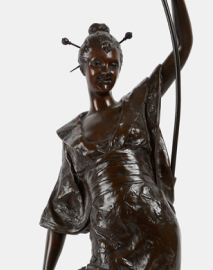
Statue, Meisje met kat - 43 cm - Plaster


06
days
01
hour
24
minutes
01
second
Starting bid
€ 1
Reserve price not met

No bids placed
Catawiki Buyer Protection
Your payment’s safe with us until you receive your object.View details
Trustpilot 4.4 | 138800 reviews
Rated Excellent on Trustpilot.
Meisje met kat, an Art Nouveau plaster sculpture by the Gebroeders van Paridon, circa 1905, made in reinforced gypsum (Paridur) with gold and green decoration, backmarked GvP and model 629, dimensions 43 cm high by 8 cm wide and 8 cm deep, in reasonably good condition.
AI-assisted summary
Description from the seller
Art Nouveau figurine of a girl feeding her cat. Made by the Van Paridon brothers at the beginning of the 20th century. It is made of a reinforced gypsum, the so-called Paridur, and decorated with gold and green. This decoration gives a bronze-like effect. On the back stamped with GvP and the model number 629.
Around 1905 the brothers Pieter (1876), Peter (1885) and Hendrik Van Paridon (1887) opened a workshop in Rozenstraat in the Jordaan. The brothers worked together with sculptors such as Jan Verdonk from Den Bosch, who designed sculptures in the Toorop style. Many classical sculptures were made, often after antique models. After 1920 the Paridons mainly produced Christian religious statues and stopped with classical and modern art. This figurine was therefore produced before 1920.
The plaster is still intact. Here and there the paintwork has sustained some damage over time.
Art Nouveau figurine of a girl feeding her cat. Made by the Van Paridon brothers at the beginning of the 20th century. It is made of a reinforced gypsum, the so-called Paridur, and decorated with gold and green. This decoration gives a bronze-like effect. On the back stamped with GvP and the model number 629.
Around 1905 the brothers Pieter (1876), Peter (1885) and Hendrik Van Paridon (1887) opened a workshop in Rozenstraat in the Jordaan. The brothers worked together with sculptors such as Jan Verdonk from Den Bosch, who designed sculptures in the Toorop style. Many classical sculptures were made, often after antique models. After 1920 the Paridons mainly produced Christian religious statues and stopped with classical and modern art. This figurine was therefore produced before 1920.
The plaster is still intact. Here and there the paintwork has sustained some damage over time.
Details
Era
1900-2000
Country of origin
Netherlands
Style
Art Nouveau
Material
Plaster
Title of artwork
Meisje met kat
Signature
Noted GvB 629
Colour
Gold, Green
Condition
Fair condition
Height
43 cm
Width
8 cm
Depth
8 cm
Sold by