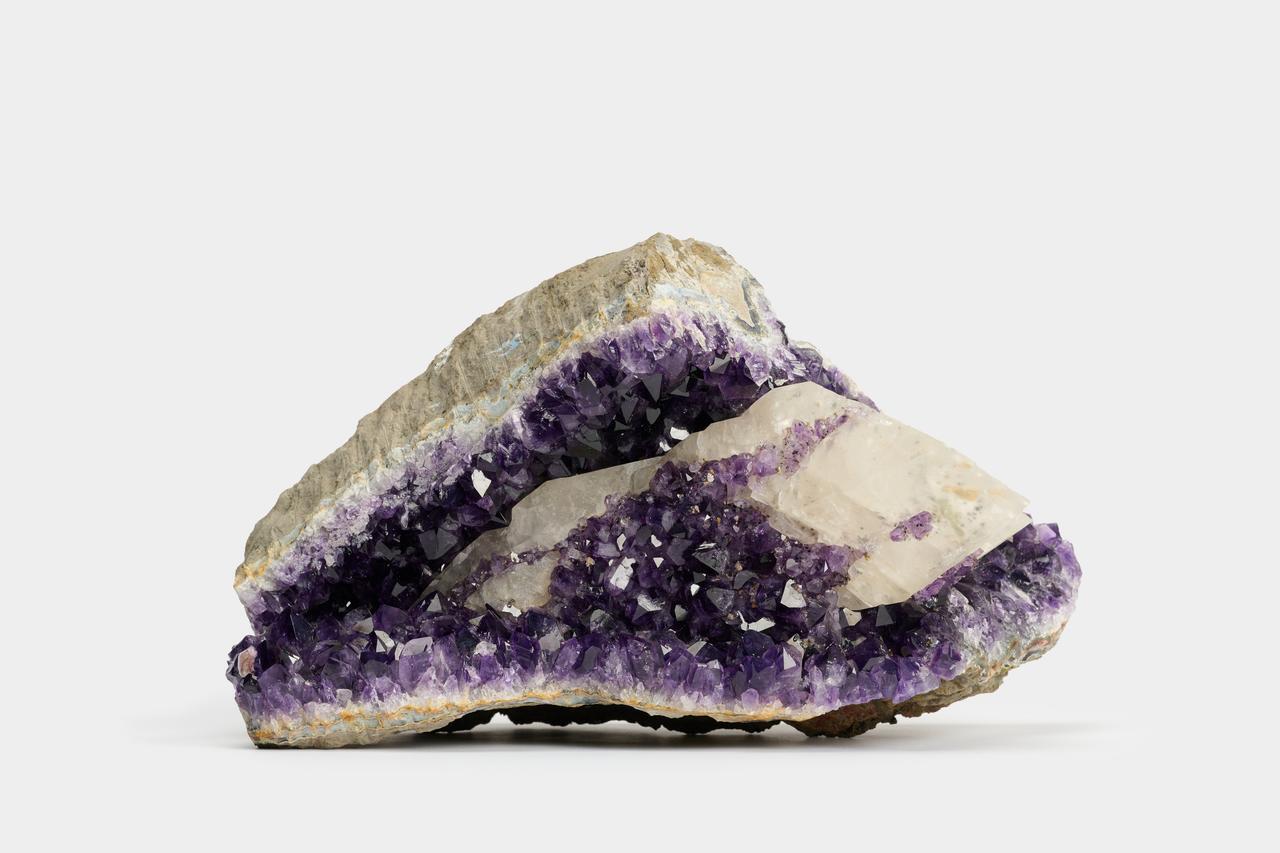
Green Malachite Pyramid A Pyramid Showcasing Botryoidal Malachite Patterns - Height: 94 mm - Width: 103 mm- 678 g - (1)


02
days
01
hour
20
minutes
32
seconds
Current bid
€ 30
Reserve price not met

Expert
Selected by Antonio Rapisarda
Holds a master’s in chemistry with 25 years’ experience in minerals consulting.
Estimate € 190 - € 210
 | €30 | |
|---|---|---|
| €15 | |
| €5 |
Catawiki Buyer Protection
Your payment’s safe with us until you receive your object.View details
Trustpilot 4.4 | 139803 reviews
Rated Excellent on Trustpilot.
Green malachite pyramid, assembled in mosaic technique, from Katanga region, Democratic Republic of the Congo; dimensions 94 × 103 × 102 mm, weight 678 g.
AI-assisted summary
Description from the seller
AAA Quality Congo Malachite - Katanga Mines — This lot features a pyramidal sculpture of notable size, entirely made from natural malachite from the Democratic Republic of the Congo. The piece results from a refined mosaic artisan technique, in which selected fragments of the mineral are cleverly assembled and polished to create a perfect geometric form. The pyramid stands out as a visually striking piece, a bridge between the mathematical perfection of its shape and the organic, unpredictable beauty of natural matter. Viewing closely the four triangular faces reveals an universe of patterns and colors. Each surface is a unique collage, a puzzle of malachite sections that reveal the mineral’s different morphologies. Areas with concentric and wavy bands alternate—the famous "growth rings" of malachite—gradating from bright emerald green to deep forest green, nearly black. The mirror-polish enhances the silky luster and the color transitions, giving the object visual depth. In some tesserae of the mosaic one can recognize the mineral’s original botryoidal or cluster-like structure. Here, the smooth surface intersects with globular concretions, creating the famous “eyes” of malachite, concentric circles that hypnotize the eye and testify to the slow, layered growth process of copper carbonate. This technique not only allows the creation of large objects but also offers a complete view of the mineral’s infinite aesthetic variations. Malachite is a basic copper carbonate (Cu₂(CO₃)(OH)₂), a secondary mineral that forms in the oxidation zones of copper deposits. Its iconic veining results from chemical precipitation from aqueous solutions in underground cavities, a process that occurs on geologic time scales. The mines of the Democratic Republic of the Congo, particularly those in the Katanga region, have historically been among the most important in the world for extracting high-quality malachite, valued for the intensity of its color and the complexity of its patterns. Since ancient times, malachite has been revered as a decorative and symbolic stone. The ancient Egyptians ground it into pigments for makeup and painting, and used it to create amulets and jewelry. Its popularity reached a peak in Imperial Russia, where it became the preferred material for monumental columns, vases, and cladding, as evidenced by the famous “Malachite Room” in the Winter Palace in Saint Petersburg. This pyramid fits into this long tradition of mineral cabinetry, interpreting a classic form with a precious material. As a collectible object or a piece of furniture, this pyramid represents a synthesis of natural history and design. It is an ideal piece for a modern Wunderkammer, where the scientific charm of the mineral blends with the elegance of the sculptural form. Placed on a desk, on a bookshelf, or as a centerpiece, it catches light and attention, inviting contemplation of its intricate beauty. The pyramidal shape, archetype of stability and energy, adds an additional layer of meaning to an object already rich in charm. Technical details Name: Malachite Pyramid Classification: Worked mineral (Malachite) Origin: Democratic Republic of the Congo Dimensions: 94 x 103 x 102 mm Weight: 678 g Material: Natural malachite assembled with mosaic technique
Seller's Story
The Mineral Art Gallery offers minerals, fossils, shells and natural elements.
Born in Italy in 2017, today she collaborates with international galleries and collectors, she is a direct importer of large minerals and naturalistic collectible elements; deals with the processing to insert them inside the living space. A section of the gallery was dedicated to the Wunderkammer, "chamber of wonders or cabinet of curiosities" in which Mirabilia elements are presented: naturalia and italiania, a union between "the present is the past".
All lots are shipped via DHL Express and Fercam couriers, with insured parcel and tracking.
Translated by Google TranslateAAA Quality Congo Malachite - Katanga Mines — This lot features a pyramidal sculpture of notable size, entirely made from natural malachite from the Democratic Republic of the Congo. The piece results from a refined mosaic artisan technique, in which selected fragments of the mineral are cleverly assembled and polished to create a perfect geometric form. The pyramid stands out as a visually striking piece, a bridge between the mathematical perfection of its shape and the organic, unpredictable beauty of natural matter. Viewing closely the four triangular faces reveals an universe of patterns and colors. Each surface is a unique collage, a puzzle of malachite sections that reveal the mineral’s different morphologies. Areas with concentric and wavy bands alternate—the famous "growth rings" of malachite—gradating from bright emerald green to deep forest green, nearly black. The mirror-polish enhances the silky luster and the color transitions, giving the object visual depth. In some tesserae of the mosaic one can recognize the mineral’s original botryoidal or cluster-like structure. Here, the smooth surface intersects with globular concretions, creating the famous “eyes” of malachite, concentric circles that hypnotize the eye and testify to the slow, layered growth process of copper carbonate. This technique not only allows the creation of large objects but also offers a complete view of the mineral’s infinite aesthetic variations. Malachite is a basic copper carbonate (Cu₂(CO₃)(OH)₂), a secondary mineral that forms in the oxidation zones of copper deposits. Its iconic veining results from chemical precipitation from aqueous solutions in underground cavities, a process that occurs on geologic time scales. The mines of the Democratic Republic of the Congo, particularly those in the Katanga region, have historically been among the most important in the world for extracting high-quality malachite, valued for the intensity of its color and the complexity of its patterns. Since ancient times, malachite has been revered as a decorative and symbolic stone. The ancient Egyptians ground it into pigments for makeup and painting, and used it to create amulets and jewelry. Its popularity reached a peak in Imperial Russia, where it became the preferred material for monumental columns, vases, and cladding, as evidenced by the famous “Malachite Room” in the Winter Palace in Saint Petersburg. This pyramid fits into this long tradition of mineral cabinetry, interpreting a classic form with a precious material. As a collectible object or a piece of furniture, this pyramid represents a synthesis of natural history and design. It is an ideal piece for a modern Wunderkammer, where the scientific charm of the mineral blends with the elegance of the sculptural form. Placed on a desk, on a bookshelf, or as a centerpiece, it catches light and attention, inviting contemplation of its intricate beauty. The pyramidal shape, archetype of stability and energy, adds an additional layer of meaning to an object already rich in charm. Technical details Name: Malachite Pyramid Classification: Worked mineral (Malachite) Origin: Democratic Republic of the Congo Dimensions: 94 x 103 x 102 mm Weight: 678 g Material: Natural malachite assembled with mosaic technique
Seller's Story
The Mineral Art Gallery offers minerals, fossils, shells and natural elements.
Born in Italy in 2017, today she collaborates with international galleries and collectors, she is a direct importer of large minerals and naturalistic collectible elements; deals with the processing to insert them inside the living space. A section of the gallery was dedicated to the Wunderkammer, "chamber of wonders or cabinet of curiosities" in which Mirabilia elements are presented: naturalia and italiania, a union between "the present is the past".
All lots are shipped via DHL Express and Fercam couriers, with insured parcel and tracking.
Translated by Google TranslateDetails
Number of objects
1
Main mineral
Green Malachite Pyramid
Mineral form
A Pyramid Showcasing Botryoidal Malachite Patterns
Supplement
Artisanal Mosaic
Weight
678 g
Origin (region/city)
Katanga
Country of origin
Congo
Height
94 mm
Width
103 mm
Depth
102 mm
Sold by
Disclaimer
It is believed that certain gemstones and minerals have beneficial health and spiritual properties. However, using or wearing gemstones or minerals does not mean that you can treat, cure or prevent any disease. Please consult your health care professional for information on health care issues and do not stop any medications or courses of treatment, without first consulting your health care professional. The use of gemstones or minerals as a wellness therapy is one of personal choice. While stones or crystals have been used historically to relieve or prevent symptoms, the objects sold on our website offer no guarantee of results. Therefore, Catawiki cannot guarantee or be held liable for the effectiveness of these objects sold herein.
It is believed that certain gemstones and minerals have beneficial health and spiritual properties. However, using or wearing gemstones or minerals does not mean that you can treat, cure or prevent any disease. Please consult your health care professional for information on health care issues and do not stop any medications or courses of treatment, without first consulting your health care professional. The use of gemstones or minerals as a wellness therapy is one of personal choice. While stones or crystals have been used historically to relieve or prevent symptoms, the objects sold on our website offer no guarantee of results. Therefore, Catawiki cannot guarantee or be held liable for the effectiveness of these objects sold herein.