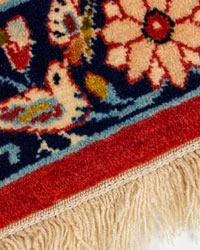
Afghan - Rug - 135 cm - 90 cm


05
days
18
hours
26
minutes
25
seconds
Starting bid
€ 1
Reserve price not met

Expert
Selected by Richard Ebbers
Certified appraiser at Federation TMV with 30 years' professional antiques experience.
Estimate € 350 - € 400
No bids placed
Catawiki Buyer Protection
Your payment’s safe with us until you receive your object.View details
Trustpilot 4.4 | 140426 reviews
Rated Excellent on Trustpilot.
Model Afghan, wool on cotton rug from Afghanistan from the late 20th century, dimensions 135 cm by 90 cm.
AI-assisted summary
Description from the seller
Afghan war rugs (war rugs) are authentic, hand-knotted rugs that emerged as a direct consequence of the Soviet-Afghan War (1979–1989). Instead of traditional floral and geometric patterns, Afghan weavers began incorporating tanks, helicopters, Kalashnikovs, and hand grenades into the wool. This phenomenon has become a unique textile and historical testimony to the country's modern wartime history.
The Background of the Motifs
When the Soviet Union invaded Afghanistan in 1979, daily life changed drastically for the population. The traumatic experiences, heavy military presence, and omnipresent weaponry found their way into the local craft.
Documentation of Daily Life: For the weavers—often women and children, many living in refugee camps in Pakistan—the rugs became a way to process and document the reality of the war.
Military Hardware: Traditional design elements were replaced. Geometric medallions were reshaped into Russian tanks (such as the T-55 and T-62), borders were filled with rows of ammunition cartridges, and life trees were replaced by attack helicopters.
Mujahideen Fighters: Some rugs depict Afghan resistance fighters with their weapons aimed at the occupying forces.
Evolution After the Fall of the Soviet Union
The tradition of knotting war rugs did not stop when Russian troops withdrew in 1989. The patterns have been continuously updated as new conflicts have shaped the region:
Civil War and Taliban Rule (1990s): Continued motifs featuring landmines, weapons, and local fighting.
The US Invasion Post-9/11 (2000s): Rugs depicting the terrorist attacks on the World Trade Center, American stealth bombers, maps of Afghanistan, and English text snippets like "Peace."
Modern Era: In the 2010s, rugs featuring unmanned drones began to appear, reflecting the reality of modern aerial warfare.
Collectibles and Authenticity
Today, authentic vintage war rugs from the 1980s war against Russia are highly sought-after collector's items worldwide.
Authentic Rugs: The original rugs are knotted using wool (often with dark red or brown base colors) by local nomadic or village tribes, such as the Beluch or Turkmen.
Replicas: Due to high demand from international buyers, many commercial copies and newly produced "war rugs" are made today for the souvenir market. An authentic rug from the 1980s is usually recognized by its rawer, unique design, where tanks and motifs were woven from memory rather than a standardized, commercial template
Afghan war rugs (war rugs) are authentic, hand-knotted rugs that emerged as a direct consequence of the Soviet-Afghan War (1979–1989). Instead of traditional floral and geometric patterns, Afghan weavers began incorporating tanks, helicopters, Kalashnikovs, and hand grenades into the wool. This phenomenon has become a unique textile and historical testimony to the country's modern wartime history.
The Background of the Motifs
When the Soviet Union invaded Afghanistan in 1979, daily life changed drastically for the population. The traumatic experiences, heavy military presence, and omnipresent weaponry found their way into the local craft.
Documentation of Daily Life: For the weavers—often women and children, many living in refugee camps in Pakistan—the rugs became a way to process and document the reality of the war.
Military Hardware: Traditional design elements were replaced. Geometric medallions were reshaped into Russian tanks (such as the T-55 and T-62), borders were filled with rows of ammunition cartridges, and life trees were replaced by attack helicopters.
Mujahideen Fighters: Some rugs depict Afghan resistance fighters with their weapons aimed at the occupying forces.
Evolution After the Fall of the Soviet Union
The tradition of knotting war rugs did not stop when Russian troops withdrew in 1989. The patterns have been continuously updated as new conflicts have shaped the region:
Civil War and Taliban Rule (1990s): Continued motifs featuring landmines, weapons, and local fighting.
The US Invasion Post-9/11 (2000s): Rugs depicting the terrorist attacks on the World Trade Center, American stealth bombers, maps of Afghanistan, and English text snippets like "Peace."
Modern Era: In the 2010s, rugs featuring unmanned drones began to appear, reflecting the reality of modern aerial warfare.
Collectibles and Authenticity
Today, authentic vintage war rugs from the 1980s war against Russia are highly sought-after collector's items worldwide.
Authentic Rugs: The original rugs are knotted using wool (often with dark red or brown base colors) by local nomadic or village tribes, such as the Beluch or Turkmen.
Replicas: Due to high demand from international buyers, many commercial copies and newly produced "war rugs" are made today for the souvenir market. An authentic rug from the 1980s is usually recognized by its rawer, unique design, where tanks and motifs were woven from memory rather than a standardized, commercial template
Details
Era
1900-2000
Model
Afghan
Colour
Brown
Length
135 cm
Width
90 cm
Material
Wool on cotton
Country of origin
Afghanistan
Condition
Overall in good condition with traces of ageing and usage
Professionally cleaned
No
Manufacturing period
Late 20th century
Weight
2200 g
Sold by