Mblo mask - Baule - Côte d'Ivoire


04
days
09
hours
40
minutes
33
seconds
Starting bid
€ 1
Reserve price not met

Expert
Selected by Julien Gauthier
A decade of experience in historical arms, armour, and African art.
Estimate € 150 - € 200
No bids placed
Catawiki Buyer Protection
Your payment’s safe with us until you receive your object.View details
Trustpilot 4.4 | 140076 reviews
Rated Excellent on Trustpilot.
Description from the seller
Ivory Coast
Baoulé
Wood
Height: 535mm
Width: 180mm
Depth: 140mm
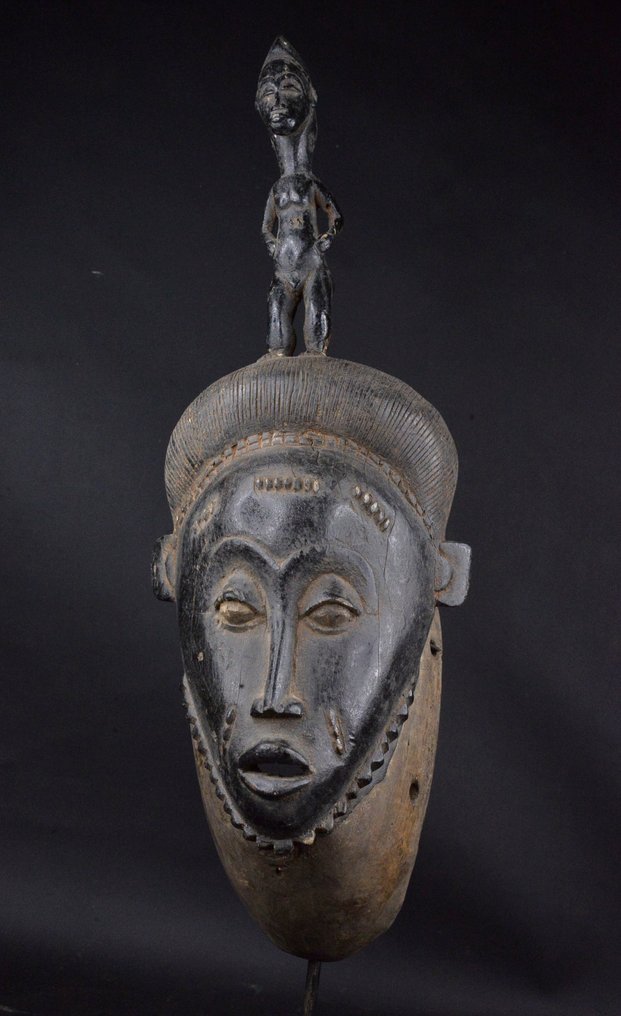
African wooden mask from the Baoulé ethnicity of Ivory Coast.
This anthropomorphic wooden mask is a remarkable example of central Ivory Coast art.
This mask is of Baoulé origin, one of the country’s most important ethnic groups, celebrated for the refinement, delicacy, and balance of its statuary. More precisely, this piece crowned with a full figure belongs to the category of portrait or entertainment masks, called Mblo (or Ndoma).
1. Baoulé origin and aesthetic characteristics
Visual analysis of the mask immediately reveals the idealized beauty canons specific to Baoulé sculpture:
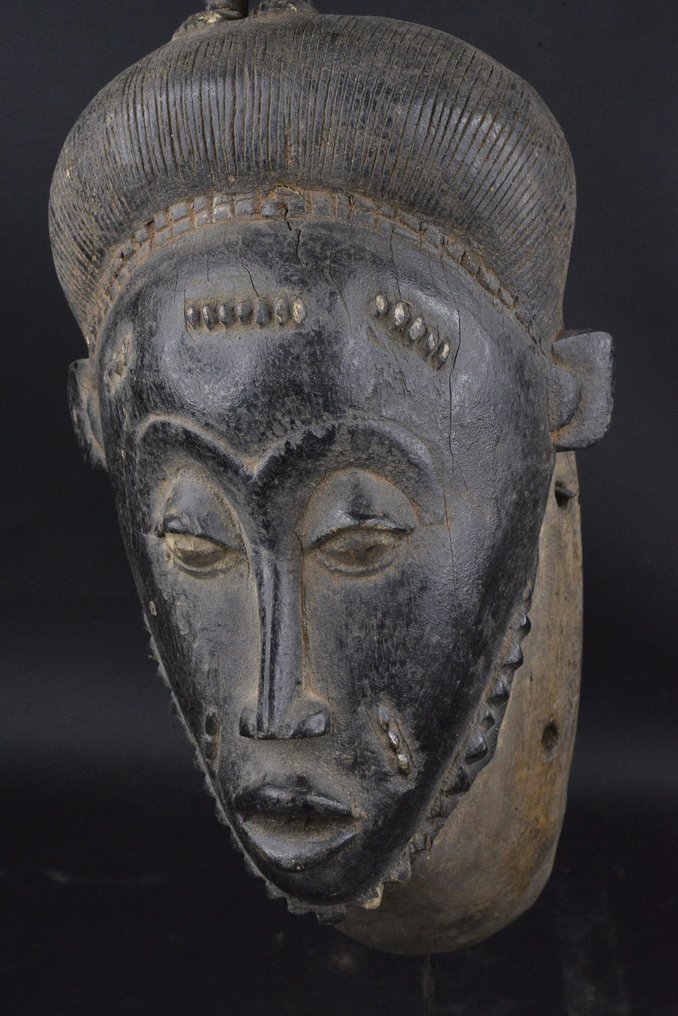
A face of great serenity: The forehead is high, rounded and clear. Almond-shaped, half-closed eyes oriented downward give the mask an expression of introspection, restraint, and respectful dignity. The nose is long, fine and straight, while the mouth, small and slightly open, hints at carefully sculpted lips.
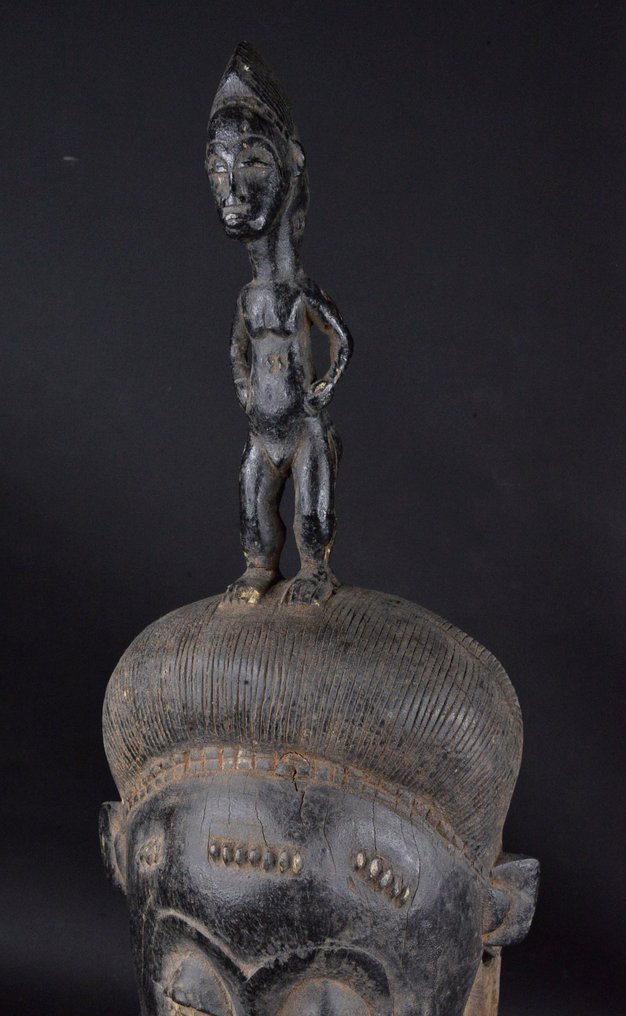
Ritual scarifications: The face is adorned with small geometric reliefs symbolizing traditional scarifications (ngole). A series can be seen aligned across the top of the forehead, as well as small marks at the corners of the eyes and on the temples, signs of cultural refinement and social belonging.
Hairstyle and frill: The hair is styled in a rounded bun finely lined with parallel lines. Around the jaw, a notched or toothed border (optimal visibility on the chin) stylizes a prestige beard or a decorative frill that structures the oval of the face.
The summit statuette: The top of the mask is crowned by a complete anthropomorphic female figure, sculpted standing, hands on hips. Her crest-like hairstyle echoes that of the main mask. This superposition of figures adds an exceptional level of prestige to the object.
The dark patina: The surface bears a black, smooth and polished patina, traditionally obtained by treatments with plant dyes and repeated rubbing, contrasting with the rough sawn wood on the back.
2. Ritual and social use: Mblo rejoicing dances
Unlike the sacred and formidable masks of the Baoulé (such as the Goli or the Bonu Auen which are forbidden to women), the Mblo mask has essentially secular and festive use:
A tribute to a community member: Mblo or Ndoma masks are designed to celebrate or honor a real village member, reputed for physical beauty, dancing talents, or great moral qualities (generosity, wisdom). The sculpted figurine at the top may refer to an identity trait of this person or to their lineage.
The course of the dance: During entertainment festivals, funerals of notable persons, or public commemorations, an accomplished dancer wears the mask, fully costumed in fabrics and fibers to conceal their body. The back of the mask shows the small lateral holes on the inner border, which were used to thread ties to securely attach the object to the wearer’s face.
Public appearance: The dancer performs a rhythmic and theatrical choreography, often accompanied by the woman or personality the mask is meant to honor. It is a moment of parody, social cohesion, and collective aesthetic celebration.
3. Meaning: A celebration of beauty and social order
In Baoulé country, art serves to make the world more beautiful and harmonious to soothe spirits. This mask is not a realistic (photographic) portrait of the honored person, but an idealized representation of their soul and status.
The perfection of lines, the perfect symmetry of features, and the careful patina celebrate self-control, intelligence, and spiritual maturity. By exhibiting such a mask to the public, the Baoulé community reaffirms its highest moral values: respect for elders,
Fast and protected shipping. Packages are sent with tracking numbers. Delivery in France in 1 to 3 days via Chronopost, 2 to 5 days across the European Union via Chronopost International. Delivery via Colissimo International to the rest of Europe and worldwide.
We speak english.
mask african art Afrikanische Maskenkunst arte de máscaras africanas arte delle maschere africane
statue african art Arte de estatuas africanas arte delle statue africane Afrikanische Maskenkunst
Seller's Story
Passionate about World Arts and more specifically about African Art, we buy from collectors, former officials, military, health workers, public works staff who have worked in Africa and also in Côte d'Ivoire, from antique dealers and traders who roam across West Africa to find quality objects.
It is with pride that we present works that, beyond their power to beautify spaces, invite our collectors to resonate with the richness and depth of human expression through the most authentic art.
At Arts Ethniques Gallery, we have the privilege of offering our visitors an exclusive selection of artworks, all unique and original. Each piece presented is the outcome of a demanding artistic approach, driven by a singular vision and mastered craftsmanship, all elements that guarantee authenticity and value.
The works we offer are not industrial reproductions. They are individual creations, crafted with sensitivity and precision, each bearing its own story, identity and presence. Originality is the very foundation of our commitment to excellence. Thus, every mask and every statue in our collection is the subject of a rigorous selection, in order to preserve their rarity and singularity.
Acquiring a work from Arts Ethniques Gallery means owning a truly unique piece: a creation that embodies both talent, cultural memory and the expressive force of African art. It is also a lasting investment in a work whose artistic and emotional value transcends time.
We guarantee that every work leaving our gallery is an authentic piece, without replicas, bearing witness to the creativity, heritage and passion of the African artists who shaped them.
We invite you to participate in our gallery’s auctions with confidence. Each presented work is an original, unique and irreplaceable creation, selected with the greatest rigor to guarantee its authenticity and artistic value.
Whether you wish to enrich a personal collection or introduce an exceptional artwork into your space, Arts Ethniques Gallery offers a safe, transparent and professional setting to acquire remarkable pieces.
Art auctions are a privileged moment to discover rare works, capable of becoming the heart of a collection. Acquiring a work at our sales is not just buying an object: it is investing in a creation whose aesthetic value and cultural reach reinforce over time.
The pieces presented by Arts Ethniques Gallery testify not only to the talent and vision of the artists but also possess the ability to transform spaces and enrich the gaze of those who behold them.
Participating in our auctions is taking part in a singular experience, where the passion for art meets the rigors of collecting. Bidding on a work from Arts Ethniques Gallery goes beyond a simple transaction: it is a gesture of commitment and appreciation for art in its most authentic form.
We invite you to bid with passion and to join us in this adventure dedicated to discovery, transmission and celebration of art.
Perhaps your next heart piece is already waiting for you."
Translated by Google TranslateIvory Coast
Baoulé
Wood
Height: 535mm
Width: 180mm
Depth: 140mm
African wooden mask from the Baoulé ethnicity of Ivory Coast.
This anthropomorphic wooden mask is a remarkable example of central Ivory Coast art.
This mask is of Baoulé origin, one of the country’s most important ethnic groups, celebrated for the refinement, delicacy, and balance of its statuary. More precisely, this piece crowned with a full figure belongs to the category of portrait or entertainment masks, called Mblo (or Ndoma).
1. Baoulé origin and aesthetic characteristics
Visual analysis of the mask immediately reveals the idealized beauty canons specific to Baoulé sculpture:
A face of great serenity: The forehead is high, rounded and clear. Almond-shaped, half-closed eyes oriented downward give the mask an expression of introspection, restraint, and respectful dignity. The nose is long, fine and straight, while the mouth, small and slightly open, hints at carefully sculpted lips.
Ritual scarifications: The face is adorned with small geometric reliefs symbolizing traditional scarifications (ngole). A series can be seen aligned across the top of the forehead, as well as small marks at the corners of the eyes and on the temples, signs of cultural refinement and social belonging.
Hairstyle and frill: The hair is styled in a rounded bun finely lined with parallel lines. Around the jaw, a notched or toothed border (optimal visibility on the chin) stylizes a prestige beard or a decorative frill that structures the oval of the face.
The summit statuette: The top of the mask is crowned by a complete anthropomorphic female figure, sculpted standing, hands on hips. Her crest-like hairstyle echoes that of the main mask. This superposition of figures adds an exceptional level of prestige to the object.
The dark patina: The surface bears a black, smooth and polished patina, traditionally obtained by treatments with plant dyes and repeated rubbing, contrasting with the rough sawn wood on the back.
2. Ritual and social use: Mblo rejoicing dances
Unlike the sacred and formidable masks of the Baoulé (such as the Goli or the Bonu Auen which are forbidden to women), the Mblo mask has essentially secular and festive use:
A tribute to a community member: Mblo or Ndoma masks are designed to celebrate or honor a real village member, reputed for physical beauty, dancing talents, or great moral qualities (generosity, wisdom). The sculpted figurine at the top may refer to an identity trait of this person or to their lineage.
The course of the dance: During entertainment festivals, funerals of notable persons, or public commemorations, an accomplished dancer wears the mask, fully costumed in fabrics and fibers to conceal their body. The back of the mask shows the small lateral holes on the inner border, which were used to thread ties to securely attach the object to the wearer’s face.
Public appearance: The dancer performs a rhythmic and theatrical choreography, often accompanied by the woman or personality the mask is meant to honor. It is a moment of parody, social cohesion, and collective aesthetic celebration.
3. Meaning: A celebration of beauty and social order
In Baoulé country, art serves to make the world more beautiful and harmonious to soothe spirits. This mask is not a realistic (photographic) portrait of the honored person, but an idealized representation of their soul and status.
The perfection of lines, the perfect symmetry of features, and the careful patina celebrate self-control, intelligence, and spiritual maturity. By exhibiting such a mask to the public, the Baoulé community reaffirms its highest moral values: respect for elders,
Fast and protected shipping. Packages are sent with tracking numbers. Delivery in France in 1 to 3 days via Chronopost, 2 to 5 days across the European Union via Chronopost International. Delivery via Colissimo International to the rest of Europe and worldwide.
We speak english.
mask african art Afrikanische Maskenkunst arte de máscaras africanas arte delle maschere africane
statue african art Arte de estatuas africanas arte delle statue africane Afrikanische Maskenkunst
Seller's Story
Passionate about World Arts and more specifically about African Art, we buy from collectors, former officials, military, health workers, public works staff who have worked in Africa and also in Côte d'Ivoire, from antique dealers and traders who roam across West Africa to find quality objects.
It is with pride that we present works that, beyond their power to beautify spaces, invite our collectors to resonate with the richness and depth of human expression through the most authentic art.
At Arts Ethniques Gallery, we have the privilege of offering our visitors an exclusive selection of artworks, all unique and original. Each piece presented is the outcome of a demanding artistic approach, driven by a singular vision and mastered craftsmanship, all elements that guarantee authenticity and value.
The works we offer are not industrial reproductions. They are individual creations, crafted with sensitivity and precision, each bearing its own story, identity and presence. Originality is the very foundation of our commitment to excellence. Thus, every mask and every statue in our collection is the subject of a rigorous selection, in order to preserve their rarity and singularity.
Acquiring a work from Arts Ethniques Gallery means owning a truly unique piece: a creation that embodies both talent, cultural memory and the expressive force of African art. It is also a lasting investment in a work whose artistic and emotional value transcends time.
We guarantee that every work leaving our gallery is an authentic piece, without replicas, bearing witness to the creativity, heritage and passion of the African artists who shaped them.
We invite you to participate in our gallery’s auctions with confidence. Each presented work is an original, unique and irreplaceable creation, selected with the greatest rigor to guarantee its authenticity and artistic value.
Whether you wish to enrich a personal collection or introduce an exceptional artwork into your space, Arts Ethniques Gallery offers a safe, transparent and professional setting to acquire remarkable pieces.
Art auctions are a privileged moment to discover rare works, capable of becoming the heart of a collection. Acquiring a work at our sales is not just buying an object: it is investing in a creation whose aesthetic value and cultural reach reinforce over time.
The pieces presented by Arts Ethniques Gallery testify not only to the talent and vision of the artists but also possess the ability to transform spaces and enrich the gaze of those who behold them.
Participating in our auctions is taking part in a singular experience, where the passion for art meets the rigors of collecting. Bidding on a work from Arts Ethniques Gallery goes beyond a simple transaction: it is a gesture of commitment and appreciation for art in its most authentic form.
We invite you to bid with passion and to join us in this adventure dedicated to discovery, transmission and celebration of art.
Perhaps your next heart piece is already waiting for you."
Translated by Google TranslateDetails
Indigenous object name
Mblo mask
Ethnic group/ culture
Baule
Country of Origin
Côte d'Ivoire
Material
Wood
Sold with stand
No
Condition
Good condition
Sold by
