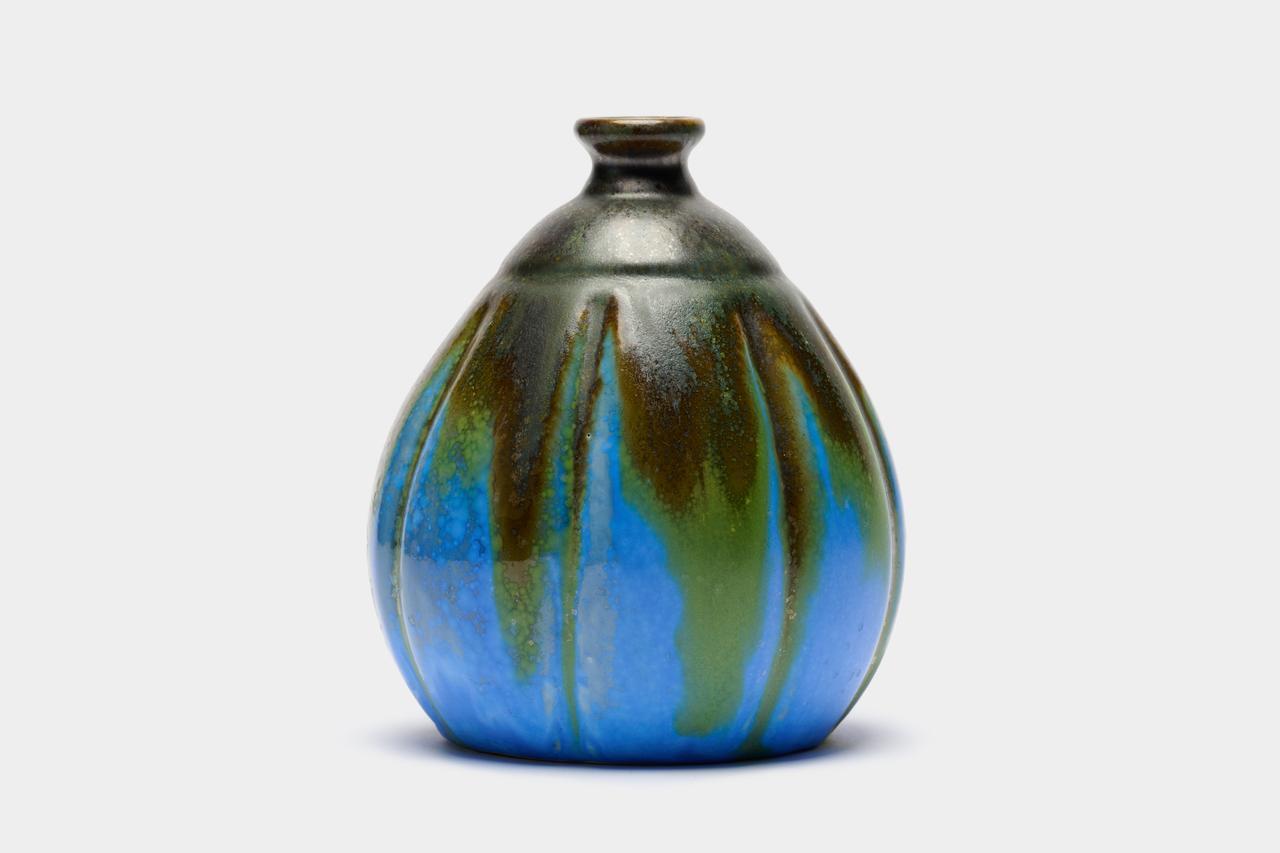
Ewer - Porcelain


06
days
23
hours
09
minutes
21
seconds

No bids placed
Catawiki Buyer Protection
Your payment’s safe with us until you receive your object.View details
Trustpilot 4.4 | 140355 reviews
Rated Excellent on Trustpilot.
Description from the seller
Limoges Porcelain Morning Jug – Carlo X / Restoration Era (c. 1820-1830)
Description:
Service jug in hard-p porcelain, probably produced in Limoges during the decade of the Bourbon Restoration.
Historical Notes on the Manufacture:
During the Restoration period (1815-1830), to celebrate the return of the Bourbons to the French throne, artisans crudely impressed on the biscuit-fired base a specific commemorative mark: the monogram with the letter A (Artois) and L (Limoges), surmounted by the royal crown.
stylistic and decorative analysis:
The stout body is enhanced at the neck by a raised geometric frieze in gilt with a “current waves” motif (sea current). The handle, of clear Neoclassical derivation, attaches to the shoulder with a lower edge shaped like a palmette in gold. The belly is decorated with bouquets of cornflowers (barbeau motif, originally much favored by Marie Antoinette) and flowing garlands in cobalt blue, interspersed with small gold leaf points of thickness.
The base presents its typical biscuit-era workmanship, with the factory mark crisp and handwritten before firing.
Condition:
Excellent / Museum State. The glaze is brilliant and entirely free of swirls, felting, or weaving defects. The porcelain shows no chipping or loss on the lip, rims, or handle. The gilding in gold leaf is exceptionally and magnificently preserved to a mirror finish, with no haziness, abrasion, or wear from rubbing, testifying to immaculate conservation over the centuries.
Limoges Porcelain Morning Jug – Carlo X / Restoration Era (c. 1820-1830)
Description:
Service jug in hard-p porcelain, probably produced in Limoges during the decade of the Bourbon Restoration.
Historical Notes on the Manufacture:
During the Restoration period (1815-1830), to celebrate the return of the Bourbons to the French throne, artisans crudely impressed on the biscuit-fired base a specific commemorative mark: the monogram with the letter A (Artois) and L (Limoges), surmounted by the royal crown.
stylistic and decorative analysis:
The stout body is enhanced at the neck by a raised geometric frieze in gilt with a “current waves” motif (sea current). The handle, of clear Neoclassical derivation, attaches to the shoulder with a lower edge shaped like a palmette in gold. The belly is decorated with bouquets of cornflowers (barbeau motif, originally much favored by Marie Antoinette) and flowing garlands in cobalt blue, interspersed with small gold leaf points of thickness.
The base presents its typical biscuit-era workmanship, with the factory mark crisp and handwritten before firing.
Condition:
Excellent / Museum State. The glaze is brilliant and entirely free of swirls, felting, or weaving defects. The porcelain shows no chipping or loss on the lip, rims, or handle. The gilding in gold leaf is exceptionally and magnificently preserved to a mirror finish, with no haziness, abrasion, or wear from rubbing, testifying to immaculate conservation over the centuries.
Details
Era
1400-1900
Style subtype
Charles X
Number of objects
1
Material
Porcelain
Country of origin
France
Style
Antique
Condition
Excellent condition: barely used with minimal signs of wear
Height
14 cm
Width
18 cm
Estimated period
1800-1850
Sold by